|
50
OF THE BEST
Xiamen
Hotels
The
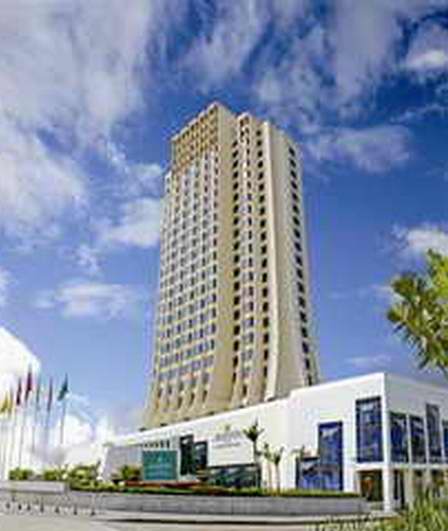
First & Finest International Xiamen Hotel:
Millennium
Harbourview
CLICK HERE to see why

Last
Updated Dec. 2009
|
Books
have illustrations and photos from famous folk such as Zhu
Qingfu,
Wu Guangmin,
Hu Xiaogang, & historian
Hong Bu Ren.
Valentine
for Amoysue
"Letters
from Readers
Back
to Top
Reedley
California (Our
U.S. home--the "biggest little town in America")
TRAVEL
LINKS Favorite
Fujian Sites Fujian
Foto Album Xiamen
Gulangyu
Fujian
Guides Quanzhou
Zhangzhou
Longyan
Wuyi
Mtn Ningde
Putian
Sanming
Zhouning
Taimu
Mtn. Roundhouses
Bridges
Jiangxi
Guilin
Order
Books
Readers'
Letters Amoy
Vampires! Readers'Letters
Hint:
narrow search results with parenthesis, such as "Xiamen tourism"
Back
to Top

 
Back
to Top 
NOTES....
History
of Amoy (adapted from "MagicXiamen--Guide
to Xiamen)
5,020 Years
Our province of Fujian (Fukien,
Fuhkien, etc.) has a history extending back before the dawn of Chinese
civilization 5,020 years ago. [I was told China has 5,000 years
of history, but that was 20 years ago]. Fujianese also claim that
scientific records prove that cave relics in Sanming's Wuyishan [三明万寿岩]
are 180,000 years old.
Leave it to the Chinese to keep scientific records for 180,000 years.
Little is known of ancient Fujian inhabitants
like the Mín (闽) because they left no written records, other than some
Shāng Dynasty (商代16th-11th century B.C.) pictographs carved into a rock
in a Huì‘ān (惠安) village.
Eventually, some ancient Chinese wit discovered writing, or at least how
to draw better (Chinese characters are pictographs), and began recording
Fújiàn’s history back around the Warring
States Period (475 – 221 BC). That was when the State of Chu (Húběi and
Húnán Provinces) chewed up the Yuè3 (越) in present-day Jiāngsū (江苏) and
Zhèjiāng (浙江) Provinces. The Yuè fled to Guǎngdōng (广东), Guǎngxī (广西),
Vietnam, and Fújiàn, where they were called
the Mǐnyuè (闽越).
Ancient Fujianese
left us some pretty strange relics, such as the 4,020 year old boat-shaped
tombs hundreds of feet up the vertical cliffs of Wǔyí
Mountain (Wǔyíshān, 武夷山). I’ve been dying to know why and how they
made such tombs. Had von Danaken, author of “Chariots of the Gods”, seen
them, he’d have claimed ancient extraterrestrials made frequent stopovers
in Fújiàn, probably for Chinese take-out. NASA may think so too.
Back
to Top  
Ancient Fújiàn’s Mǐnyuè were joined by such tribes as the Shē clan (Shēzú,畲族)
and the Miáo tribe (Miáozú, 苗族). Originally from the Yangtze River Valley,
the Shē claim descent from a legendary emperor—hence their unique ‘phoenix
clothing’ and ‘phoenix hairstyles’ (Chinese associate phoenix with royalty).
We also have the Dan Tribe (Dànzú但族), whose Mongol ancestors made the
long trek to Fújiàn about 700 years ago. They are not related to the Israelite
tribe of Dàn, though China does have so many Chinese Jews scattered about
that some experts claim they are remnants of Israel’s Lost Tribes.
And given the state of some of our maps, I can see how they got lost.
Whether China really had lost Jews or not is debatable, but we did have
lots of Lost Arabs, with at least 40,000 in ancient Quánzhōu,
the ancient start of the Maritime Silk Route (where Marco Polo sailed
from--just 70 miles north of Xiamen). Their descendants today
include the Dīng (丁) and Guō (郭) clans, some of whom look more Lǎowài
than Lǎonèi, with curly hair and hooked noses.
Back
to Top 
The Guest People Over 1,000 years ago, entire villages
of “Guest People” (Kèjiā 客家) migrated from the Central Plains to remote
areas of Fújiàn. They have so faithfully preserved their ancient language
and customs that many people mistake them for a minority, but they are
Han and proud of it.
Even after 1,000 years they still call themselves “Guest People”.
To avoid being shown the door, these gutsy “guests” built the
giant earthen fortresses that have fascinated architects the world
over (UNESCO dubbed them “The World’s 8th Wonder”; see p. 148).
They also got the C.I.A.'s attention...
Hakka Silos? I told
some Hakka friends that their homes were round so their wives couldn’t
corner them, and some agreed with me! But back in 1985, President Reagan
and the CIA had a different explanation. An intelligence report warned,
"We are not joking here to use 'group'. The group nuclear base is
likely to be a fact. According to our report through the KH22 satellite
hovering, there a re
over 1, 500 unidentified huge mushroom-like buildings in Fujian Province
of China, which are extremely similar to nuclear equipment. New penetrative
satellite can observe through high buildings, but failed in front of the
1, 500 high-rises, in which China's sophistication of nuclear research
can be seen. Therefore, it is
necessary to grasp the nature of the buildings." People’s Daily,
April 7, 2004
In December, 1985,
a couple from the New York
Institute of Photography visited China to take photos—supposedly of scenery
and culture, but their real goal was to photograph the “silos.”
Zhāngzhōu’s Federation of Literature and Art warmly received the “photographers”
and proudly gave them a tour. The couple reported to the CIA that the
“sophisticated” silos were earthen fortresses, some of them centuries
old.
NASA, meanwhile, is probably wondering if the saucer-shaped dwellings
aren’t proof that the ancient Min really did come from space.
....continued in "Magic
Xiamen-Guide to Xiamen"
Back
to Top
Bill's
Blogs:
"Off the Wall"
"Old China Photos &
Text"
"Our Daily Noodles"
Privacy policy:
* Google, as a third party vendor, uses cookies to serve ads on your
site.
* Google's use of the DART cookie enables it to serve ads to your users
based on their visit to your sites and other sites on the Internet.
* Users may opt out of the use of the DART cookie by visiting the Google
ad and content network privacy policy.
Because publisher sites and laws across countries vary, we're unable
to suggest specific privacy policy language. However, you may wish to
review resources such as the Network Advertising Initiative, or NAI, which
suggests the following language for data collection of non-personally
identifying information:
We use third-party advertising companies to serve ads when you visit
our website. These companies may use information (not including your name,
address, email address, or telephone number) about your visits to this
and other websites in order to provide advertisements about goods and
services of interest to you. If you would like more information about
this practice and to know your choices about not having this information
used by these companies, click
here.
|