Click
to
Access
Click
to
Access
OUTSIDE China
Click
to Access
INSIDE
China 

Xiamen
Gulangyu
Jimei
Tong'an
Jinmen
Zhangzhou
Quanzhou
Wuyi
Fuzhou
new!
#1Fujian
Sites!
Fujian
Foto Album
Books
on Fujian
Readers'Letters
Ningde
Zhouning
Longyan
Sanming
Putian
Bridges
Travel
Info,
Hakka
Roundhouses
Travel
Agents
Mosques Temples

Amoy
People! 
Darwin
Driving
Amoy
Tigers
Chinese
Inventions
Tibet
in 80 Days!
Dethroned!
Misc.Writings
Latest
News
Lord
of Opium
Back
to Main Page


Order
BooksXiamenguide
Forum 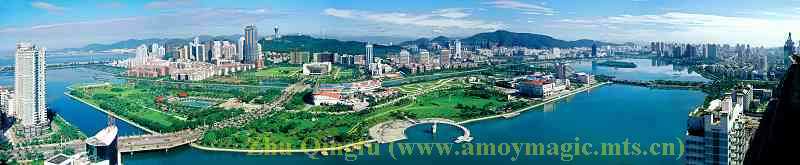

Xiamen Business Success Stories
"Magic
Xiamen"
2008 Edition.
Newly rewritten with much more info on Xiamen
sites, shopping, dining, history, business; with 100s of illustrations
and B&W and color photo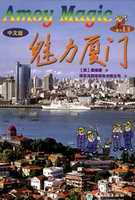 s,
many by such award-winning Fujian photographers
as Zhu Qingfu, Hu
Xiaogang (Babushka), and Wu Guangmin, with
historical photos from Hong Buren.
Sold in Fujian bookstores or Order
Online.
s,
many by such award-winning Fujian photographers
as Zhu Qingfu, Hu
Xiaogang (Babushka), and Wu Guangmin, with
historical photos from Hong Buren.
Sold in Fujian bookstores or Order
Online.
In 2002,
in Stuttgart,Xiamen won the gold at Livcom,
the Oscar of environmental communities. And the U.N. awarded Xiamen
(former Amoy) the coveted Habitat award. Xiamen
is a delightful place to live, work or study. It also has a rich
1000+ year history, dating back to when we were part of the legendary
port of Zaytun (Quanzhou), the Start
of the Maritime Silk Route. Xiamen had Quanzhou's
best port, so Marco Polo probably sailed from Xiamen, not Quanzhou City
proper. In 1893, Pitcher wrote in "Fifty
Years in Amoy" that Xiamen may even have been the Chinese city
spoken of by Ptolemy. That is just conjecture, of course, but without
doubt, 700 years ago Amoy was one of most important
ports on the planet, and in the 1840s it was one of China's first five
ports opened to trade after the 1st Opium War.
Xiamen was also the birthplace of Chinese Protestantism.
On tiny Gulangyu Islet, the members
of the Amoy Mission helped pioneer China's
modern medicine, modern education,
modern sports, modern music, modern
literature, etc. We were the home of famous writers like Lin
Yutang, famous artists like Teng Hiok Chiu,
and the base for the hero Koxinga,
the last man to stand up against the Manchus, and the man who liberated
Taiwan from the Dutch. Click
Here to read excerpts from Dutch governor Coyett's graphic, even humorous,
depiction of Koxinga.
Xiamen is fascinating, but above all--a great place to live, work, or
study. Jobs are plentiful (click here
to find one), and you can study Chinese and other subjects at Xiamen
University and other fine schools. Eenjoy the planet's prettiest
boardwalk, or our dozens of fine gardens
and parks. We have excellent dining, and shopping.
And if you get island fever, visit my Favorite
Fujian Sites, all easily accessible thanks to excellent highways (my
first drive to Wuyi Mountain in 1993 took 35 hours;
today you can do it in only 7!). Even the surrealistically beautifully
Taimu Mountains are only five hours from Xiamen.
When I moved to Xiamen in 1988 with my family, I had lived
in over 30 places, and had no intention settling down here either, but
I'm still here 20 years later. Visit, settle down, and you too will
find that Amoy is indeed magic. Dr.
Bill
Favorite
Fujian Sites Fujian
Foto Album Xiamen
Gulangyu
Fujian
Guides Quanzhou
Zhangzhou
Longyan
Wuyi
Mtn Ningde
Putian
Sanming
Zhouning
Taimu
Mtn. Roundhouses
Bridges
Jiangxi
Guilin
Readers'
Letters Travelogues
by Scott Ballantyne




 Click
to E-mail
Click
to E-mail  Readers'Letters
Last Updated: January 2009
Back
to Top
Back
to Top
CHAPTER XXV.
DEPARTURE TO AMOY. p. 331
ON Jan. 7th, 1846, I engaged a crew of Chinese to convey me from Foochow
in their boat to a vessel a few miles down the river, in which I was to
embark for Amoy. The weather still continued to be very cold, the thermometer
standing at about 4:5 degrees. Having the tide in our favor, we arrived
in two hours off of Pagoda Island. Here, we doubled the point, a strong
head-wind meeting the tide rendered our course rather dangerous, and our
boat was nearly swamped. The Chinese, though the worst sailors, are the
beat boatmen in the world. The experience, on former occasions, of their
extraordinary cleverness in managing a boat imparted to my mind a feeling
of confidence, which I could seldom, on a similar emergency, have placed
in the skill of foreigners. A man at the bead of the boat watched every
wave as it approached, and raised a shout, so as to give the stroke altogether
.at the proper moment for avoiding the threatening mass of water. About
noon I embarked on board the "Wolverine" brig-of-war, in which,
through the kindness of the captain in command, I obtained a passage to
Amoy. We did not weigh anchor till the following morning, when we sailed
slowly down the river with the ebb-tide, another brig of war, and also
a war-steamer, with the British admiral on board, keeping us company a
few miles astern. Near the entrance of the narrow channel called the Kin-pai-mun,
where the Min expands into the broad harbor formed by the mouth of the
river and two or three adjoining islets, a sudden jerk and rolling of
the vessel warned us of our having run aground, and the anchor was immediately
let go. It was soon discovered that the vessel W88 suspended mid-ships
on a rock, of which the charts gave no mention, in the middle of the channel.
With eight or nine fathoms of water at our bow and stern we remained here
for two hours, the admiral, in the mean time, passing in the steamer between
us and the southern shore.. Just as the admiral had made a signal to the
other brig to stand by “vessel in distress," and three man-of-war's
boats were rowing alongside to haul us off, the rising tide floated us
aright, and we were soon again on our course. The next signal from the
admiral's ship, "Proceed to Amoy," relieved us from the suspense
in which the possibility of our accompanying him across to the island
of Formosa had kept our minds. Soon after we came to anchor, among a fleet
of junks and opium-vessels, till the next morning, when we crossed the
bar, and proceeded before a fresh breeze, nine knots an hour, toward Amoy.
At daybreak, on Jan. 10th, we arrived among the islands which, at the
distance of about eight miles from the city of Amoy, stretch across the
month of an extensive bay; formed by two projecting headlands on the coast.
The harbor enclosed
within extends for several miles, being open to the sea. On the southeast,
and having on the south the lofty hill or Lam-tai-boo [Nan Taiwu], situated
on the mainland, and surmounted by a conspicuous pagoda. On the southwest
lies an island, with another conspicuous pagoda, at the entrance of the
river leading to the city of Changchew [Quanzhou], the capital of the
department of that name. On the east, at a greater distance, lies the
island Quemoy [Jinmen]. The island of Amoy itself fills up the north and
northwest of this circular range of hills, which rival each other in the
bold grandeur or their towering c1iffs and the wild sterility of their
scenery. Sailing along the southern shore of the island, which is here
lined with an extensive range of batteries close to the water-edge, we
at length came to anchor in the lesser harbor, between the city and the
opposite island of Koo-lang-soo (Gulangyu), which 1ies about half a mile
distant from Amoy. After another hour I found myself domiciled among the
missionaries, experiencing that hearty welcome and hospitality which I
never failed to receive, both from British and American missionaries,
during my visit to the consular ports of China.
Back
to Top
A brier relation of the part which Amoy bore in the events of the British war with China, and of the circumstances attending the arrival of the first Protestant missionaries, will be appropriate and necessary to enable the reader to form a right estimate of the present position of the mission. A more general description of Amoy will be reserved till a later period of the narrative, and will also be gathered from the journal of dai1y occurrences.
In the summer of 1840, on the sailing of the British expedition northward to Chusan, Amoy had been exempted from the desolating terror of British arms. In a later period of the same summer, the “Blonde" frigate was dispatched to Amoy, to deliver to the local authorities a copy of a letter addressed by the foreign secretary of state, Lord Palmerston, to the principal officers and advisers of the Chinese emperor. The same letter had been sent also to other places in the north of China, where the native authorities, after transcribing the contents, had politely returned it to the messenger, with the haughty intimation that neither the subject nor the style was suited to the dignity of the imperial glance. At Amoy not even the semblance of civility was shown; and the mandarins refused to receive the letter, or even to hold any communication with the frigate. The interpreter, who was deputed by the commanding officer to go ashore and explain the objects of his visit, was also fired upon in the boat. This drew down a severe cannonade on the fort and city walls, which were speedily emptied of their defenders. The absence of a regular military force prevented further hostilities; and the commander contented himself with erecting on the beach a bamboo-staff; with a proclamation and the letter attached, for the information of the inhabitants; after which the "Blonde" took her departure.
In August of the
following year (1841) Amoy was destined to become the scene of more destructive
operations. The British squadron, on its second voyage from the south
of China, appeared off the harbor on August 26th. A combined attack of
the vessels of war on the batteries of Amoy and Koo-lang-soo, and the
landing of a body of the troops, so as to flank the Chinese troops engaged
on the sea battery, after a few hours dispersed the Chinese; and the British,
advancing without further resistance, made themselves masters of the high
ground on the east of the city, where they bivouacked for the night. The
next morning they entered the city, which had been generally deserted
by the people, and the commander-in-chief quartered himself with the troops
in the palace of the principal Chinese officer, the te-tok, or admiral.
Very little spoil was found in the city, which is a mere outport to more
important cities in the neighborhood, and is not famous for the wealth
of its traders. Numerous excesses were committed by the Indian troops;
and even to the present time husbands and fathers speak, with excited
feelings of indignation, of the outrages committed on their families,
which disgraced that occasion. Proclamations were issued by the British
commander, promising protection to the well-disposed inhabitants, and
inviting them to return to the city. This was the means of partially gaining
the confidence of the population, who soon reverted to their former trades
and occupations, and never had reason to complain of the general treatment
which they subsequently received. The main body of the force proceeded
northward to Chusan.
Back
to Top
Three vessels of war and a military force were left to garrison the island of Koo-lang-soo, and to overawe the city of Amoy, from which the troops were immediately removed. Koo-lang-soo henceforth becoming the headquarters and residence for the British. From this time the island remained in the quiet occupation of the British, and Amoy itself was unaffected by the subsequent events of the campaign in the north. In August, 1842 (one year after its capture), Koo-lang-soo was temporarily ceded, with Chusan, to the British, by the terms of the treaty of Nanking, till the payment of the stipulated indemnity money. In the beginning of 1845 it was voluntarily ceded by the British to the Chinese, about twelve months before the stipulated time of cession; and the few British residents who remained moved over to Amoy, where they experienced no difficulty in procuring suitable houses among a friendly and respectful people.
The first Protestant missionaries to Amoy had arrived at Koo-lang-soo in the beginning of 1842, which, it is necessary to bear in mind, was a few months previous to the "treaty of perpetual peace and friendship." Two American clergymen, Rev. D. Abeel (now, it is to be feared, lingering in the last extremity of pulmonary disease in his native land) and the Rev. W. J. Boone (now bishop of the American Episcopal Church at Shanghai), commenced their missionary work, by preaching, on the first Sabbath after their arrival, in the Fokeen dialect of the district, which they bad exclusively studied at Singapore and in Java among the numerous emigrants from this part of China. Being unconnected with tbeBritish, they occasionally ventued across from Koo-lang-soo to Amoy; and although, in the excited state of the popular mind, the experiment was by no means safe, their knowledge of the dialect enabled them to remonstrate with the people on the very first appearance of danger, and to disarm the first systems of hostility. After being for a time deemed neutral, they soon were regarded even as friends, and the frequent cases of maltreatment which they were able, as gratuitous interpreters to the British commandant, to avert or remedy by their influence, soon caused the missionaries, as a body, to be viewed as peaceable, upright, and good men. Frequent cases occurreded, also, in which, as interpreters, they were able to mediate between the British and the native authorities, which secured for them, among the latter, feelings of respect, in some cases, perhaps, associated with the character of the American nation, rather than of the Christian religion. It is, however, due to those excellent men, to state, that there appear to be no grounds for suspecting them of a desire to encourage this confusion of ideas, or to sink, in the slightest degree, their distinctive character as missionaries of the cross into that of mere partisans or patriots. Their numbers were strengthened by gradual additions, both of British and American missionaries. After recent losses by death or removal, they now amounted to six in number, four of whom were Americans,and two British. At the cession of Koo-lang-soo, tbey migrated with the mercantile residents and the British consulate to Amoy, where they now reside on the edge of the water, opposite to Koo-lang-soo, having two chapels situated in streets about a quarter of a mile distant, in which divine service and preaching were regularly held.
During the first
week after my arrival at Amoy, I paid frequent visits, with some or the
missionaries, to the opposite island of Koo-lang-soo. After a few minutes'
sailing in a boat, we landed on a long causeway of large granite slabs
roughly hewn, and very slippery from the multitude of little shell-fish
left on them at high-water. The island itself is about a mile in length,
and the same in width at its broadest part. Partaking of the same general
ruggedness of aspect, which is the almost unvarying feature of the whole
coast of China, from the mountainous shores of Shantung to the rocky cliffs
of Hainan, is possesses a romantic beauty or scenery peculiarly its own,
in the glens and defiles which, in alternate succession, conduct the visitor
among the overhanging masses of rock of every imaginable form and appearance.
In some parts, little groves of banian-trees encircle a few houses; and
the signs of cultivation are to be seen in the crops of wheat and rice
which line the beach on its level parts. There are only two villages on
the island, which are prettily situated on the seaside.
Of these, one lies on the shore opposite to Amoy; the other occupies the
northern and more picturesque extremity of the island. A series of gardens,
with their rich foliage, rise gracefully up the slope of a little hill,
till they meet the same odd jumble of chasms and boulder stones, piled
aloft or loosely scattered around; huge masses of rock forming peaks on
high, and seeming to vibrate in the air, and to quiver in their nicely-balanced
position. From the eminence at the extreme southern point a fine view
is obtained of the outer harbor, and of the Six Islands, with the sea
beyond. On this point or land a British flag-staff and battery formerly
stood, commanding the approach to Amoy.
Back
to Top
In the center of
the island the ground generally rises by a gentle acclivity, except in
a few parts where the granite peaks suddenly rear their towering heads.
The island of Koo-lang-soo commands the city on the opposite side, and
was well selected as the quarters of the British garrison, who found too
small a force to be left in occupation of the populous city itself. On
the evacuation of the British, every building, and every object which
served to remind them of British occupation, were destroyed or removed.
The barracks, the forts, the f1ag-staffs, and even the framework of the
windows and verandahs, were all speedily demolished, and the materials
converted into fire-wood. The work of destruction continued till no remnants
of the foreigners remained, and the houses were restored to their primitive
condition. The work of purgation was vigorously persisted in. The roads
were dug up, and the fields had again began to assume the appearance of
cultivation. The power of superstition and the aid of heathen priests
were duly invoked. Scarcely a day passed without precessions of idols,
which were to be seen passing in boats through the harbor among the fleet
of junks, each of which, with loudly-sounding gongs, saluted the deity
as it passed under the vessel toward the island on the opposite side.
The fearful mortality, which carried off so many of the British, and which
was unknown previous to their occupation of the island, had continued
to prevail to an alarming extent during the previous summer, notwithstanding
the gradual resumption of tillage. In one family, known to the missionaries,
and occupying one house, out of nine persons, seven had fallen victims
to the prevailing fever. Even those who tilled the ground generally returned
after the day’s labor to the less insalubrious residence of Amoy to spend
the night. The fears of the ignorant imputed the common calamity to the
evil spirits of the English, who had been buried on the island. The superstitions
of the people magnified every little event; and the villagers were to
be heard expatiating on the mysterious scenes which they had witnessed,
of the ghosts of barbarians running up and down the hills at night, and
“talking English most fearfully.” On the first occasion of my visit, a
large platform was erected in the northern village. Close by was a temporary
building, destined to be succeeded, at some future period, by a more substantial
edifice. In this the idols had been duly installed, and the tutelary deities
were invited back to assume their rule. Some priests of the Taou sect
stood by to reconsecrate the spot, with attendants bearing cakes, fruits,
and sweetmeats; while others beat drums and gongs, or played some sacred
air on a wind-instrument resembling the bagpipe. A mournful chant was
commenced, and they moved forward in slow and solemn procession to mount
the platform, where the offering of gilt paper and the burning of incense
were prolonged amid the anxious interest of the village crows. Subscriptions
of money had been levied on the inhabitants of Koolang-soo and Amoy, and
the afflicted people endeavored to encourage themselves in the hope that
their calamities of war and pestilence were now in course of termination.
Back
to Top
Some European graves on the eastern beach proved the former existence of a foreign trade at Amoy. Two gravestones, with English inscriptions, bore the respective dates of 1698 and 1700. There was also a grave-stone erected to the memory of a Spaniard. In another part were buried the remains of a former Roman Catholic bishop. There are also independent grounds for believing that a considerable trade and intercourse existed in former times between the Dutch in Formosa and the Chinese at Amoy.
Indelible monuments of the recent foreign occupation remained in the crowded British cemetery, in which lay the unfortunate sufferers who fell victims to the insalubrity of the spot. This cemetery was situated at the eastern side of the island, near the landing-place, and had many elegant grave-stones, erected by the sympathy of surviving comrades. Near the northern village, screened from view by a little assemblage of trees, was situated the burial-ground of the missionaries. The unhealthiness of the climate had been severely felt by this class of the Lord’s laborers, who followed in the train of earthly conquerors, to extend the bloodless conquests of their divine Savior. During the last thirteen months, out of twenty-five members of the missionary families, eighteen had been removed by various providential events. Three missionaries had permanently left, either from the failure of their own health, or of that of their families. Two wives of missionaries had set out for their native land, on account of ill health, one of whom died on the voyage; while two others had been suddenly summoned from the scenes of their missionary work to higher employment in a better world. Two children had died, and nine others had been sent to Europe or America. Six missionaries now remained, one of whom was married; so that there were in all seven laborers on the field. In this little retired spot of ground were interred the bodies of three female missionaries, Mrs. Boone, Mrs. Dotey, and Mrs. Pohlman, with the two children of the last. They left America in the vigor of youth, to consecrate their lives to the missionary work; but were cut down, one after another, by premature death, leaving their earthly p0artners to sorrow not as those who have no hope. Appropriate texts and inscriptions on the grave-stones told the confidence of the departed in that Savior in whom they had trusted, and their devotion, even in the cold embrace of death, to that work in which they had humbly sought to spend and be spent. Among all the achievements which the annals of fame or the affection of the living delight to tell of the departed dead, where is the man, who has tasted the good word of God and the powers of the world to come, who will not concede that the most substantial glory is that which silently adorns the missionary’s grave?
CHAPTER XXVI
Daily Occurrences at Amoy
Interview with the “Hai-hong, Large Collection of Ancestral Tablets,
Idol Shops, Friendliness of People, Missionary Services, Regular Attendants,
Services for Chinese Females.
Too be continued….
Click Here for more old documents about Amoy

FAQs
Questions?
Real
Estate
Shopping
Maps
Trains
Busses
Hotels
News
(CT)
Medical
& Dental
YMCA
Volunteer! 
XICF
Fellowship
Churches

Expat
Groups
Maids
Phone
#s

Schooling
your kids
XIS(Int'l
School)
Xiamen
University
Study
Mandarin
CSP(China
Studies)
Library
Museums
History

Restaurants
Asian
Veggie
Junk
Food
Chinese
Italian
International
Visas
4 aliens

Massage!
Beaches
Fly
Kites
Sports
Boardwalk
Parks
Pets
Birdwatching
Kung
Fu Hiking
Music
Events
Festival&Culture
Humor&Fun
Fotos

Doing
Business
Jobs!(teach/work)
Hire
Workers
Foreign
Companies
CIFIT
(Trade Fair)
MTS(Translation)
Back to Top