Click
to
Access
Click
to
Access
OUTSIDE China
Click
to Access
INSIDE
China 
TRAVEL LINKS
Xiamen
Gulangyu
Jimei
Tong'an
Jinmen
Zhangzhou
Quanzhou
Wuyi
#1Fujian
Sites!
Fujian
Foto Album
Books
on Fujian
Readers'Letters
Ningde
Zhouning
Longyan
Sanming
Putian
Bridges
Travel
Info,
Hakka
Roundhouses
Travel
Agents
MISC. LINKS
Amoy
People! 
Darwin
Driving
Amoy
Tigers
Chinese
Inventions
Tibet
in 80 Days!
Dethroned!
Misc.Writings
Latest
News
Lord
of Opium
Back
to Main Page

Order
BooksXiamenguide
Forum 

| Chapt.
1 Eastward Ho! Chapt. 2 Chinchew 600 Years Ago |
Chapt.5
Chinchew Houses & Temples Mosque Chapt. 6 Mandarins & Illuminati |
Chapt.7
Chinchew City Wall Chapt.8 First Things First |
Scanned by Dr. Bill Brown
(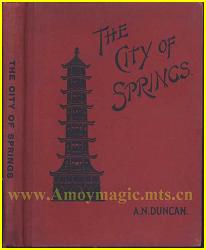 please use freely, but acknowledge Amoy Magic
as source--or link! Thanks!)
please use freely, but acknowledge Amoy Magic
as source--or link! Thanks!) Click
thumbnails on this page for larger images
Click
Here to View or Download Biography of Jessie M. Johnston, Missionary
to Amoy for 18 years (1885-1904)
Click
Here to View or Download Biography of Caldwell Family (in Fujian from
1899 to 1949)
Click Here
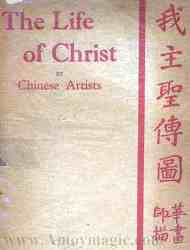
for "The Life of Christ by Chinese Artists!" (1940)
Scanned by Dr. Bill Brown (
 please use freely, but acknowledge Amoy Magic
as source--or link! Thanks!)
Click Here
for "The Life of Christ by Chinese Artists!" (1940)
please use freely, but acknowledge Amoy Magic
as source--or link! Thanks!)
Click Here
for "The Life of Christ by Chinese Artists!" (1940)
THE city of Chinchew, in South China, lies a short distance inland from
the port of Amoy, opposite the north corner of Formosa. It is about the
size of Edinburgh, and, like Edinburgh, is devoted to learning, if the
product of Chinese mental activity may be so described. The graduates
who have taken their second examination there and gone on to Pekin for
their third examination, which entitles them to a place in the Government,
have been men of mark. In the Temple of Confucius there is a Hall hung
with tablets given to illustrious Chinchew men by the Emperor, which is
the pride of the city.
 The story of the growth of a Christian community in that city, so as to
become a recognised factor in its life, is so noteworthy and told so well
in the following pages, that a note of commendation is hardly called for.
The story of the growth of a Christian community in that city, so as to
become a recognised factor in its life, is so noteworthy and told so well
in the following pages, that a note of commendation is hardly called for.
I am glad, however, of this opportunity of recommending this book to the
many Sabbath Schools north of the Border who are interested in Miss Duncan's
work. They have held the ropes while their missionary has ventured into
this unknown sea. A. H. F. BARBOUR. EDINBURGH, October 1902.
THE CITY OF SPRINGS
CHAPTER I EASTWARD Ho!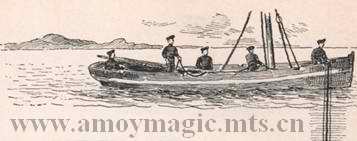
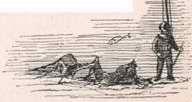
NORTHWARDS, they say, lies the magnetic pole; but for how many of Britain's
children does the spirit-compelling magnet lie, not northward, hut eastward,
ever eastward t The spell of the Thousand And One Nights is still on us;
tales of Xanadu, with "stately pleasure-dome," still possess
us; creeds framed ages back by hoary Chinese sages command our reverence;
let us but catch a glimpse of the inscrutable face of Buddha the impassive,
and we too are devotees, longing for Nirvana. So, at one time or another,
does the vision of the "Gorgeous East" hold our spirits in thrall.
Back to Top Amoy
Magic Guide to Xiamen and Fujian
"We grow older, and the glamour of an Eastern past fails before the
light of our practical "Western today. Another and a truer vision
now rises on us. To one here and another there is given to see, not the
East of the Past, but a modern East; stripped of her gilding, with charm
stolen away; sunny Asia black with the plague-spots of heathenism.
Instead of a mighty rolling Ganges we see now the crowds of dusky men
and women vainly seeking salvation in its waters. Those picturesque palm-trees
that fascinated us once screen thousands of idol-temples round whose images
of wood and plaster, of stone and precious metal, rise the "vain
repetitions of the heathen." Buddha, displaced in India, broods grand
and unavailing as ever in his new Japanese garden shrine at Kamakura.
How the hitter wail of a helpless and
a modern Empress-Dowager guilty of the blood of the martyrs, and forced
to fly before the avengers as they neared the walls of Pekin.
Tales of Eastern princesses resolve themselves into the wail of wronged
and hopeless womanhood and childhood. British rule has indeed suppressed
the horrors of Suttee and Juggernaut, but still the terrible patience
of millions of purdah-hidden lives cries to us. Little children in China
still sob in agony over their cruelly mutilated feet; and from baby-tower
and baby-pit alike a terrible "Inasmuch as ye did it not" is
written over against Christendom.
This is the second vision which comes to some of us; and when, with the
vision, there rings in the ears the Great Command, "Go ye into all
the world and preach the gospel," then the East has indeed claimed
us for herself, and one more missionary of the Cross is enrolled.
Of all the countries of Asia, China, the land of Sinim, the Middle Kingdom,
is the chosen field. At the outset the would-be missionary has to face
the unknown in the shape of Mission Councils and Executive Committees.
After much trepidation of spirit we learn that we have been passed from
the category of candidate to that of accepted missionary, with "be
ready to sail in autumn " as our first order.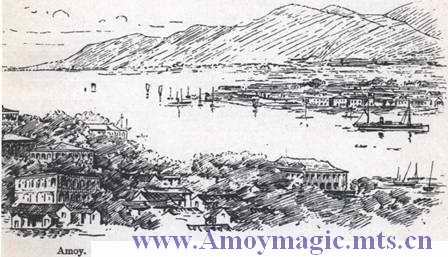
The getting-ready process centres round the mysteries of an outfit list.
Before this list has heen realised, i.e. stowed in concrete form inside
a number of packing-cases, we begin to understand that we are preparing
for a seven years' stay in a country whose climate is very unlike our
own. These last weeks fly past all too quickly. Then comes one morning,
the last, when the packing is quite done, and Fate, in the shape of a
prosaic old four-wheeler, waits at the door.
Grey mists hang over the Northern Capital, where friends wait to wish
us "God-speed." We take a last look at the monument, and at
the old castle glooming half-hidden above us. All too soon Auld Reekie
lies behind us, and we are "ower the border and awa'" in good
earnest. We awake next morning to find ourselves in London.
Have you ever attended a missionary valedictory meeting? On the platform
is ranged the missionary party, its raw recruits side by side with veteran
workers. One address follows another, and prayers rise that this little
detachment of the great missionary army may fight the good fight, and
wrest many captives from the arch-enemy. We join with something of a thrill
in the dear old hymns, "0 God of Bethel," and " From Greenland's
Icy Mountains "; but it is the full strain of "Jesus shall reign
where'er the sun Doth his successive journeys run," that suddenly
lifts us all from our narrowing .selfishness, and makes the audience one
in spirit with the pathetically inadequate little company up there on
the platform.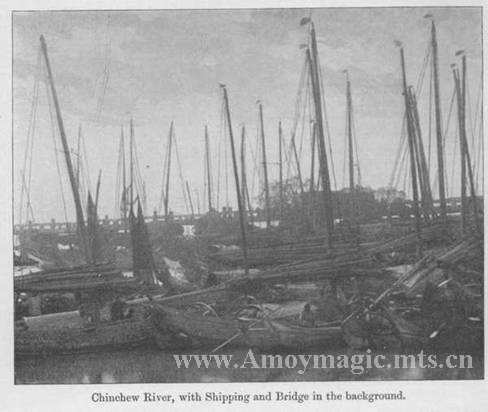
The meeting is over; but for us the next few days are one prolonged "valedictory,"
which only ends when the launch, our last link with the home-country,
steams steadily back to London Town. It is a very forlorn and insignificant
unit that is left behind on the deck of an ocean-going steamer.
Six weeks are ahead of us-six weeks to forget in, to learn in, and, above
all, six weeks in which to take in new impressions. Surely no one can
ever forget his first contact with the East. The gleaming white teeth
of that rascally black donkey-boy in Port Said; the first attempt to bargain
with an Oriental, when we were royally cheated by that smooth-tongued
charmer; the sense of boundless space, as day in day out the rhythmical
beat of the engine marks our steady progress eastwards across the Indian
Ocean; the idleness of long days of heat; the varying moods of sea and
sky; the rich glory that makes a sacrament of the sunset hour; and those
stars, surely never the same as our cold northern friends !
Back
to Top Amoy Magic Guide to Xiamen
and Fujian
Such are some of the first voyage impressions which are with us to this
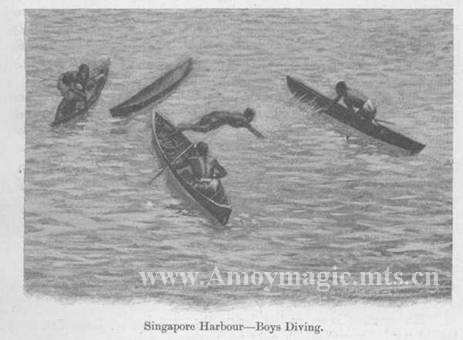
hour. Then, as at last we touch our most southerly limit at tropical Singapore,
there stands John Chinaman himself, gowned and pigtailed as we had heard,
but never till that moment realised. From there, as we face northwards,
and pitch and roll through all that wicked China Sea, if we are ever allowed
one lucid interval, it is to China, rather than to the home-land, that
our thoughts now turn. At last we are actually at peace, anchored in the
magnificent harbour of Hong-kong, and inclined to hold our heads just
a trifle higher, as we realise that it was British energy that transformed
that bare rock into this port of the East.
Only a couple of days more of coast sailing and we arrive. This is, perhaps,
the most curious sensation of all. We decided to go to China; we have
come all the long way out to China, and now we are here!
 This
is Amoy harbour; that is the little island of Kolong-su, and
beyond is the mysterious mainland of China. These men in sampans,1 pushing,
scrambling, and yelling, are all Chinese, and those uncouth sounds belong
to their language, which, in a misguided hour, we had thought we might
aspire to learn. These men, in fact, belong to the great class of "heathen"
whom we have come all this way to try and teach. If ever human being feels
like an infant, ignorant and helpless, surely it is the poor little newly
arrived missionary, who takes in with all her five senses at once the
overwhelming fact of the absolute pole-apartness in looks, speech, habits,
thoughts, and everything else of John Bull and John Chinaman.
This
is Amoy harbour; that is the little island of Kolong-su, and
beyond is the mysterious mainland of China. These men in sampans,1 pushing,
scrambling, and yelling, are all Chinese, and those uncouth sounds belong
to their language, which, in a misguided hour, we had thought we might
aspire to learn. These men, in fact, belong to the great class of "heathen"
whom we have come all this way to try and teach. If ever human being feels
like an infant, ignorant and helpless, surely it is the poor little newly
arrived missionary, who takes in with all her five senses at once the
overwhelming fact of the absolute pole-apartness in looks, speech, habits,
thoughts, and everything else of John Bull and John Chinaman.
A warm welcome awaits us from missionaries who mercifully still remember
their mother-tongue, and who appear all to have survived the process of
"learning the language." A few days, and the neophyte may be
found armed with a copy of the famous "Douglas Dictionary,"
and if inspired with a boundless enthusiasm, is steadily massacring every
one of the seven distinct tones of the Amoy dialect, and this in an honest
if vain endeavour to imitate the sounds produced by that most long-suffering
of mortals, a Chinese teacher.
Back
to Top Amoy Magic Guide to Xiamen
and Fujian
CHAPTER II CHINCHEW
SIX HUNDRED YEARS AGO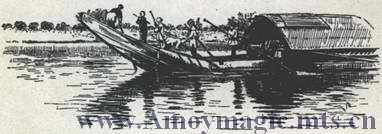
THE name Chinchew, now so familiar to us, is merely an anglicised form
of Tsuien-chow, being the northern or mandarin pronunciation of the name.
In the Amoy language it is pronounced Tsoan-chiu. Tsoan-spring or fountain,
and chin-a city whose resident mandarin ranks as a prefect. The whole
may be translated City of Springs.
Chinchew has probably an interesting history dating back many hundreds
of years; only, like most things in China, it is difficult to get at the
exact truth about it.
Before describing the city as we in those latter days found it, it may
be of interest to know what Marco 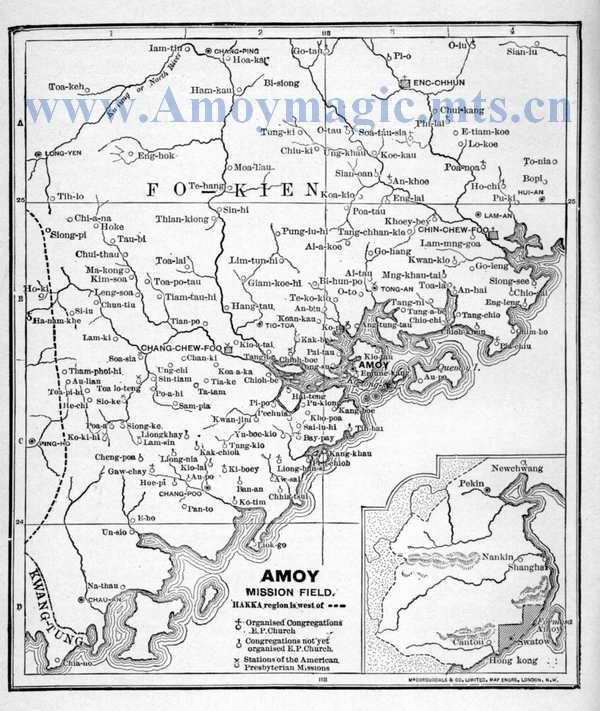 Polo,
the great Venetian traveller, wrote of it so far back as the thirteenth
century.
Polo,
the great Venetian traveller, wrote of it so far back as the thirteenth
century.
The following description (taken from his records) may seem a little wonderful,
especially in the matter of the enormous trade with India; yet we must
remember that it is only within the last half-century that steam has killed
the trade of those large ocean-going junks. Also, as we see to-day, flat-bottomed
boats can enter a channel of very limited depth. Another possibility is
that the bed of the Chinchew, River may, in the intervening six centuries,
have become silted up, rendering it less navigable now than formerly.
"Now this city of Fugu" (identified as our Chinchew of to-day)
"is the key of the division which is called Chonka, and which is
one of the nine great divisions of Manzi.1 The city is a seat of trade
and great manufactures. The people are idolaters and subject to the great
Khan (Kublai Khan). A large garrison is maintained there by that prince
to keep the kingdom in peace and subjection; for the city is one which
is apt to revolt on very slight provocation. There flows through the middle
of this city a great river, which is about a mile in width, and many ships
are built at the city which are launched upon this river.
Back
to Top Amoy Magic Guide to Xiamen
and Fujian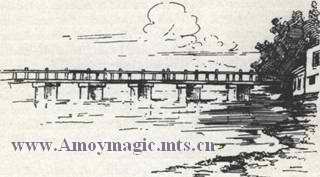
Enormous quantities of sugar are made there, and there is a great traffic
about the isles of the Indies; for this city is, you see, in the vicinity
of the ocean port of Zayton. The vessels pass on to the city of Fugu by
the river "(i.e. the estuary of the Chinchew River)" I have
told you of, and 'tis in this way that the precious wares of India come
hither. The people have abundance of all things necessary for subsistence;
fine gardens with good fruit; and the city is wonderfully well ordered
in all respects."
Marco's Venetian contemporaries frankly discredited his tales, but those
Jesuits who visited China later on 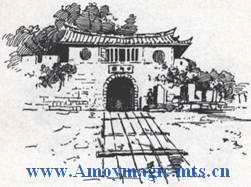 confirmed
the truth of what he had written.
confirmed
the truth of what he had written.
"In this province there is a town called Izungu, where they make
vessels of porcelain of all sizes, the finest that can be imagined. They
make it nowhere but in that city; it is abundant, and very cheap.
"The process is as follows:-Collect earth as from a mine, and laying
it in a great heap, suffer it to be exposed to the wind, rain, and sun
for thirty and forty years, during which time it is never disturbed. Thus
it becomes refined and fit for being wrought into the vessels. Suitable
colours are then laid on, and the ware is afterwards baked in ovens and
furnaces. Thus it is collected for children and grandchildren. You may
there have eight dishes for one Venetian groat."
Fine porcelain is made to this day in Foh-Kien, and the details of the
process correspond to this description. One of his notes on Manzi is rather
startling. He says of one of its cities: "I was told, but saw them
not, that they have hens without feathers, hairy like cats, which yet
lay eggs and are good to eat. Here are many lions, which make the way
very dangerous."
We might with his contemporaries have been inclined to question the veracity
of Marco or of his informants had we not ourselves gazed with astonishment
on the quaint-looking fowls to which he refers. The cat fur, however,
proves on nearer inspection to be simply an abundant crop of soft, downy-looking
feathers. They are certainly proper fowls, only they are a sort of big-baby
kind, the adults still wearing the fluffy down of their unfledged days,
and somehow never attaining to the dignity of a quill. If they resemble
any cat it must be the fleecy Persian. As to the "many lions,"
he is quite right, except that they are not lions, but tigers 1 By some
curious error he always confuses the two. Presumably he had never seen
a menagerie. The Polos left Venice when Marco was only nineteen years
of age, and did not return from the court of the Grand Khan for twenty-six
years, so it is small wonder if the traveller occasionally confused Tartar
and Italian, and called things by their wrong names.
Back to
Top Amoy Magic Guide to Xiamen
and Fujian
LEAVING the end of the thirteenth for the beginning of the twentieth century, let us follow the ordinary route from Amoy to Chinchew.
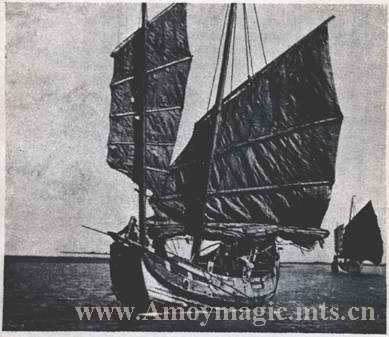
The great city lies between fifty and sixty miles in a north-easterly direction from Amoy, yet to reach it two days are usually required. The first day's journey is by junk (or latterly by steam launch) and takes us as far as An-hai. The remaining twenty miles of land journey are covered next day in six to seven hours by sedan chair.
We pass through a bare, uninviting stretch of country, broken by one or two slight hills. The main road, for this is part of the great mandarin road which runs from Pekin to Canton, degenerates at times into an untidy track. At one point it crosses a small stream by means of a log, chained at one end to prevent its being carried off in time of flood; and at another it meanders helplessly up and down a stone staircase leading over a little bit of a hill; but finally it becomes a purpose-like embankment stretching across a rice-plain, paved in places with lengths of substantial granite.
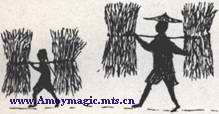
Streams of burden-bearers-"coolies"-pass up and down this narrow highway. The loads, slung to the ends of their carrying-poles, show an endless variety of merchandise. Huge crates of earthenware pots, bundles of native tobacco-leaf, bags of rice, heavy jars of sugar-cane juice, great wicker cages teeming with tiny ducklings, dried grass for fuel done up in loads about the size of small haystacks, baskets of sweet potatoes, taro and vegetables of many kinds, a live black pig carried by two bearers, bales of cloth, of paper, of cotton-wool, etc. etc., all these are carried, not on carts or railway trucks, but by the very primitive carrying-pole balanced on long-suffering human shoulders.
Such, too, is our own position; for we are being borne along by two men, and as they carry us onwards we notice the front bearer every now and again shifting the cross-bar at the end of the long bamboo chair-poles to ease the pressure on neck and shoulders. Query: What will those men say to the inevitable railway train.
Back to Top Amoy Magic Guide to Xiamen and Fujian
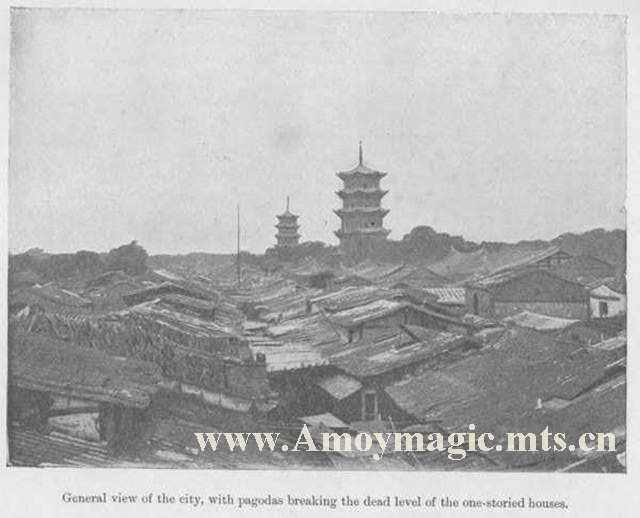
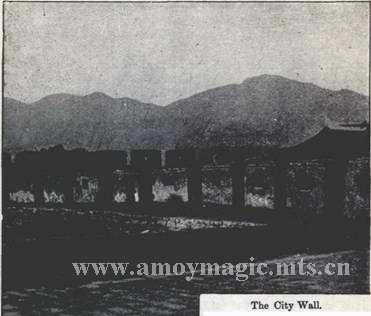
At last, far off, we see Chinchew; that is, we see a stretch of its high, battlemented wall, over which the tops of two great pagodas are clearly distinguishable, and behind which the houses of the city are quite hidden. Beyond, and to the west of the city, several high hills rise abruptly from the great rice plain.
As we approach, the villages grow larger, till, by and by, the road is lined continuously with market-stalls. Long before the great South Gate is reached, we have said good-bye to fresh air and free space, and have begun to make serious acquaintance with the various sights, sounds, and odours inseparable from a Chinese city.
We cross the Chinchew River by a long, high bridge made of lengths of granite, resting on solid piers of the same. Its very open stone fence, adorned at intervals with grotesquely carved lions' heads, forms a rather inadequate-looking balustrade.
The river below seems fairly busy. A good many small junks, laden with lime, wood, etc., are coming down; while others, carrying salt, and various city-manufactured articles, are preparing for the more arduous up-stream journey. There are larger vessels, too,-fishing-boats from the coast, sea-going passenger-junks, and, farther down the river, large rice-junks. These all add to the bustle of the scene; and the clamour of voices from the jetties rises to us on the bridge in a confused babel.
On over the bridge, and past the Customs' barrier, we plunge again into the narrow, busy, close-smelling thoroughfare. Presently the way leads us under an archway, whose massive stonework and heavy gates remind one of some ancient "donjon keep." The uneven pavement leads on, with several characteristic twists and turns (these to circumvent the demons, who, it seems, require straight lines for their evil works), and we emerge again to find that we have been entering by the South Gate, and are now actually inside the great city of Chinchew.
Back to Top Amoy Magic Guide to Xiamen and Fujian
CHAPTER IV CHINCHEW-ITS STREETS AND SHOPS
How describe a Chinese city to those who have never seen one? It is attempting the impossible. Photographs help home friends to realise things a little; but, on the other hand, they always do China an injustice, for they do not show up dirt and disrepair, two elements which are almost invariably present. Then the narrowness of the streets makes it difficult to focus a building. Good photos of street life in China are extremely rare, probably for this reason.
We would first ask the reader to try and dismiss from mind every idea of a home city. Thoughts of broad thoroughfares and the rattle of conveyances, side pavements with lamp-posts, tall houses on either side, and shops shining with plate-gJass windows,-all these must go, for Chinchew knows nothing of such. Instead, try to picture a city of single-storied houses, with streets not broader than our home side-pavements. In summer, large mats of woven grass or split bamboo, supported on bamboo rods stretched from roof to roof, keep off the burning sun. The result is a grateful shade; but also an atmosphere more exhausted and more actively " stuffy " than before.
Wheeled conveyances are here unknown, and the straw-sandaled feet of the burden-bearers pass quietly over the uneven flags. Noise there is in plenty, but not home-street noise. What we hear is literally the clamour of tongues. Bargaining accounts for most of the din. What looks to us to be a battle royal is merely a fairly amicable discussion over the price of some trifle; and possibly the sum of one cash is involved (500 cash = Is.). Had we time to wait, we should see the matter settled to the satisfaction of all parties; but our front bearer is shouting himself hoarse in his efforts to announce our sedan-chair. Chairs take precedence of foot-passengers and luggage-carriers in the streets; but they in turn have perforce to yield to an idol procession.
We feel quite certain at one moment that our chair is going to knock down half the people on the street, and hold our breath as some old man narrowly escapes a severe bump. Next minute we are waiting in a fascinated way the results of an impending collision with a stall that juts out farther than usual; but our bearers jog on ahead, apparently regardless of consequences, shouting constantly, "Lang-a lai-lai-lai!" ("People coming, coming, coming!"), and somehow nothing happens. Only once do we remember our chair giving a somewhat severe bump to a passer-by.
Back to Top Amoy Magic Guide to Xiamen and Fujian
City women, except a few very ancient ones, are conspicuous by their absence; but field women, who. live in the villages round about, may often be seen in the streets of Chinchew. These field women form a class by themselves, and are allowed a wonderful amount of freedom. They have natural feet; work in the fields, planting rice, etc.; and carry loads to and from the city, just like men. They certainly have a hard life; yet their strapping gait, their healthy, open faces, tanned with exposure to sun and weather, are in striking contrast to the pitiful, hobbling walk and the sallow, unhealthy complexions of their shut-in city sisters.
The shops on either side are full of interest. Perhaps one should say stalls, rather than shops, in many cases. When the shutter-boards are taken down in the morning, the shopkeeper puts out various trestles and boards, thus making increased surface for the display of his wares. Then, too, he must have his heavy wooden signboard in full view. All this encroaches seriously on the already too limited street space.
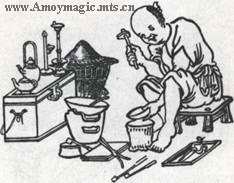
Some streets are given up to shops of one kind only. On entering the city the narrow street keeps at first by the wall, and here each shop shows pens, pens, pens. A little tuft of sable or of rabbits' hair, fixed in a bamboo tube, makes the brush-pen of China. Chinchew is a literary city, therefore pens galore. Here is Flower Lane, where every shop shows tinsel and silk artificial flower hair ornaments for women. Another street is given over to men's shoes. These shoes, along with the ordinary round, red-knobbed "bowl hats" worn everywhere, are two of the special exports of Chinchew.
On a little farther, where the street is wider, we find, amongst others, earthenware and china shops. Their goods overflow into the street. Never mind, there is still a clear passage in the middle, so the bowls, tea-cups, etc., are respected. Imagine the state of mind of a London policeman on such a street! As for a medical officer of health- but here imagination fails one.
There are cloth, silk, rice, basket, paper, and lantern shops. In the latter, you watch the workman covering little bamboo frames with paper, on which he paints the "character" of the god for whose shrine the lantern is destined.
Back to Top Amoy Magic Guide to Xiamen and Fujian
There are fruit-stalls where, amongst other fruits, bananas are sold for eleven out of every twelve months. There are huge pomelos (in structure, like oranges, but in size more approaching a moderate football), arbutus, dragon's-eye fruit, lychee, peaches (never properly ripened, and, as wo find, made a specialty of for keeping babies quiet in church !), lengths of sugar cane, tiny citrons and mandarin oranges, plums, persimmons, and many other fruits, known and unknown, all appearing in their season.
These are all nice, quiet, inoffensive shops. But oh, the frying apparatus doing its work in the street beside a refreshment shop!
Deadly looking messes frizzle noisily and odoriferously, and the whiff from the cauldron of seething fat, as it comes to a passer-by on a hot day, is a thing not easily forgotten.
Then there are the fish stalls, whence uncouth monsters of the deep grin at one. There are baskets piled with shrimps ; others with writhing crabs; there are whitish cuttlefish, exuding an inky-black fluid; while the narrow gray "ribbon-fish" show a perverted tendency to trail beyond the bounds of their baskets, and on to the street. Fishes, known and unknown, big and little, are there exposed for sale. In cold weather, the butchers and fish shops are quite passably nice, but hot weather can make them surprisingly haunting. Our hope in passing such was that this was not the shop patronised by our cook !
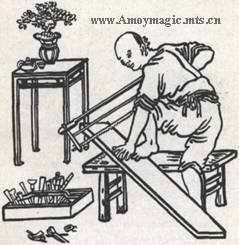
Many of the shops are such as could only be found in a heathen city. Wo see the workman, in full view of the public, carving out of a block of wood the image of the Goddess of Mercy, or some of their hundred odd deities; and this image, when finished, will be bought by some householder, that he and his may worship it. There are cheaper clay images, gaudily painted, and at prices to suit all purses.
A very large number of people are employed in connection with paper-shops, in making idolatrous paper-money, i.e. tissue" paper, with circles cut in it in imitation of coins, for use of the spirits in the graves. Once annually pious descendants visit their family graves, and strew an abundant supply of this mock "wherewithal" on the little mounds scattered everywhere in China. Then there is gold and silver paper-money, made of coarse yellowish paper, with a square inch of tinfoil in the centre, the "gold" being the same varnished over with yellow. This is for the spirits in the down-below regions, who receive this money by medium of fire, and so are provided with all the pocket-money necessary for their well-being.
Does everybody know that, a la Chinoise, the spirit of a man is threefold, and at death these three spirits find separate dwelling-places 1 One stays by the grave, another is banished to the infernal regions, and the third is politely housed in the little wooden "ancestral tablet" such as missionaries show at meetings. As each of these spirits requires attention, you will believe us when we tell you that the Chinese are a busy people. These attentions can be paid pretty cheaply, however, as paper-money is inexpensive. Also, spirits of children do not need any special care; and they believe that no woman, unless married and the mother of boys, has a spirit worth troubling about. So it comes that though some have triple honours paid them at and after death, yet many have none at all, thus evening up things somewhat.
This making of paper-money is light work, such as even frail people can easily manage. Many of the women who are now Christians, formerly made idolatrous paper, and one of the first claims the new religion made on them was to give up that by which they earned their daily bread.
The Chinese make all sorts of ornamental papers used as decorations at New Year time, generally with superstitious ideas attached. Shops and house-doors have those pasted on them to bring good luck and keep off evil spirits.
Back to Top Amoy Magic Guide to Xiamen and Fujian
Candle, incense, and firework shops are also in the idolatrous category. Crackers are constantly fired off at all functions, but very specially at weddings round the bride's sedan-chair, to scare the evil spirits and bring good luck.
Three or four years ago, a characteristically Chinese episode occurred in the South Street, Chinchew. Someone fired off a string of crackers in the street, probably when a funeral or a red bridal-chair was passing. Some of these crackers jumped into a firework shop, and unfortunately set on fire some of the goods there. They in their turn began to fizzle and jump about, and crack and shoot and explode wildly in a deafening pandemonium. The fire spread to the shop next door-an oil shop, as it happened-and then followed a right royal blaze. Soon the shops on the opposite side caught fire too, and the flames were not got under till a considerable amount of property on both sides of the street was totally destroyed.
One of the burnt-out shops was rented by a Christian. He and his friends managed to remove the goods from their shops in time, but his wife's property, which consisted of some boxes of garments valued at one to two hundred dollars, was all burnt up. As we remember it, the woman bore her loss well, expressing thankfulness that no life had been lost. We realised in this incident the value of the injunction against the specially Eastern customs of laying up treasure on earth, but we nobly refrained from quoting it to her.
We had hoped that this disaster might prove a practical lesson to the Chinese as to the danger of leaving so little street space. We were disappointed to find the buildings rebuilt with the frontage even a little further forward than before.
The Christian family rented another shop farther down the street, this time one with fireproof stores built behind!
We must not forget to mention the opium dens. The uninitiated would pass easily without noticing them. The frontage is closed in and looks innocent enough ; only whiffs of the drug caught in passing suggest the proximity of those dens of vice.
Back to Top Amoy Magic Guide to Xiamen and Fujian
To speak of Chinese streets and to omit to tell of the dogs found therein would be a grave error. South China seems to know only one size of dog, a wolfish-looking creature, nearly as big as a collie. He may be black, or brown, or white and black, or a mixture of all. Some are well-to-do animals, with a home; others are wanderers, hungry and outcast. They are mangy, often hairless, decrepit-looking wrecks, that ought to be poisoned off quickly, only it is nobody's business to do the merciful deed. These latter are spiritless enough, but the house-dog justifies his office of watcher by barking at every stranger, and very specially at the "foreigner." It seems as if they always recognised the different sound made by our shoes on the stones, and each time they hear it, it comes to them as a challenge. They follow, barking and snapping, till one has passed their domain, and only cease their rather trying attentions when the next watcher along the street has been roused to a sense of his duties, and takes up the refrain. Some of the missionaries have to confess to feeling safer with a good stout umbrella in their hands at certain special street corners.
One of the dogs belonging to the missionaries disappeared suddenly and completely. Speaking with one of the men-servants about it, the missionary expressed a hope that the thief would at least treat the animal kindly. "Treat him kindly, indeed !" was the reply; "why, they have certainly eaten him up by this time, for he was young and plump." It was rather solemnising.
China has cats, mostly tethered, and gifted even beyond our home friends with the most heartrending and pitiful of wails. When asked why they kept the poor creatures tied up, they told us that without being tied up they would run away. Our pussy was evidently an exception to this rule. Other familiars on the street are hens, very often the fluffy white kind; also the inevitable and inimitable black pig. These hens make a living by their wits, it would seem, and arc often seen on the busiest thoroughfares scuttling hither and thither, always hopeful, but never attaining to much. Piggies, on the contrary, are fed regularly, and respond to the call of their owner with most unpiglike alacrity. These frequent the quieter and opener residential streets. Inside the courts of the houses, and also, I regret to say, inside the houses as well, both hens and pigs are constantly to the fore. Is anyone who reads this second cousin to the old lady who stopped her subscription to missions because missionaries ate fowls every day, while she could rarely afford one even for Sunday dinner 1 If so, we would fain invite the relative to "chicken" dinner in Chinchew. We believe that for smallness of stature and sheer muscular development, these wiry "chickens" of Chinchew are unsurpassed.
Back to Top Amoy Magic Guide to Xiamen and Fujian
CHAPTER V CHINCHEW-ITS HOUSES AND TEMPLES
THERE is a general plan of the city which, if accurately carried out, would make its topography very simple. The great surrounding wall of the city is pierced in four places by gates known as the North, South, East, and West Gates. From these gates run four main streets, named respectively, the North, South, East, and West Streets. These converge towards the heart of the city, and form a cross at point of meeting. Spanning each of these four main thoroughfares, at a few minutes distance from the central cross, are high buildings like archways. These are called the Ko-lau, or Drum-towers, and are distinguished, as were the gates and streets, by calling them the North, South, East, and West Drum-towers. The square within these four towers is considered the heart of the city.
That sounds a simple enough plan; but, first, the walls do not lie four square, nor are those four gates equidistant. There are, in fact, three other gates, namely, the New, Water, and Mud Gates, and they too have streets named after them. The streets are never straight, but purposely winding-this also on account of the spirits,-and again they do not intersect exactly in the centre of the city, but nearer the North than the South Gate, thus making the "heart of the city" not at the exact centre. Add to the above the great similarity of the business thoroughfares, the countless number of narrow intersecting passages, the absence of any clearly printed street names, and it will be seen that it is fairly easy for strangers to lose their way in Chinchew. The most crowded part of the city is towards the South Gate. There is also a large population outside of it. Goods are pretty heavily taxed on entering the city; for this reason many evade the duties by doing their business just beyond city bounds.
The gates we have referred to above are always closed by about nine o'clock at night. The boom of a cannon announces the fact; and latecomers must all wait till sunrise next morning for admission, when another report proclaims them open.
Back to Top Amoy Magic Guide to Xiamen and Fujian
Chinchew is not without its attempts at drainage. Under the uneven granite slabs which form the street pavement, there is a drain to carry off surface-water. The drains are seldom interfered with. It takes only a short spell of real rain-and it can rain properly and systematically in China !-to prove beyond contesting that these are hopelessly inadequate.
The North Street, just beyond the crossways, is, in the rainy season, in a chronic condition of being flooded. Often the schoolgirls bound for i he South Street Church have to wade at that place. Sometimes the way is quite impassable, and a separate service held in the school hall is the result. The doctor, who had at one time to pass up North Street on his way to hospital, suffered much inconvenience from this constant flooding. Seeing that a little rearranging of the drain would allow this standing water to run off quickly, he offered to benefit the whole neighbourhood by paying all expenses in connection with the alterations.
 His
offer was politely but decidedly refused. It seemed that the changes would
involve the moving of some of the paving stones with which the " luck
" of that part was intimately connected. The whole community would
rather endure any amount of such minor inconvenience as flooding, than risk
the ill-will of spirits.
His
offer was politely but decidedly refused. It seemed that the changes would
involve the moving of some of the paving stones with which the " luck
" of that part was intimately connected. The whole community would
rather endure any amount of such minor inconvenience as flooding, than risk
the ill-will of spirits.We remember on one occasion walking to week-night prayer-meeting in the South Street Church when rain was just threatening. While in the meeting, the downpour came, the noise of it drowning the speaker's voice. At the close of the meeting wo were informed that the street was impassable, and we must wait till chairs could be procured for us. After some delay these were found, and we, sitting high and dry in our chairs, had a fine view of the scene. The streets were river-beds, and at the crossways, where a few stone steps lead up to the North Street, we were met by a roaring cascade. The bearers, with their short trousers tucked up as high as possible, and protected overhead by their most practical rain-hats, waded on slowly and carefully to avoid slipping, and deposited us safely at our own door.
It often happens in rains of this sort that the houses are flooded, and in specially great floods the streets may be quite impassable, except to a swimmer, or by means of a boat.
On one occasion a missionary coming down from Engchhun, found himself, boat and all, inside the city; nor could he tell us by which Gate he had entered, as the rice plain was- completely under water, and landmarks unrecognisable.
Back to Top Amoy Magic Guide to Xiamen and Fujian
There is also one great city ditch arranged on a system which would be excellent if it would only work. This great open channel begins outside the city wall by the river, and it runs in a bend through the city; then, piercing the city wall, it runs again to the river. The small drains under the streets are supposed to empty themselves into this ditch; and the ditch itself ought, twice a day, to be flushed by salt water at high tide. It usually happens, however, that the ditch is more or less choked, and if a mandarin wants a good excuse for extra taxation, he says he wishes to expend the money on clearing it out. This clearing process,
 unfortunately,
he usually defers.
unfortunately,
he usually defers.We have said that the city consists of single-storied houses. To this again there are exceptions. The theory is that any building jutting out beyond the general level destroys the good Fungshui of the place.
There is, however, at least one private house in the city with an upper storey. The facts about it are instructive. A Chinchew man went abroad, probably to the Straits. There he made money, saw something of the modes of life of other peoples, and became more or less emancipated from the laws that obtain in his native city. Having " made his pile," he, like a true son of China, returned homewards again.
Once back in Chinchew, the desire seized him to build himself a fine house, and, very unwisely, he decided to defy the spirits and have it built with an upper storey. The house was finished with a good deal of fine woodwork and ornamental plaster decorations, and looked really well. Such defiance of use and wont, if it did not annoy the spirits of the air, certainly roused the spirits of the citizens of Chinchew. They did not pull down his house, but made a determined set on his purse by instigating one lawsuit after another against him. By the time the house was finished the poor man had not sufficient money left to live in it himself, but was forced to seek a tenant. Our medical missionary, happily, was able to rent it, and the cool open verandah of the upper storey has been a great boon to our mission staff.
Back to Top Amoy Magic Guide to Xiamen and Fujian
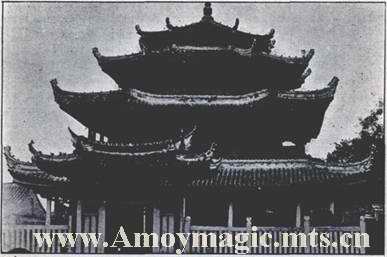
Then there are the four Drum-towers, and also the two great many-tiered East and West Pagodas. The latter are the most noticeable architectural features of the city. When they were built no one can tell. There they stand a little way back from the West Street, looking like great guardians on either side of a large Buddhist temple. These pagodas are supposed to be very specially connected with the luck of the city. Should anything happen to them a panic would certainly ensue.
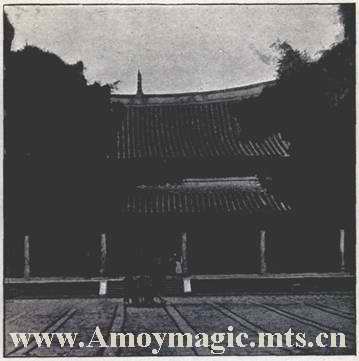
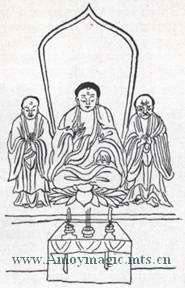
As to temples, Chinchew has, of course, its full complement of these, and the images they enshrine compare favourably for sheer repulsive-ness with those of other places. The majority of the temples are Buddhist. The entrance courts have a certain grandeur about them,-but the interiors are tawdry and unlovely to a degree.
The great Confucian temple is dignified by contrast, its single tablets typifying the homage paid to the memory of the one great teacher seeming a noble conception in face of these temples full of gaudy, ungainly images.
Back to Top Amoy Magic Guide to Xiamen and Fujian
The Moslem Mosque Chinchew possesses the ruins of a rather remarkable building, namely, a Mohammedan temple. It must have been a handsome and outstanding structure in its day. The roof is now gone, and the walls are somewhat broken; while only the bases of the pillars remain; yet the dressed granite stones of the walls, with their Arabic inscriptions still legible on them, and the well-laid pavement of the main building, give some idea of the former solid proportions of the building. It probably dates back several centuries. Followers of Mohammed are chiefly found in Central and Northern China; and it is scarcely probable that many in Chinchew were ever really of Moslem faith. It is more likely that some powerful mandarin coming from the North-West Provinces settled in Chinchew, and built this mosque for his own family and retainers. The family has either left or died out; and now barely a dozen worshippers assemble on special feast-days in the poor little room rented by them beside the ruins of their former temple. The leader of the sect seems ignorant enough; and, though able to repeat passages from the Koran, was unable to explain them to us. One of the worshippers rents his house strictly on the understanding that his tenants do ' not keep pigs; and this same man spits conscientiously when he sees anyone eat pork!
Another trace of Mohammedanism is to be found in a village near Siong-see, where the people claim that their ancestors worshipped the God of the Christians. They really were Mohammedan at one time; now the only difference between them and the heathen round about is that they never offer pork to the spirits of the ancestors. The wave of Mohammedanism did indeed spread far and wide; but now only this stranded ruin and the pitiful handful of worshippers remain to show that the receding wave had actually touched the eastern confines of China.
The only other specially notable buildings of Chinchew are its Examination Halls, and the yamens of the various mandarins. One at least of the latter has good grounds attached.
Not many years ago, a head military mandarin of Chinchew, General Sun, determined to enjoy the pleasures of driving. Accordingly he had a short carriage drive constructed within his own grounds, and ordered a European-made carriage. He once invited some of the missionaries to his yamen, and treated them to a drive. One man stayed by each pony; and the spectacle of these men wildly encouraging their respective animals, and of "Jehu" driving furiously, was almost more than any Westerner could view without being hopelessly overcome by laughter.
This General Sun is the man who, while commanding the Chinese forces in Tam-sui (N. Formosa), held the French at bay, literally and metaphorically. He delighted to "fight his battles o'er again" in presence of an appreciative audience. According to his story, the poor French had not a quarter of a chance against him! He has gone now, and the carriage is no longer in evidence.
Inside the yamens there is space; and there might be dignity, only an unkept and uncomfortable air pervades everything. There is a want of freshness, neatness, and even cleanliness which no amount of grand dresses worn by the lords and ladies within can quite counteract.
Back to Top Amoy Magic Guide to Xiamen and Fujian
CHAPTER VI MANDARINS
AND LITERATI
ANY description of the city which, deals only with its business parts
must be incomplete, not to say misleading. While Chinchew is a large centre
for trade, it is also an important governmental centre; but its proudest
claim is being a literary city. They tell you, "Changchew for commerce,
but Chinchew for learning." Changchew is a large city inland from
Amoy.
The Chinese grade trades or professions thus:-1. The Literati; 2. Farmers;
3. Artisans; 4. Shopkeepers. This makes Chinchew rank three steps higher
than Changchew-in its own estimation!
The civil and military governors of the province have their headquarters
at Foochow. Chinchew ranks next as a prefectural city, and its prefect
has powers over a wide district. Various yamens, at once the residences
and court-houses of these rulers or mandarins, are scattered over different
parts of the city. There are always soldiers about, and their barracks
and parade-grounds are in the more open parts, between the North and East
Gates. There curious scenes, such as of warriors astride prancing ponies
shooting arrows wildly in the direction of paper targets, were till quite
recently the joy of the amazed Western beholder. Nowadays volley-firing
in the small hours of the morning seems to be absorbing their martial
energies, and it is an exercise rather disturbing lo the neighbourhood.
Then as to the literary claims of the city. All mandarins attain their
rank simply through competitive examinations. Their office is never hereditary.
There are in China an untold number of aspirants for office. These study
the works of Confucius, Mencius, and others, and come up periodically
for examination to the various centres. The mandarins in their turn are
the examiners. At Chinchew a good many degrees may be obtained, though
the highest must be sought by the student at Pekin.
Chinchew has annual examinations, but the great examinations fall due
only every second or third year. At such times students from far and near
flock into the city, as many as ten thousand of them. The streets are
then full of those curious anachronisms, men with their minds steeped
in the learning of twenty-five centuries ago, and who could not name over
the countries of Europe if their lives depended on it; men whose supercilious
stare-if they do condescend to look at one-is sufficient indication of
their attitude towards the mushroom foreigner.
Back
to Top Amoy Magic Guide to Xiamen
and Fujian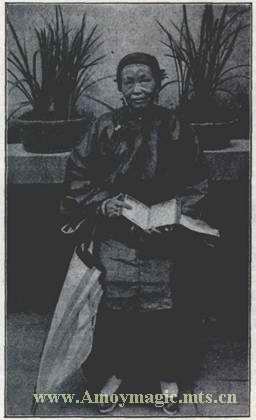
They form an imposing-looking set. The portentous strut, long robes of
delicately coloured silk (pale lavender predominating), the enormous spectacles,
the long pigtail undulating as he walks, the fan adorned with choice sayings
of the ancients, and the long bird-claw finger-nails much in evidence,
proving that their owner never did one stroke of honest manual labour;
all these, steeped in an atmosphere of intense self-conceit, go to the
make-up of that most bigoted of beings, the Chinese literatus.
These are the men who hate every innovation, and who have kept China standing
still. These are the men vho know by heart the moral maxims of Confucius,
while their vicious lives are in utter contradiction to his teaching.
And yet, remembering how "even in Sardis" some few had "worthy"
written over against them, we must not condemn those men root and branch.
Dr. Griffith John, writing of the Chinese crisis in 1900, says: "The
command had gone forth to massacre all foreigners and to annihilate the
Church, and but for such men as Liu Kunyi, Chang Chih-tung, and Tuan Fang,
it is almost certain that all the missionaries in the interior and all
the converts in the Empire would have perished."
Speaking more particularly of Chang Chih-tung, he says: "The love
of money does not seem to be in him." Another says of him : "This
man finds his ideal of human life in Confucianism; he is a true patriot
and an able statesman." There are, then, some few bright exceptions
to the above sweeping charges brought against the literati of China.
Back
to Top Amoy Magic Guide to Xiamen
and Fujian
CHAPTER
VII THE CITY WALL
BEFORE proceeding to trace the planting and development of the mission
in Chinchew, there is yet one physical feature of the city which claims
some special attention. Chinchew, like most Chinese cities, has its great
surrounding wall. This is a structure of solid masonwork about thirty
feet in height. Just outside of it there runs a moat in very incomplete
condition. This mild defence would not hinder an enemy for long; but the
solid face presented by the walls looks as if it would keep off any attacking
force that would conscientiously refrain from using dynamite.
The wall is kept in good repair. It is about ten feet wide on the top
at its narrowest parts, and is much wider in places.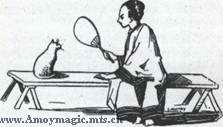
Mounting by the stone staircases at any of the gates, we find ourselves
at once lifted to a purer atmosphere. There, if anywhere, even after the
hottest of days, there is a coolness which refreshes wonderfully after
the heavy tainted air of the city. Missionaries often walk here just after
sundown; and as the Chinese never think of "taking a walk" in
our sense of the word, they have the wall to themselves.
Only once do we remember seeing any considerable number of Chinese on
the wall. It was in a time of great flood, when water was about eight
feet deep in some of the houses outside the West Gate. There were people
huddled in a state of damp misery on their sloping tiled roof, while others
in boats were moving about carrying cooked rice, etc., to the unhappy
refugees. We found quite a farmyard establishment on the wall. Fowls,
goats, pigs, and cattle had been driven up there, and their owners were
beside them, waiting in dreary patience till the waters should subside.
On the wall, at intervals, are stray cannon. Probably there once was a
time when these were usable; but as they lie there dismantled on the stones
they reveal one of the causes why China fell such an easy prey to Japan.
Back
to Top Amoy Magic Guide to Xiamen
and Fujian
As we walk on we come to a great pit inside the wall itself. Look down
into it. There is not much to see; only some most pitiful little bundles
done up in matting. Do you realise what those are? Girl babies; only girls,
and so not wanted. Why have all the trouble and expense of bringing up
another girl when in the end she will marry into another household. She
is of no use in "building up" the family she was born into,
so the little mat-bundle is made up, carried to the wall-top, and dropped
into this silent, ghastly "baby-pit." Poor China, a country
where womanhood is not respected, nor child-life held sacred!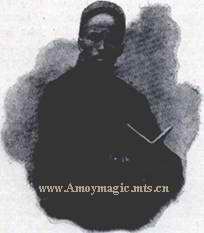
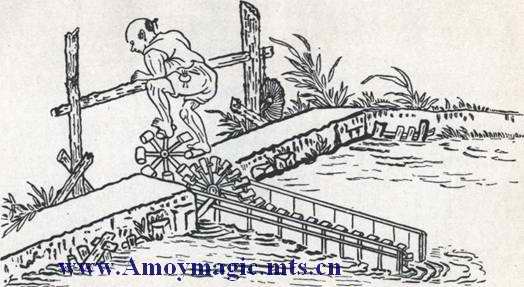
Looking outwards through the openings in the battlements we see the rice
plain, and have a capital view of the busy farmers, who raise two and
three crops from the same ground in one year. Sometimes the fields are
being flooded with water, and the penetrating creak, creak of the irrigator-worked
by a sort of treadmill contrivance-is over all the land. Only a few weeks
later and the startling sheer green of growing rice has hidden the water,
and again this gives place to the yellow of waving grain ready for the
sickle.
But it is inwards, to the city itself, that our eyes turn. Two things
that surprise one are, first, the amount of open unbuilt space between
the North and East Gates, where vegetable and chrysanthemum gardens prevail;
and, second, the number of fine old trees, notably banyan and dragon's-eye
fruit trees, one sees in parts. The banyans are usually inside the grounds
of a yamen, or beside a temple.
There below us lies the city. The undulating roofs of its single-storied
houses seem to us coterminous, so little break do the narrow intersecting
thoroughfares make.
These waved roofs are fascinating. Beneath them live some 300,000 people
bound soul and body by custom and superstition, and bitterly resenting
any interference with their bonds. One goes to heathen lands with strangely
erroneous ideas as to the heathen and their needs. The Chinese people
are not stretching out their hands for the gospel, they are more than
content with their own idolatries. They are not looking-consciously, at
least-for a Saviour, or greedily drinking in the message you send them.
The truth is, they despise the foreigner and all his ways, and they are
the most appallingly self-satisfied race under the sun.
And yet even here, amongst this people intent, like the man with the muck-rake,
on all that is low, vile, and worthless, whose highest ambitions are pitifully
low, some are found whom God has inspired to seek after, if haply they
may find Him. There have been men in Chinchew so in love with righteousness
and moral living that they of their own accord preached morality to their
fellows, and this before the gospel reached them. Here aud there we have
found heathen women practising a self-denial that would put us to shame;
and their reason for so doing was that they or their families might live
good and pure lives. Just one instance of this. The ancestral home of
a rather well-known priest is in the city, near the North Gate. This priest
was attracted by the gospel, and finally became a decided Christian. By
throwing up a lucrative profession he, of course, incurred the ill-will
of his relatives.  "While
he was still alive he had influence enough in the family to secure that
one or two of the children of the household should attend school, but
after his death these were withdrawn, and we seemed to have lost all touch
with the family.
"While
he was still alive he had influence enough in the family to secure that
one or two of the children of the household should attend school, but
after his death these were withdrawn, and we seemed to have lost all touch
with the family.
Back
to Top Amoy Magic Guide to Xiamen
and Fujian
As we were passing the house one day, we thought we might as well call
in and see if a renewed hearty invitation to church would meet with any
response. Instead of going to the main part of the house, we found ourselves
in a little back room, where a very old woman was sitting. She was, I
think, a sister-in-law of the former priest. We invited her to church
next "worship day."
"No, I am too old, and I do not know how to read."
We assured her that the Heavenly Father would not reject her because of
her age, and told her it did not matter at all about being able to read.
"I am too feeble; I could not walk all the way to church." She
had tightly-bound feet, and looked old and frail enough, so we told her
that God was everywhere-she could worship Him here.
"But I am a vegetarian," she said, coming at last to the real
reason. "Yes, for the last twenty-five years I have eaten only vegetable
food. It was not for myself I was doing it, though."
The usual idea in vegetarianism is that by a restricted diet the body
is purified, and merit accumulated, so that the spirit is made worthy
to become after death an object of worship, to become an idol-spirit,
in fact.
"No, it is not for myself I am doing this, it is for my son. I want
him to be good. I have commanded him to go to your church, and to worship
your God. If he worships God he will not eat opium and will be a good
man. I am going to give over all my twenty-five years' merit to him."
We suggested that she would surely like her spirit to be with his after
death. If her son worshipped God, he would go to be with Him. Would she
not like to go too!
"No, I must go on eating vegetables only for him, for I want him
to be a good man, and ho is to have all my merit."
She was old and frail, and confirmed in her idea. Her mind seemed incapable
of taking in a new thought. For all those long years she had lived her
life of self-denial for her son, and now nothing that we could say could
shake her belief in the efficacy of this transferred virtue. Evidently
the old priest-the one Christian she had known-had been a good man, and
his life had convinced her of the power of the God of the foreigners.
Back
to Top Amoy Magic Guide to Xiamen
and Fujian
Without any thought of self, she had done what her poor ignorant old mind--or was it heart!--suggested to her, and to us it seemed very beautiful indeed.
Weleft her quite untouched by our words, and probably she had died long ere now. A heathen woman who could love like that,--oh, the pity of it all! Why did we not send sooner to tell her of Him who is Love? Once again the old rock-text comes to us, and this time with a deepened meaning--"Shall not the God of all the earth do right?"
PART II MISSION WORK IN THE CITY
CHAPTER VIII FIRST THINGS
WHEN our Church sought to establish a mission in China, it sent as its
first missionary William Chalmers Burns. He left England in 1847, recommended
by the Church at home to choose Amoy as his headquarters. It was not till
1851, however, that Burns left Hong-kong and Canton, and actually settled
in Amoy. There he was joined by various other missionaries, ordained men
and medical men, and slowly the mission took definite shape. The work
took hold on the mainland at first in the Pechuia and Bay-pay districts,
to the south-west of Amoy. Later on a little, in 1857, a beginning was
made to the north-east, when Dr. Carstairs Douglas visited An-hai. In
1859, that station was definitely occupied. A glance at the map will show
that An-hai is a sort of half-way house to Chinchew, and such in effect
it has proved to be.
While
engaged in the work of opening this new centre, the missionary could not
but hear constantly of the great unknown city beyond. From dawn to dusk
the road stretching northwards showed its long narrow procession of blue-clad
carrier?, to whom " the city" was as the centre of the universe.
As he went about the markets and streets of An-hai preaching and teaching,
the quick ear of the man who was to compile our dictionary would soon
distinguish amid the babel the rapid utterance, modified vowels, and peculiar
accent which mark a Chinchew man. In his country work round An-hai, Dr.
(then Mr.) Carstairs Douglas could not but hear tales of the dark days
when some of the interminable village feuds, which are characteristic
of that turbulent district, roused the wrath of the city mandarin. Vengeance,
in Chinchew Plain, with "Dragon-Fountain Hill" in the distance
(see page 59) the shape of a body of soldiers, would be seen marching
down the long highway, and woe betide the hamlets where these settled
to dispense their summary justice!
Then, again, whether in town or village, everywhere he would meet with
some who wore the long robe of the student. To these men "the city,"
with its examination halls, was the beginning and end of existence. So
in countless ways the missionary would be led to turn longing eyes northward,
and the thought "the city for Christ" would take an ever deepening
hold on his mind and prayers.
Away back in the end of the fifties, one incident stands prominent, marking
the beginning of the work in Chiuchew. We of a later generation have heard
the story, and pictured it to ourselves so often that it almost seems
as if we had seen that little band of native Christians, led by Dr. Douglas,
kneeling there on the hilltop amongst the granite boulders. This story,
and the record of the first visits to Chinchew, had best be given in the
missionary's own words.
Back
to Top Amoy Magic Guide to Xiamen
and Fujian
"On Monday last, 13th June (1859), I went, for the second time, to
a village four or five miles distant (from An-hai) in the direction of
Chinchew, called Leng-sui, i.e. ' Spiritual water.' After spending the
day preaching to the villagers under a large banyan tree, we returned
by way of a high hill, called the ' Dragon-Fountain Hill,' which rises
just above the village. Part of the ascent was in the chair which brought
me from An-hai, the upper part on foot. That view was most impressive.
The day being clear, we saw quite plainly the mountains of four departments
-Chinchew, Chang-chew, Hing-hwa, and Yung-chun. Of these, the two latter
have not yet heard the gospel at all.1 The plain around the hill is-as
we find everywhere-crowded with large villages; but, to my eye, the great
object of interest was the populous city of Chinchew, of which I had a
full view about ten miles distant. With a small telescope I saw clearly
one of its large bridges, and the two fine pagodas within the city. Before
descending, we knelt together on the summit of the hill, making supplication
for the wide region of darkness spread at our feet, and especially for
the city of Chinchew, whose sole specimen of Christianity consists of
the two opium ships moored at the mouth of the harbour. Alas, that it
should still bo true that the children of this world are wiser in their
generation than the children of light, wiser and more zealous too! Pray
ye, therefore, the Lord of the harvest, that He may send forth labourers
into His harvest."
[1"Hing-lioa" is now occupied by the missionaries of the
C.M.8. and of the American K. Moth. S; while " Yung-chun" is
our own Eng-chhun.]
CHAPTER IX EARLIEST
VISITS TO THE CITY
IN the end of the same year (1859), and again in December 1860, Dr. Douglas
paid his first two visits to Chinchew.
So far as is known, only one missionary had previously visited the city.
That was some three years earlier, when a British consul, accompanied
by Dr. Talmage, of Amoy (American Presbyterian Mission), passed through
it.
Dr. Douglas moved about the city, visited the various public buildings,
and preached a number of times with surprising freedom from molestation.
He noted at once as the two characteristics of the people superstition
and pride in their learning. Commenting on this pride, he writes: "The
city has produced many distinguished men, the latest, Hwang Tsung Han,
who succeeded Yeh as Governor-General of Canton. I saw yesterday a tablet
erected to him a few years ago in the Confucian temple here; his elder
brother still lives in the city as the head of its literati."
One note is very prominent in the earlier letters, and that is bitter
regret that the heralds of the gospel should have been forestalled in
this, as in so many- other places, by the opium-dealer.
On the second visit Dr. Douglas was accompanied by the Rev. H. L. Mackenzie.
On their arrival they found a freshly pasted-up copy of the Ten Commandments
just at the South Gate, a happy augury for their work there.
Strangely enough, most of their preaching was done at the mosque, to which
we have already referred. Dr, Douglas writes: " One day we preached
in the street opposite its door, and on another occasion within its ruined
walls. I should scarcely say ruined, for, though it has evidently been
long roofless, the walls of the mosque are in excellent preservation.
It is some sixty or seventy feet square, built of good granite; the bases
of the internal pillars still remain. It was a scene calling up a crowd
of strange associations; to stand, in the midst of a great heathen city,
on a broken pedestal, within the roofless mosque, preaching the gospel
to a crowd of Confucians, Mohammedans, and Buddhists; while those walls,
covered with Arabic inscriptions, which had so of ten "resounded
to the words of the Koran, now echoed the name of Jesus, the only-begotten
Son of God. The Moslems were a witness to the heathen that there is only
one God, and that the idols are vanities; but they seem to have quite
forgot their own worship, except that in some measure they reverence one
day in seven, and-if we understood them' right-that they offer a burnt
sacrifice once a year."
Back
to Top Amoy Magic Guide to Xiamen
and Fujian
His prayer for Chinchew is: "Oh that we may be permitted to prepare
the way of the Lord, and make straight His paths in this city of three
or four hundred thousand inhabitants!"
Since his two first visits to Chinchew recorded above, Dr. Douglas had
wished much to have a station opened there, but the work was spreading
rapidly to the south-west of Amoy and absorbed the missionaries' energies.
In the meantime the little much-persecuted congregation at An-hai, with
its twenty-four members, had been doing its utmost to spread the knowledge
of the gospel in its own district. When its membership had increased to
thirty-two, this brave little congregation thought it should now be attempting
greater things, and so consulted Dr. Douglas as to the advisability of
taking up Chinchew as its mission-field. Dr. Douglas went north again
with two native agents, and found no difficulty in renting rooms suitable
to serve for a small preaching hall. These were situated in the very heart
of the city, and close to the great thoroughfare of the South Street.
The two native helpers remained in the newly-rented premises, and thus
was made a first beginning towards the permanent occupation of the city.
The Rev. W. S. Swanson in I860, and the Rev. W. M'Gregor in 1864, came
to Dr. Douglas' assistance. In 1866 we find Mr. M'Gregor writing: "The
Foo city of Chinchew we now number among our regular stations."
We, who have known only the Chinchew of to-day, can scarcely realise what
it must have meant for those pioneers to visit the city as they did from
time to time. There was not one Christian there to welcome them. As foreigners,
they would be objects of the greatest curiosity. Out of doors, wherever
they went, they would be practically mobbed; while even in their lodgings
privacy and quiet would be out of the question.
Their "Amoy," fluent as it might be, would sound barbarous in
the ears of those northerners.
More preposterous even than the appearance and tongue of the foreigners
would be the message they brought. Imagine a Chinaman standing on the
steps of St. Paul's proclaiming with passionate earnestness, in broken
English, the doctrines of Confucius. Think for a moment of the chaffing,
jeering crowd around him, of the sheer amusement his unthinkable conceit
and audacity would create. Would any single man in the millions of London
dream of taking him seriously 1 Hear him tell how for over 2000 years
the name of Confucius has been the most honoured in the far East, and
how to-day 400,000,000 Chinese acclaim him the great teacher, and profess
to shape their lives by his teaching. How would such statements affect
the Londoner! Let him go on to expound one of the best moral maxims of
the Chinese sage, and for how many minutes would they give him a hearing!
Back
to Top Amoy Magic Guide to Xiamen
and Fujian
Or take Edinburgh, a city famed, like Chinchew, as a centre of learning,
and with much the same population. Picture to yourself two or three misguided
Chinamen standing at the gates of the University, ready with basket-loads
of tracts which explain the merits of the teachings and person of Confucius.
How many of our Edinburgh students would receive such tracts at their
hands ? How many, if they did accept them, would really study them afterwards
? What chance would those Chinamen have of making one convert ?
You think the cases are not equal, but they are, and far more so than
you would believe. We speak of our Western civilisation, and of ourselves
as "the heir of all the ages," but has not the Chinaman more
of a past than we have, and has he not been civilised long before we were
a people ? Do we call it arrant folly and impertinence for a Chinaman
to preach to us t In just such a light does the literatus of China consider
our interference. Are we sure that we have the truth for ourselves and
for all the world besides ? No less certain is our long-gowned friend
that he alone knows anything at all. The only difference between us is
that we want to convert him to our way of thinking, while he is in the
more dignified attitude of keeping himself to himself.
What, then, is our warrant for interfering with this ancient and civilised
people? Why, when we know that we would never tolerate a Chinaman's preaching
Confucius to us, do we offer him tracts, and expect him to listen to our
preaching of Christ? The only answer is that Confucius and his vows are
dead and powerless, while we preach One who "ever liveth," whose
words are "quick and powerful"; One whose last command was,
" Go ye therefore and teach all nations," and who, when He revealed
Himself again to His beloved disciple, said, ''And let him that heareth
say, Come."
It was a noble order, inaugurated by St. Paul, that of "fools for
Christ's Sake." Those who, in the early days, faced the wise men
of Chinchew, and told them in imperfect Chinese of the One greater than
Confucius, even Christ, these men have earned their fellowship with the
Apostle of the Gentiles in this holy "order"!
Back
to Top Amoy Magic Guide to Xiamen
and Fujian
CHAPTER X "FIRST
THE BLADE"
IN the early days any visits made by the foreign missionary to Chinchew
would be short, and at very infrequent intervals. Much of his time had
to be occupied with business matters connected with the renting of chapel
premises. While his appearance attracted crowds, making him perforce act
as a capital walking advertisement of the gospel, still it was only a
few days at best that he could give to the work of preaching. Such fragmentary
efforts could not, of course, build up a church. To the native preachers,
and very largely to the lay helpers from An-hai, belonged the privilege
of gathering in the first converts in Chinchew.
We can in a sense share the joys and the hopes of the pioneer foreign
missionary, but it requires more effort to put ourselves in the place
of these faithful native helpers. Themselves but "babes in Christ,"
it would be with sinking hearts that they escorted the missionary through
the South Gate, bade him a reluctant "good-bye," and turned
to face, with what courage they could muster, the formidable task of holding
the fort there in the very stronghold of the enemy.
Theirs was no easy task. To the foreigner a certain amount of outward
deference would be paid; but the message on the lips of those who were
unlearned and ignorant men would meet with scant ceremony. They would
be taunted with "eating" (i.e. making a living off) "the
foreign doctrine," and with joining a sect that had "neither
father nor mother," the latter being a cutting reference to their
having ceased to worship their ancestors. So long as they were few in
number, the literati would ignore them; but let them have any slight measure
of success, and these would surely stir up trouble.
Day after day these workers proclaimed the gospel, in season and out of
season; wherever and whenever they could get a hearing they told out the
"old, old story"; and, in the telling, it became more real to
themselves.
Sunday would be their brightest day, for one or two of the An-hai brethren
spent many a week-end in the city, willingly walking the twenty miles
there and back that they might help in the Sunday services. Those who
could not take their turn at preaching could at least form the nucleus
of a congregation, and by their presence cheer the hearts of these lonely
workers.
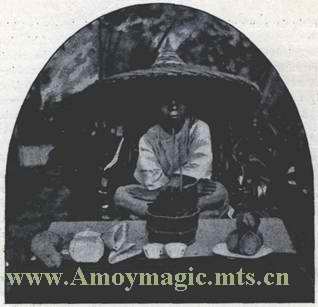
The
God of the Rain-hat. This boy was made a god because he prophesied that
rain would come. The hat is only worn in wet weather.
One or two men from a village eight miles to the north, several from outside
the South Gate, a stray hearer from the city itself- these, with the brethren
from An-hai, formed the first congregation. It was a feeble enough beginning,
but the Great Worker had already touched some of the hearts there.
In 1866 came the first active opposition. The chapel premises were suddenly
attacked and dismantled, the helpers suffering considerably. "The
whole was done by the literati, for the people in general have shown quite
a friendly spirit."
In 1867 Dr. Douglas wrote that the premises were repaired, and that there
were twenty-one candidates for baptism. Most of those, he thought, understood
the way of salvation, but "none have hitherto been received into
the church at Chinchew, as we are anxious to be careful about those first
admitted."
Back
to Top Amoy Magic Guide to Xiamen
and Fujian
The following winter the first members were baptized by Dr. Douglas, and
the Chinchew church was founded with a membership of fourteen.
Who were these men? "Not many noble, not many mighty," that
is certain. A list of their occupations is suggestive. We find, amongst
others, a sorcerer, or spirit-medium; two boatmen, cousins, working on
the An-khoe river; a Buddhist priest; from eight miles north of the city
came two villagers who had been "vegetarian Buddhists" (a sect
we usually find thoughtful and serious-minded), an actor, and a maker
of incense. All were obscure and illiterate men. Their names were not
to be found amongst those inscribed in the city's halls of learning, but
they were written above, in the Lamb's book of life.
Of these men, Ho, the incense-maker, is specially interesting, from the
fact that he was the first city man to confess Christ, From his first
hearing of the gospel he seems to have believed it, but his trade proved
for a time a stumbling-block. At length he decided to give it up; and,
much to his wife's indignation, he took to hawking eatables about the
streets, a comparatively unremunerative occupation. We find him, too,
bringing in five or six new inquirers, city men like himself. Having thus
proved his sincerity, he was baptized and admitted to church membership.
CHAPTER XI OPPOSITION
AND GROWTH
IN 1869 a second attempt was made by the literati to extinguish the mission,
but progress was made in spite of-or was it partly because of 1-this trouble.
Gradually the little band of Christians grew till in 1875 there were forty
adult members. These elected their own elders and deacons, making Chinchew
from that time onwards a separate congregation, no longer merely a mission
station counted under the supervision of the An-hai church.
The chapel premises being found too small* it was decided to buy a larger
house, to be used as a new chapel. This was done, "but the literati
got the mandarins to arrest the seller and two middlemen." These
unfortunate men remained prisoners for fourteen months, when happily a
change of magistrate brought about their liberation.
"That interminable Chinchew case," as Dr. Douglas calls it,
was settled in 1877 by the deeds of the house that had been bought being
restored to their owner, while the mission in return secured permanent
possession of the old chapel, with considerable extensions thereto. The
extensions included sufficient space to allow for a new church, a school,
a dwelling-house, and a frontage right out to the South Street-a capital
position on the great thoroughfare, quite ideal for use as a preaching
hall.
So it has come about that our well-known South Street Church is on the
site of the old mission chapel, in which the first converts were gathered
in.
Since this settlement our work has been carried on without disturbance,
both in the city and in the surrounding country.
Since the official settlement above referred to, Christianity has had
a recognised position in the city; but even to this day we must act with
caution.
Back
to Top Amoy Magic Guide to Xiamen
and Fujian
The literati have all along closely watched our proceedings. At first
their boast was that no city man had become a Christian. According to
them, all the church members were insignificant villagers, and one had
only to note how their pigs, goats, and poultry all died, to be certain
that they were being pursued by the anger of the gods!
Then, as they observed that some of the city people did become Christians,
they had placards posted over the city giving details of the calamities
which overtook those who followed the foreign doctrine. The following
is a specimen of one of these documents:
"Not one of those who have entered the church has come to a good
end.
"Boon, the cake-dealer, within a year after he became a Christian,
lost his father; within two years he lost his brother; within three years
he lost his son and lost his pigs; within four years he died himself.
This everyone knows to be the case. The Ong-ia "(title of an idol)"
punished him for his misconduct.
"Koai, the dealer in cooked rice, by becoming a Christian wasted
his inheritance and ruined his business, so he has now sold himself as
a slave to the barbarians.1 Neither has he escaped the vengeance of the
gods: all his children are girls, and if by any chance he happens to have
a son, the child dies. If then he buy a son, he also dies. His pigs also
die, or are stolen."
For Ho, the first city convert, who had taken to the work of a carrier,
they cheerfully prophesied that "the heavy burdens he had to carry
would certainly break him down some day." It must have been rather
annoying to them to find that Brother Ho lived to a green old age.
There was, however, just enough truth in the other assertions to make
these posters particularly galling. To the Chinese the favour of the gods
seems to be synonymous with health and worldly prosperity, and any reverses
they meet with are promptly put down as punishment for having offended
those dignitaries. It takes even the Christians a very long time indeed
before they rid themselves of such ideas. On this account the Chinese
come nearer to understanding the Book of Job than we do, for in the case
of a great calamity their first thought is that it is a punishment for
sin, and friends and neighbours instinctively range themselves with the-to
us-rather provoking three "comforters."
We remember a London Missionary Society preacher telling us that the only
missionary of his district had been forced to leave. Sighing deeply he
said, "The sins of the people of Hui-an are very heavy, so that God
will not permit a foreign teacher to remain with us." On another
occasion one of our schoolgirls had been kept at home by her father against
our express wish. While at home she took plague and died. The sad news
was brought us by a woman, who began thus: "Nui-a's father's sins
are very heavy, his daughter has died of plague." The death was to
her a direct consequence of his refusing education to his child.
Any trouble, such as loss of property, or death in the family, is a very
severe test to the faith of a new convert. Either he fears that God Himself
is displeased with him, or that he is being pursued by the enraged idol-spirits;
thus the temptation to doubt whether God has the will and the power to
protect him from these other spirits is a very real one.
While the work within the city, face to face with pride, ignorance, and
superstition, progressed steadily, if slowly, the "regions beyond"
were not forgotten. On the coast at Siong-see, up the An-khoe Valley at
Sian-oan, and nearer the city at Khoe-bay, there were some who had early
been interested in the gospel. To help these, and to bring in others,
halls had been rented, and preachers stationed there.
Back
to Top Amoy Magic Guide to Xiamen
and Fujian
CHAPTER XII MEDICAL
WORK
THE year 1881 is memorable as that which saw the settlement of a medical
missionary in the city. It was an event of the first importance in the
history of our work in Chinchew, for the coming of the foreign doctor
marks the opening of numberless channels for mission work of a most effective
kind.
Up to this point, be it noted, there had been no foreigner resident'1
in the city. Missionaries from Amoy had visited it at longer or at shorter
intervals, when they dispensed the sacraments, and advised preachers and
members. While absent, they kept up constant communication by letter,
and, as far as possible, were in touch with the work in and around the
city, and guided its development.
This state of things could not but be rather unsatisfactory, and it is
interesting to find Dr. Douglas, as far back as in 1868, writing as follows:-"
This visit has more than ever impressed me with the importance of getting
a medical missionary for the working of Chinchew, by far the most important
place occupied by our mission. We ought to have several chapels and a
hospital, with two or three missionaries to work the city and neighbourhood."
Again : "Even this short tour through country as yet unexplored,
has shown the importance of having a strong mission at Chinchew, so as
to work thoroughly the populous valley of the An-Khoe Kiver."
Twelve years later we find this much-longed-for medical missionary a reality
in Chinchew.
Having once gained some familiarity with the language, the doctor did
not wait till he had a hospital built ready for him, but, using what lay
to his hand, started work in the old preaching hall. Small rooms behind
the hall served as consulting-room and dispensary; patients waiting to
see the doctor were addressed by the preacher in the hall itself, and
dressings were done in the chapel courtyard, where a slab of granite did
duty on occasion as operation-table.
There are stories of the work of the "foreign devil" which have
been, and in many places still are, diligently circulated and implicitly
believed. The most common one explains that the foreigner takes out
the eyes of his patients, and with them makes his medicines and charms.
These superstitions and slanders die hard, but nothing kills them off
so surely or so quickly as the work done by a skilful and judicious medical
missionary in a large centre like Chinchew.
Of those opening days, when the work was done in such cramped surroundings,
one writes : " I have seen the street outside the preaching hall
blocked with the sick and maimed. I used to help in passing in a few at
a time into the hall; there was such a crush sometimes that the would-be
patients were difficult to manage. We looked at several houses for a hospital.
It was only after much prayer and long deliberation that the present (i.e.
the original part of the present) hospital was fixed on. It was a fearful
place; but scraping, and washing, and painting, and whitewashing, and
floors relaid with new tiles and bricks, soon transformed the dark, black,
filthy, malodorous house into a serviceable hospital, where the doctor's
surpassing skill and gracious gentleness soon gathered great crowds of
patients."
The strain on our medical missionaries is always very heavy, but at the
first it must always be specially so. They are single-handed, and must
train their own dressers and dispensers. While constantly consulted by
crowds from the city and district for many miles round, they must find
time to give their own students a thorough and systematic medical training;
so the doctor is also a whole staff of professors rolled in one. Difficult
operations must be undertaken, and that without the chance of a consultation
with a fellow-medical; whilst the assistance and appliances procurable
(especially at the commencement of the work) fall far short of what might
be desired. Great care must be taken that no operation be undertaken where
the case is likely to end fatally, for the people are, after all, ignorant
heathen, and would not be slow to charge the doctor with fraud, incompetency,
or even murderous intent. Then, as the doctor in their eyes represents
the whole mission and "the doctrine" as well, it will be easily
seen that one or two injudicious steps at the outset might shut the city
against us and our message.
Back
to Top Amoy Magic Guide to Xiamen
and Fujian
On the other hand, news of a successful operation brings a whole crop
of similar cases to the doctor. For instance, a patient comes blinded
with cataract. The doctor performs the necessary operation, and the man
returns to his village home rejoicing. To say that the village is astonished
is putting it mildly. The doctor is at once credited with more than mortal
powers. Presently all the sufferers from any form or degree of eye complaint
in that village-and these number probably not a few-start off hopefully
toward the city. The doctor finds himself faced by some cases that are
curable, others where the sight may be more or less improved; and alas!
by some also where there is no room for hope. Possibly the would-be patient
has been stone-blind for years. When he tells the latter that they are
beyond his help, they simply do not believe him. They prostrate themselves-in
act of worship-before the doctor, who promptly tells them to get up again.
Then they offer money, and vow all sorts of impossibilities if he will
only look favourably on them and cure them. It is a very sad business
to have to quench their hope, and make them understand that it is not
the will but the power to perform miracles that is awanting; that the
doctor does not work cures to the highest bidder, but that his skill is
subject to certain defined human limitations. In not a few cases, however,
those disappointed of bodily healing learned in the hospital to know the
Great Healer.
Among our church members are to be found very many whose first knowledge
of the truth was obtained in the waiting-rooms or the preaching halls
of the hospital; and probably even a larger number date their first interest
to the days when a member of the family or a neighbour returned from the
city full of the good news he had heard there, and eager to pass it on.
' It is happily true that a real Chinese convert makes a real missionary,
and this fact is one of the most hopeful elements in our work.
During a very severe visitation of cholera the doctor was able to save
many lives. Seeing the foreigner so eagerly sought after, the literati
thought they might establish an opposition hospital, and make a very good
thing of it. The so-called hospital was soon equipped, and it was announced
that three doctors were at the service of the people, and that they would
attend any case without fee. The story went on as follows :-" One
man had a member of his family attended to by these men, but finding her
grow worse, sent for our doctor, who succeeded in saving her life. The
native 'doctors' then demanded a fee from him. He said, 'We are told that
you attend gratuitously like the foreign doctor.' 'Oh yes,' they said,
' of course wo do; but the allowance made to us does not provide us with
opium or whisky, and necessarily you are expected to give something.'
He said, ' But it was not you who cured' my daughter-in-law-it was the
foreign doctor,' and refused to give anything. Within ten days the opposition
hospital collapsed."
Dr. Maxwell, formerly of Formosa, in a letter describing a visit to Chinchew
Hospital, points out that this work invariably has two sides, the one
being the purely medical, and the other the spiritual side. A mission
hospital in which either side is too much developed is a failure, but
"in Chinchew our brother seems to have struck the golden mean. He
is heart and soul a missionary, never forgetting the spiritual end and
aim of his presence as a servant of Christ among the heathen, quietly
but constantly on the alert to devise new, or perfect the already existing
means of dealing with the souls of the patients. Assistants, servants,
patients, all feel that this man, who never opens his own mouth to give
a public address, is a man who yearns over their souls. Not a patient
leaves the hospital without first seeing the doctor in his room and having
a word from him.
Back
to Top Amoy Magic Guide to Xiamen
and Fujian
"On the other side, if his patients did not realise how real and
thorough is his dealing with their individual diseases, they would not
come from all quarters as they do, sleeping in the lane sometimes, not
to run the risk of being, among those who cannot be seen. Besides the
fruit gathered in Chinchew and in other near and distant places, a great
and blessed leavening work is being wrought in and through this hospital."
The results of this work were soon evident in the native church. One letter
says: " You will be glad to hear that seven adults were baptized,
five of whom were old patients." Another: "At Khoe-bay I baptized
Giah, who first heard the gospel at the Chinchew Hospital a year ago.
His uncle, a man greatly respected in his village, is now a Christian
through the influence of this nephew." And again: "At Phoa-noa
the influence of the Chinchew Hospital has been of the greatest service
in enabling us to secure a house as a place of worship. A former patient
occupies an influential position near Phoa-noa, and ... he used his influence
to prevent any opposition to the opening of the chapel."
CHAPTER XIII MEDICAL WORK (continued)
THE new hospital premises-since then enlarged and renovated-had accommodation
for a goodly number of in-patients, and it is amongst those that the most
lasting work is done. The hospital preacher has endless opportunities
for work amongst them, and the longer the patient is resident in the hospital,
the more thoroughly he is taught. Many learn to read "Romanised colloquial,"
and, becoming tolerably familiar with the gospels, are able to read for
themselves, and also to follow intelligently the services in hospital
chapel and in church.
Back
to Top Amoy Magic Guide to Xiamen
and Fujian
The whole life and work in the hospital is in itself an object-lesson.
The cleanliness, the excellent regulations, the fair treatment each receives,
the fact that it is not worked for money, and the kindly atmosphere of
the whole, all these cannot fail to impress for good. Above all, when
the patient understands and feels something of that love which is the
motive power of it all, then the aim of the hospital has been attained,
for through it God's kingdom has been extended.
"We would ask the reader to visit with us the women's part of the
hospital on an "out-patient day."
The early service is over, and the doctor is now in his consulting-room.
One by one the men patients are being examined by him, and then passed
on to the dispensary window whence they proceed home with pill or powder,
lotion or bottle of medicine, and oft-repeated warnings not to drink the
lotion or take the tonic all in one dose, etc. etc. In the meantime the
women, to the number of forty or fifty, have been gathered in this waiting-room,
and are seated on benches facing a small platform with a teacher's desk.
The floors are laid with large square red tiles, and the walls are white-washed.
Round the room are hung various pictures of Bible stories. Just over the
platform is "The Return of the Prodigal." Let us take a seat
by the door, and watch the proceedings. Ko-niu steps on to the little
platform and faces her audience. There is a slight lull in the chatter,
and a mother makes some faint attempt to quiet her howling infant. Some
of these women have been here before, and claim a special greeting, but
many have come for the first time. One or two are Christians, and these
back the Ko-niu in her request for silence. "Ko-niu is going to tell
the doctrine; all should listen quietly." By this time all eyes are
turned to the platform, and the new-comers are inspecting the foreigner
with her queer dress and face and still queerer ways. The address is of
a very informal nature indeed.
By way of opening up the subject, a few words are said of the one God,
the Father of all our spirits.
Back
to Top Amoy Magic Guide to Xiamen
and Fujian
One old woman nods vigorous comprehension, and proceeds to explain to
the whole room: "Ko-niu says there is only one God; she says truly.
We should all worship the ' Heavenly Grandfather."
Some kindly words from one of the Christians present secures silence again
for a little.
Ko-niu takes up the thread by explaining that the "Heavenly Grandfather"
is only one of their many idols, and not to be confused with the one supreme
God.
Producing a "character" hymn-book, she reads slowly the opening
lines of the first hymn-
"God created the heavens and the earth, Completed the universe. He
is all-powerful."
A few murmurs of astonishment go round, "Does she know our books?"
All are requested to repeat the words in chorus after her, "God created
the heavens "- and so on, over and over again till they have it pretty
accurately.
Starting from those words, Ko-niu tries to picture this great God as One
who yet takes note of us, loves us, and looks for our love in return.
Alas! we have forgotten Him, and have worshipped idols of wood or plaster
instead, and so have sinned against Him.
Perhaps up to this time there has been at least a semblance of attention
; but some ideas have been working in those minds, and now they must be
aired. "Ko-niu, my arm aches very badly at nights, and will you tell
the doctor for me that I have had plasters on it, and it isn't any better;
and the night before last my daughter-in-law said "- The long story
is here cut short by the matron of the establishment, who explains carefully
that the doctor-teacher will attend to her arm later on without any special
recommendations from Ko-niu, and that now is the time to listen to the
"doctrine." Another hearer, who till now has been half asleep,
brightens up to ask, "Have you a father and a mother in your ancestral
home?" while another volunteers the information that her son was
once in one of our "worship halls" and he said that " the
doctrine was very good to hear."
Some youngsters are having a fine little game just in front of the desk,
but the matron again comes to the rescue and secures quiet. Ko-niu now
turns to the picture on the wall beside her, and asks all to look carefully
at it, "Standing there is a venerable old man; kneeling and looking
up into his face is a young man who seems a bundle of dirt, tatters, and
misery; yet the old man does not look at all angry, does he? Well, I want
you all to sit quietly while I tell you.the story of these two men."
Then the gay young "prodigal" is pictured leaving home with
his dollars. He is traced, in sedan chair and junk, journeying to the
" far country"-usually suspiciously like Singapore or the Philippine
Islands!-and is seen with his boon companions feasting, rioting, and smoking
opium. Soon his dollars are all used up, not a cash left, and his friends
vanish suddenly. At this a running commentary from some of the hearers
helps, rather than interrupts, the progress of the story. "Ah, yes,
he emigrated, and in Singapore he smoked opium ; of course when they had
eaten all his cash, they left him to starve," and so on, with an
accompaniment of ejaculations and head-shakings to the end of that wonderful
parable written for all time and for all countries-of which China certainly
was one.
Pointing out that we have all been "prodigals," Ko-niu invites
all to learn the simple prayer, "I entreat the Heavenly Father to
forgive my sins, trusting the Saviour. Amen." It is repeated in chorus,
then one and another tries to say it separately. Some chant it vigorously,
doubtless with the idea that it will bring them the special favour of
the doctor, while others with more understanding ask when the words are
to be used 1 Does one need to say them very loud 1 and so on.
The speaker now calls on a Bible-woman to take her place, and soon the
new voice is compelling attention. So it goes on for about two hours,
when a message is brought to say that the doctor is ready, and calls for
the woman with tally number one.
Instantly the spell is broken, the quiet time gone, while each eagerly
awaits her turn to be summoned. You ask what remains now of all they have
been hearing 1 In some cases not much, if anything at all. Others have
had their curiosity stirred, and may remember enough to chat about when
they return home. One seldom knows which have been the real listeners;
but surely some heart has responded to the story, and some day we may
know of it.
An old white-haired woman who has been for years a member of the South
Street Church heard the gospel first on outpatient day. 'After listening
in amazement to the story of the Cross, she exclaimed, "Did He do
all that for me, and no one ever told me of it till now?" Such ready
comprehension is an exception. The women of China are mostly care-laden,
and come with preoccupied minds. It usually takes many times of telling
to awaken in them a real interest in the gospel. We would not say that
this work is unfruitful, far from it, but we do say that it requires "long
patience"; yet ever and again come those sweet surprises, such as
the Master loves to prepare for His messengers, when He lets them know
of His blessing resting on the word spoken. How this knowledge banishes
the weariness, and heartens the worker to fresh endeavour!
Back
to Top Amoy Magic Guide to Xiamen
and Fujian
As year after year passes by, this work of healing and teaching goes on
in our mission hospital. In the providence of God, one worker is replaced
by another. Now, as a crowning blessing to the women of Chinchew, a lady
medical is working there. An untold amount of physical suffering is being
relieved; and, better still, very many men and women are learning in and
through our mission hospital to know and obey the Great Physician.
CHAPTER XIV PASTOR
TAN
WHILE the year 1881 saw the beginning of medical work in the city, with
1885 came another forward movement. The native church, whose first beginnings
we saw in a former chapter, was growing much larger in city and district,
and needed more systematic oversight. The church members were now ready
to call and support a pastor of their own. Tan Soan-leng, then pastor
at Pechuia, was the man of their choice. He was inducted to the new charge
in 1887, and is to this day our beloved Chinchew pastor.
We doubt if there is any Chinese name better known to the home friends
than that of pastor Tan. He is the senior pastor of our mission, and a
man of marked individuality.
In the beginning days, when Mr. Burns went about the Pechuia and Bay-pay
districts preaching, he used to send a man before him carrying a board
painted plainly with the Ten Commandments. Our pastor, then a very small
boy, had, like his fellow-villagers, a dread of "the holy man,"
and stood aside, in awe of him. as he passed. The board and the foreigner
in native dress are among his first recollections. He was even then learning
the Bible, for the man who had bought him when a baby, and adopted him,
had become a Christian. Later on he studied in Amoy, and was the first
man ordained by our mission. His absolute integrity; his fearless, straightforward
way of upholding what he considers right; his quick understanding; the
breadth and soundness of his judgment, combined with a very real personal
humility,-all these are qualities invaluable in a man called to such an
important charge.
We feel impatient over the attempt to describe Tan Sian-si.1 The man must
be seen and known, and no selection of adjectives can bring up his interesting
and vigorous personality. We wish we could make our readers see and hear
him for themselves on some Sunday, in his own pulpit in South Street Church.
His energetic and unconventional ways strike one from the first. A heavy,
inert congregation is abhorrent to the man. One complaint that might be
lodged against him is that he never lets his hearers have a comfortable
nap! He is full of devices for promoting wakeful attention, and he is
usually successful, even in the hottest weather.
We have heard him stop short suddenly in his sermon, and call out, "Brother
So-and-so, wake up!" and then go oh to advise the defaulter to try
standing for a little, to help him to overcome his sleepiness. A worshipper
on the women's side of the screen, who had also been dozing at this time,
was evidently conscience-stricken, for she forthwith stood up and shook
herself. This brought hearty commendation from the pastor, who invited
all who felt drowsy to follow this most excellent example. By this time
we were all thoroughly wide awake, and could give our minds to the rest
of his sermon.
The following may give some idea of Pastor Tan's vigorous pulpit style,
and of his happy knack of using everyday incidents to help to drive home
a truth.
Back
to Top Amoy Magic Guide to Xiamen
and Fujian
He read his text, "Behold I stand at the door and knock," and
then began his sermon, as follows :-"On Worship-four-day" (Thursday)
"of last week, I went to visit old Brother T-. When I reached his
door, I found it shut; so I knocked thus "(knocking on the desk),
"and waited, but got no answer. In a minute or two, I knocked again,
louder, and still heard no sound. A third time I knocked again, very loudly,
and called his name" (both knocking and calling with much dramatic
action); "and at last I heard from within a long groan" (the
groan followed in most realistic fashion); " and I called out, '
Brother T-, are you not at home V ' Alas! yes,' came the answer; ' I am
at home, but ill in bed. All the others are out; the door is locked, and
I cannot rise to open it to you.' 'So you see that, though I did go to
Brother T-'s door and knock, I could not get into his house to visit him,
so I came away feeling quite sad about it."
Having, by this graphically related incident arrested everyone's attention,
the pastor went on to explain and apply his text, while the congregation
listened, and understood all the better because of that rousing introduction.
His illustrations are wonderfully simple; but they are well adapted to
bring out his meaning. The following is an ordinary example of this:
"I noticed one day that a weed had rooted itself, and was growing
on the roof of my house. It was only a little weed, so I said that it
didn't matter. Later on, I noticed it much grown, so I tried to pull it
out; but its roots by this time had got away down amongst the tiles, and
I couldn't root it out. However, I got a knife, and cut away as much as
I could get at. In a short time that root sprouted again; and when I saw
its fresh green leaves, how 1 wished that I had been wise enough to pull
it all out at the very first, while it was still a small weed."
The little weed that grew into a big one-and these roots that somehow,
when we were not thinking, took such deep hold,-we know all about such
weeds and roots in this country, and the Chinese hearers quite understood,
too!
Another time, when speaking of the necessity of loving mutual forbearance
in the home life, the pastor did not scruple to draw his illustrations
from members of his own flock. He said : "Now, there are Mr. and
Mrs. H- ; we all know how they are constantly quarrelling and making each
other unhappy. It would be far better if we were all more like old Mr.
and Mrs. A-. Everyone knows how truly they love each other; indeed, it
would be hard to find a happier couple anywhere."
All present could not but indorse this plain-spoken application, for the
cases were outstanding ones; we had named the second couple "Darby
and Joan." The surprising feature to UB was that no one seemed to
resent the publicity of these allusions.
Back
to Top Amoy Magic Guide to Xiamen
and Fujian
The church has grown wonderfully since the days when the first pastor
was called. From this South Street congregation-the mother-church of our
stations to the far north-again and again separate pastorates have been
formed. Now we have in what was originally Pastor Tan's charge, besides
the South Street Church, no fewer than five self-supporting native congregations,
viz.-1. Siong-see; 2. Chinchew city, West Street Church; 3. Eng-chhun;
4. An-Khoe; 5. Phoa-noa. So the one has become six. Besides these, from
Siong-see to An-Khoe and Eng-chhun, everywhere in towns and villages,
there are to be found little preaching halls, where "preachers,"
or, as we should call them, " probationers," are holding the
fort nobly.
The years are beginning to tell on our pastor. We see him now, aged a
little, tried to the utmost by many crushing bereavements in his own family
circle, weighted with responsibilities, and with health less fitted to
bear the strain than formerly; yet withal full of eager zeal for his Master's
work. Younger men are coming forward, and sharing right willingly in this
work; but may our loyal, warm-hearted, and intense Pastor Tan be long
spared to us all in Chinchew!
We have now on our Chinchew staff ordained men from home. I may be asked
why, with such competent men as Pastor Tan in our churches, do we have
foreigners at all! The work of the native pastor and of the missionary
is, however, quite distinct. The church supports her own pastors; and
these, aided by elders and deacons, form their own governing body. While
in no way superseding the pastor in charge, the missionary, by advice
and the stimulus of his spiritual fellowship, as well as in many other
ways, cannot fail to be a help to these ministers in their work.
It is impossible to sum up in a few sentences the very important work
of a missionary in and around a busy centre like Chinchew. Perhaps it
is the oversight of the young preachers-probationers, we may call them-that
the missionary in charge of a district finds his greatest responsibility.
These young men are settled in the various preaching halls opened in the
villages and towns of the country round about. They are directly in mission
employ. It is to the missionary that these look for advice, direction,
and encouragement to help them in their hand-to-hand fight with heathenism.
Then again, the boys' schools are in charge of the foreign missionary.
These schools offer an ever-widening sphere of work of a kind which cannot
fail to make a lasting mark on the spiritual standards of the church.
Back
to Top Amoy Magic Guide to Xiamen
and Fujian
CHAPTER XV WOMAN'S
WORK FOR WOMEN
So far we have Barely touched on that very important part of our subject-work
amongst women and girls. - On the mission field the pioneers are men,
and their work is, in ..the .first instance, of necessity amongst men.
It is, in the natural order of things, in a country like China, that work
amongst men must be, to a certain extent, established before organised
work amongst women may be begun.
The first converts were men. At that time the chapels had no separate
accommodation at all for women worshippers; and for a number of years
a small space screened off behind the preacher's platform sufficed
to accommodate the very few women who were bold enough to venture to attend
service. The dividing screen has been moved again and again, and each
movement marked a step in the development of our work amongst women. .
That any women ventured to attend service was something to be thankful,
for; yet we fear that the dingy shut-in little corner behind the preacher
was scarcely conducive to intelligent worship. Those of the women who
turned to look towards the preacher might see his red-knobbed hat, and
a few inches of pigtail beneath it. His voice may have been audible to
them, but as he was addressing the men in front of him, it is improbable
that many of those behind the screen followed the service at all. In some
cases the women were accommodated in an adjoining room, with a window-shaped
opening in the partition to allow of the preacher's voice reaching those
unseen worshippers (see page 70). We have ourselves endured a service
in one of those women-in-the-next-room chapels, and we confess to having
been intensely interested in the invasion of our premises by a crew of
adventurous small pigs, and in their subsequent expulsion, all during
the service; and very little, if at all, interested in the sermon preached
by some unseen man beyond the window-hole.
The dividing screen is still in all our churches, and we have no wish
to see it abolished in the meantime, but now it runs down the centre of
the buildings, dividing the accommodation equally between men and women.
All sit facing the speaker, and the women worshippers at most day services
are almost as numerous as the men. Evening services are attended by men
only.
Back
to Top Amoy Magic Guide to Xiamen
and Fujian
This change from a few aged and wonderfully ignorant old women lodged
in the dingy recesses behind the pulpit, to an ordered gathering, not
only of elderly women, but also of young women and girls comfortably seated
in the body of the church, most of them bringing and using their Bibles,
all this goes to make one of the best pictures of the real progress that
has been made.
The first baptisms in Chinchew were in 1867, but it was not till 1874
that a woman member was received into the Church.
One of the earliest believers was an old boatwoman, more at home on the
river than anywhere else. It was a difficult task for this busy old body
to remember which was the seventh day, but she managed it by means of
the very simple contrivance of a string with seven cash on it.
As the church grew in numbers it became increasingly needful that the
wives and daughters of members should receive more individual teaching
and training than was possible from the pulpit at the Sunday services.
A very few women and girls did actually make the long journey to Amoy
to attend, for a term or two, the mission schools there; but much more
than that was needed if Christian homes were to be built up.
It was at this point that our Women's Missionary Association stepped in.
In 1889 the first lady missionary (Ko-niu) was settled in Chinchew; and
from time to time other workers have joined her, till now we have four
Ko-niu regularly stationed there.
Our work falls naturally into two great divisions, viz. aggressive work
amongst the heathen in and beyond this city; and work amongst the wives
and daughters of those who already have some connection with the church.
Back
to Top Amoy Magic Guide to Xiamen
and Fujian
The first division is absolutely overwhelming. We pass in review the faces
of the women and girls we have seen in their unlovely surroundings, and
each face would seem to claim our help. How we wish that the home Church
could have a glimpse into the many shut-in, unhealthy lives lived in those
dark, close houses and dispiriting courtyards-lives lived without any
ambition beyond petty debasing rivalries, with no ideals, no mental interests,
no helpful intercourse, weighted by ceaseless drudgery, or so empty and
unsatisfying as often to compel recourse to opium or suicide. Surely one
day spent in visiting such homes would suffice to burn into the minds
of the home Christians two facts, viz.: That heathenism, even of the civilised
kind, is dark beyond our power to tell; and that it is not the opening
of more treaty ports, the developing of China's mineral wealth, or improved
mechanical appliances, that will lighten those darkened lives. These women
need the gospel of Jesus Christ, and nothing short of that will avail
for them.
With the knowledge of all this heathenism pressing round us, it may seem
to some that we are wrong in giving so much time as we do to the second
division of our work, i.e. the training of those who have already some
church connection. Our answer is that it is through the Christians themselves
that the heathen outside are most easily reached. The more we teach and
train these followers of Christ, the more fitted are they to stand true
and firm themselves and to be the means of bringing in others. Better
far have your four Ko-niu spend their strength in training the Christians
to be effective missionaries to their own people, than in endless and
comparatively unfruitful visiting of heathen homes.
We doubt if even one per cent, of the worshippers in the two Chinchew
churches are there directly through the teaching of the foreigner. One
convert brings in another, one invites his [friends, another interests
his neighbours, a relative comes to satisfy curiosity, many come through
the hospital, and very many of the women through the work of faithful
Bible-women. It is the old story of the "little leaven," and
it is slowly yet perceptibly leavening the life of the whole city.
From the first it was evident that what the native church needed was to
have the individual members of each Christian, or partly Christian, family
trained as thoroughly as possible in Bible knowledge.
A mission school for boys had long ago been arranged for. Very soon after
her arrival the Ko-niu managed to gather some of the girls together and
form a small school. With unsuitable accommodation, with barely a dozen
pupils, and in the teeth of a good deal of opposition, this beginning
was made. Gradually the school grew, requiring ever larger premises, till
to-day we have the large city boarding-school, with about eighty-five
pupils, and numbers of small day schools, taught by ex-boarding-school
pupils, in the towns and villages round about.
Back
to Top Amoy Magic Guide to Xiamen
and Fujian
Not only are the girls being taught, but many who are past girlhood make
tune to attend school for a term of four or five months. In this our "
women's school," women of all ages-roughly speaking, from sixteen
to sixty-are taught to read "Romanised colloquial," and are
given a wonderfully thorough grounding in elementary Bible knowledge.
In the schoolroom elderly ladies with spectacles may be seen sitting conning
their lessons alongside of bright-faced young women, some just girl-brides.
The buildings have accommodation for about twenty-five pupils, and a more
diligent and interesting set of students it would be difficult to find
anywhere. The "a, b, ch, chh," book is much in evidence at the
beginning of the term, but soon one and another is joyfully promoted from
it to an easy " reader "; while a New Testament, with, by and
by, possibly a copy of Genesis, is added to the little stock of books.
We, who are so accustomed to the Bible stories, might almost envy the
fresh interest they possess for those reading them for the first time.
On Sundays there is something suggestive of a home country church in the
bundle of New Testament and hymn-book,. with some sweet-scented flowers,
all neatly done up in a large kerchief, which the women proudly carry
to church with them. Very many women in our churches can find easily the
chapter and verse, unless the minister is provoking enough to wander into
the untrodden ways of the later books of the Old Testament; and they can
follow very fairly intelligently all the Sunday services. This change
for the better is almost entirely due to the women's school. Many a home
throughout the district is happier, brighter, and sweeter because the
mother there began to follow Christ in the short time she spent in that
city school.
The Ko-niu's work in the hospital has already been touched on. We must
not forget to mention the women's prayer-meeting, held on a week-day afternoon,
for it is a truly interesting and important gathering. Sometimes the Ko-niu,
but more frequently one of the "sisters," leads this meeting;
and it is one of the happiest results of past years of school work that
so many of the women are able and willing to take their turn thus as "leader."
Back
to Top Amoy Magic Guide to Xiamen
and Fujian
CHAPTER XVI MORE ABOUT WOMEN'S WORK
HOME friends often ask what it is exactly that wo missionaries do; how
do we live; how do we arrange our work 1 In Chinchew we have no "mission
compound," i.e. our houses are not all built within one large enclosure.
The doctor's and the ordained missionary's houses are adjacent, but the
Ko-niu's house is about six minutes' walk from these. The women's and
girls' school buildings are alongside our house, and the blind school
is just opposite us-a most convenient arrangement for our work. We Ko-niu
never live in our schools, each school having its own resident "matron,"
a Chinawoman, of course. Our mission-houses are quite comfortable, and
we live in ordinary European style. We dress as Westerners, and are quite
free to move in and out as we choose, being by now quite familiar figures
in the street. Often in our work in the city we are accompanied by a Bible-woman,
but her escort is by no means a necessity. We meet with no real rudeness,
and usually excite little special notice; only the inevitable "small
boy" joys to chant to us some ingenious rhymes of rather uncomplimentary
import. Our opportunities for visiting heathen homes are endless, and
we have far more invitations, both in city and country, than we can ever
find time to accept.
There are nominally four lady missionaries on the Chinchew staff, but
usually one of them is at home on furlough, while a second spends a number
of months every year in itinerating in the country. Those left in the
city divide the work between them. Breakfast and morning worship over,
they separate to their several posts-to girls' school, women's school,
hospital, or, later in the day, to visiting in the city in Christian or
heathen homes.
Back
to Top Amoy Magic Guide to Xiamen
and Fujian
It is impossible to describe in detail all the branches of our work. Perhaps
if we try to picture (1) our girls at their work of a morning, and tell
(2) our ordinary experience when we visit a heathen home, the two sketches
may help the reader to realise somewhat our everyday work.
1. A Morning in the Girls' Boa ding-School.
School begins at 9 a.m., but hours before that the day's work has been
begun. The earliest astir are the two girls who are "cooks"
for the week. The kitchen fires must be lit, and rice for breakfast cooked
in the great iron rice-boilers. In the Eat-rice Hall (see frontispiece)
bowls and chopsticks must be arranged, and down the centres of the long
tables little saucers of pickled beans, salted vegetables, or of fish,
placed ready, for these form the "relish" to be eaten with the
rice, as we use butter or jam on our bread. By the time the rice is ready,
and carried in great jars to the Eat-rice Hall, all the girls are up and
dressed, and soon a hungry, expectant multitude takes possession of the
benches around the tables. A pause for "grace," and then the
work begins, East as possible the steaming rice (soft-boiled, and with
the water left
in it) is being ladled into the bowls, and handed to the girls. Aided
by dexterously plied chopsticks, the rice disappears wonderfully quickly.
When all have had enough, the tables are cleared and the room put in order,
to be used presently as an extra classroom. In the dormitories, the classrooms,
and outside in the courts, various sweepings and dustings were in progress.
Little day-scholars begin to arrive, lesson-books are in evidence, and
the hum of lessons being conned aloud is heard from all garters. At a
few minutes before nine o'clock, a bell summons everyone to the large
hall to be ready for morning "Ie-pai"1 when Ko-niu arrives.
I want you to come with me to school this .morning. 'We enter by ihe green-painted
wooden door, through the little visitors' room, and, talking the length
of the main* court, enter the school hall at the platform end. There are
our girls seated facing us, and, as wo mount the little platform, all
rise to give us the Christian greeting, "Peace."
Back
to Top Amoy Magic Guide to Xiamen
and Fujian
Ours is a splendidly airy, well-lighted hall, fitted with nicely made
desks, seating seventy girls, with extra benches to the front and lining
the side walls. At either end are serviceable blackboards fixed in the
walls. You will, however, be more interested in looking at the girls than
at their surroundings. Little "fidgets" are seated in front,
older girls, with long evenly plaited pigtails, are behind, while quite
at the back are the seniors, some with their hair done up in neat glossy
black coils, relieved by one or two small silver ornamental pins. All
wear their loose, comfortable, costume coat and trousers. You may not
be able to say you find our lassies pretty, at least not at first, but
interesting and intelligent-looking they most certainly are. While you
are having a good look at them, there are some ninety pairs of dark-brown
eyes looking at you; and if you are thinking them very queer, you may
be quite certain that they are finding you queerer still!
We begin "Ie-pai" with a hymn, helped by the useful little baby-organ.
Their singing is disappointing, I fear. Not even their own Ko-niu can
say she finds it other than a "joyful noise." There seems
[1Ie-pai (literally, ceremonious worship) is the word used for a service
of any kind.]
to be something radically wrong with Chinese
vocal chords, and the result is a hopeless flattening where semitones
are concerned. The passage chosen for the day is given out, and is then
read verse about,
or in chorus, by the girls, and the Bible-lesson on it follows. We do
our best to make our subject as bright and interesting as possible, by
question and answer and the use of black-board, maps, or pictures. Our
"Ie-pai" half-hour is closed with prayer.
Half-past nine is writing time. The lowest classes march off with their
slates, in charge of pupil-teachers, to be initiated into the mysteries
of "pot-hooks," etc. The older girls remain at their desks,
and, having prepared their supply of ink by rubbing a stick of it on a
moistened slab, they proceed to write with their brush pens on yellowish
tissue paper copybooks.
In the forenoon our girls work in "Romanised colloquial," the
Bible and all our schoolbooks having been printed in this simplified lettering;
while in the afternoon all, except the very youngest, learn to read and
write the native "character."
At ten o'clock two classes of girls file out to their respective rooms
to be taught by our girl-teachers-just our own most capable headgirls
used in their turn to teach others,-while the two senior classes remain
in the hall in our own charge.
Back to
Top Amoy Magic Guide to Xiamen
and Fujian
Let us glance for a moment into the various classrooms. In the little
room across the court the map of the eighteen provinces covers the blackboard,
and the head teacher has just called on a pupil to give the boundaries
of the province of Foh-kien. We had better move off lest she should take
to questioning us! In the Eat-rice Hall a pupil-teacher has her hands
full with a set of irrepressibles of twelve and thirteen years of age.
An Old Testament story is their lesson for to-day. When you hear "Ai-kip"
and "Hoat-lo," you must understand that it is Egypt and Pharaoh
they are speaking of.
In another room about a dozen heads are bent over slates. "Dictation
" is evidently the work on hand, and premature puckers on small brows
proclaim the anxieties of the moment. The actual spelling ought to be
fairly easy even to those small maidens, but the necessity of adding the
correct tonal mark makes a serious complication.
The two classes in the hall are awaiting us. One class has an essay to
finish, while the other has a lesson on physical geography. A globe of
the folding-up description helps to explain the wherefore of day and night;
and from the answers to our questions on the solar system, we perceive
that some, at least, of our lassies have grasped ideas still quite outside
the range of the learned graduates of our city. For physiology, the next
lesson, the two classes come together. Our studies in this branch are
far from profound, but we trust they are really profitable. A chapter
on the pores of the skin gives us an excellent opportunity of impressing
on our girls the value of personal cleanliness, and we would fain hope
that the lesson may bear fruit in many a home in and around Chinchew in
the days to come.
Eleven o'clock brings a few minutes' recess. Some games are played in
the courts, while we go round the dormitories on a tour of inspection.
Back to
Top Amoy Magic Guide to Xiamen
and Fujian
From 11.15 to 12, arithmetic claims the attention of most. We have a capital
handbook prepared by our senior missionary. We use slate and pencil, blackboard
and chalk, just as at home. The girls are fairly bright at this lesson,
though to some it is undoubtedly a trial. We find "sums" act
as very effective brain-sharpeners.
At twelve o'clock we shall spare you a lesson on one of the Epistles with
the older girls. The "a, b, ch" room will be more interesting,
and perhaps you could manage to help some slow-coach to get the letters
into her poor little muddled head, or listen while a brighter child repeats
a verse of a hymn or answers correctly some questions from an easy Scripture
catechism.
At 12.30 all reassemble in the big hall. After quiet has been secured,
let us bow politely and say "chhia"" (good-bye) to them
all; for ,the steaming rice-jars are waiting in the " Eat-rice Hall,"
and we have a not very remote prospect of dinner-without chopsticks-in
our own Ko-niu house along the lane.
. You ask who are all those girls,-how did we get them to come to a School?
These are the children of our church members. If any daughter of heathen
parents is there, it is because she was betrothed long ago to the son
of a Christian. The rules for admission for each girl are-1. Natural feet;
2. That she be promised in marriage to a Christian. Should her feet have
been bound already, it is understood that we unbind them; and the second
rule ensures that our girls when they leave us do not enter heathen homes,
but Christian ones. In this way the children are being educated, and the
church is constantly being strengthened by the forming within her borders
of many a really Christian home, the very best sort of pillar a church
can have to rest on.
2. A Visit
It is afternoon, and cool enough for our daily attempt at a "constitutional";
so we start out with our usual equipment of white-covered umbrella, hymn-book,
and fan,-the latter is for use, not ornament. We are getting well past
the busiest thoroughfares and into a quieter part, when a " brother
" appears from behind some shop counter and stops us to ask if we
will come with him now to visit his neighbours, the mother-in-law-the
presiding genius-having expressed a wish to see the Ko-niu and hear the
doctrine. He has leisure for the moment, and so offers to take us there
himself. We follow our guide, and soon he is knocking loudly on a heavy
wooden door and demanding entrance for the visitors. After some slight
wait, during which our friend belabours the door steadily, we are admitted
to the stone-flagged court, and the slave-girl is staring at us in astonishment.
Some children catch sight of us and dart about in great excitement, proclaiming
lustily the arrival of the Ko-niu.
In a few minutes the court fills rapidly; women and children stream in
through the various doors. All ages and ranks are represented. The grey-haired
old mother-in-law issues hasty orders to have the court swept and chairs
brought out for the visitors, and then advances to greet us with polite
effusiveness. The daughters-in-law, carrying their little black-eyed babies,
gather round to get a good look at those strange beings. Some of the older
daughters of the family, along with the recently arrived little bride
with paint on cheek and lip, take up a noncommittal position in a doorway.
One or two wizened old ladies, helped by their long, red-lacquered walking-sticks,
come and hobble round us, literally on a tour of inspection. Children,
eager yet half afraid, surge and swarm everywhere. Toddlers, whose incipient
pig-tails stick out comically from their shaven pates, peep at us from
safe shelter behind their mothers; while their older brothers arid sisters
show more daring in pressing forward to see and, if possible, to feel
the Ko-niu.
On such occasions we are bombarded with questions. "Ko-niu, did you
come in a chair?" "Is it true that your people do not eat rice?"
"They wear those kind of clothes! Did you make them yourself?"
We reply in the negative. "Then you hired someone to make them for
you. How much did they cost? She says she does not remember what they
cost!" Great and some sceptical astonishment.
Here tea, and its accompanying ceremonies, diverts attention for a few
minutes. After this, we suggest that if the friends would sit down, we
should like to speak to them for a very little time. "Yes, yes, we
want you to tell us the doctrine. Be quiet, all you children, and listen
carefully."
While short benches are being brought out, we make overtures to some of
the baby tribe, with a view mainly to getting into the good graces of
the mothers. Soon the older women are seated on the benches, the younger
ones standing beside them, and the little people close in round us to
be as near the centre of interest as possible. We ask for a quiet hearing,
and try to fix their attention by a very few simple words as to why we
have come.
Back
to Top Amoy Magic Guide to Xiamen
and Fujian
"The people in our ancestral home heard that you in China were a
great people, in some ways very clever and wise, but in one thing very
far from wise. They heard that you did not know the one true God, and
that you bowed down to idols which your own hands had made. It is on this
account that we have come to the Middle Kingdom, that we might tell you
not to worship idols, but the great God who made us."
Some of the women look as if they understood what we were saying, but
the silence is broken by one who has been narrowly inspecting us: "What
do you wash with to make yourself so white ?" "Would we grow
white like you if we too washed with cold water?" "No, of course
not, their people are originally white and beautiful, not dark as we are.
Ko-niu, how old are you !" The required information being forthcoming,
the next question is-"How old is your venerable mother?" Alas
and alack-a-day, we cannot tell them! But on seeing their shocked faces,
we give an approximate age, and make a mental note to ask for exact age
in next home letter.
A grimy old lady is rubbing one of the visitor's hands to see if the white
will come off. At last she is apparently satisfied as to its being genuine,
and mutters repeatedly, "White as jade-stone!"
Half despairing, we make another attempt to gain their attention, telling
them that our dull eyes see only the outsides of things, but that the
great God has power to look into our hearts and know what we are thinking.
God does not regard the colour of our skins, but He does wish our hearts
to be pure and white.
They seem to understand this, and a chorus of voices cry-" What Ko-niu
says has a shadow" (is true); "yes, it has a shadow." Some
of the younger women have such intelligent faces that we long to have
them as pupils in our women's school; and as for the girls, growing up
so quickly, and with, oh! so little chance of ever being taught anything
worth the knowing, it is hard to see them and not be able to help them
really. We add a few words by way of helping them to remember the last
thought, and then give a hearty invitation to all and sundry to attend
church next " Ceremony-worship-day." We urge the old mother-in-law
to come herself and see that all is properly conducted, and offer to send
a Bible-woman to escort her there and back. She shakes her head over this.
" I never go out of doors ; but you must come again soon and tell
us more; it is very good to hear you telling the doctrine." Alas!
we know we cannot give the time required. We offer the visit of a Bible-woman,
and then we rise to go. We are politely asked to "sit again,"
but it is getting dark, and we must not linger. "Come again, Ko-niu;
come back again!" "Walk slowly, walk slowly." "Good-bye,
good-bye ! Come again !"
Back
to Top Amoy Magic Guide to Xiamen
and Fujian
We walk off, wondering much if any one of them has really grasped any
of the truth. At the turn of the lane we look back to nod a last good-bye
to the polite hostess, who followed to the doorstep.
Lines about some who were "Bound, who should conquer ; slaves who
should be kings ; Hearing their one hope with an empty wonder, Sadly contented
with a show of things," repeat themselves in our minds, and to keep
off the disheartened feeling we try to remember that He can use even our
muddlings. Perhaps one day they may really understand.
Back
to Top Amoy Magic Guide to Xiamen
and Fujian
CHAPTER XVII BROTHER
BA AND IuN SIAN-SIN
To the long roll of "Those, our elder brothers who have gone before,
And have left their track of light along our shore,"
we would add two Chinchew names-those of Brother Ba and Iu" Sian-Si"
Brother Ba. Ba (pronounce
Bah) belonged to a family which, though poor, was still distinctly literary.
His uncle was a .graduate and his elder brother a student. Ba himself
followed his father's trade, and worked as a shoemaker. He had a hard
life, made harder through trying to please a rather irritable invalid
father. Ba seems to have been one of those who naturally incline to goodness.
All testify that his life, from his youth up, was outwardly blameless;
but Ba himself said that those who spoke thus did not know his heart.
He was first noticed in the preaching hall as "the young man with
gleaming eyes, who sat, his gaze fixed on the preacher, eagerly drinking
in all that was said about the gospel, gradually gaining courage to ask
fuller explanations of the questions that puzzled him." Day by day,
on his way to and from his work, sometimes even three times a day, he
would come to see the preacher and ask yet another question about the
Jesus-doctrine. It is said that, "We needs must love the highest
when we see it." Iu's life seems to have been a more or less conscious
quest of "the highest"; and having at last found his ideal in
the Saviour he heard of in the preaching hall, he loved Him with all the
strength of his heart and mind. Soon the questioner was a humble applicant
for baptism; and when some difficulty regarding Sabbath observance had
been settled with his master, he was joyfully admitted to church membership.
Those who knew Ba say of him that he was the most diligent Bible student
they ever knew. He studied incessantly. At any moment of leisure, whether
in his home, in the workshop, or on a journey, he would pull out his treasured
Book. His knowledge of Scripture and his eagerness to proclaim the good
news to others were so striking that, not long after his baptism, he was
asked to be a colporteur. One writes of him: "In his native city
ho had access to all classes. Owing to his uncle being a graduate, he
had access to the scholars. By earnest and wise conversation with these
proud literati he did much to remove prejudice against the 'foreign' religion.
He sold books to and conversed with shopkeepers and artisans. He even
preached and sold books to the beggars. One day another colporteur came
to me and said, laughing, ' Do you know what Brother Ba has been doing
1 He has actually been preaching to the beggars.' I didn't laugh, except
for joy, as I thought 'Verily the spirit of Jesus is in Brother Ba.' He
took the missionary to preach in what was literally a den of thieves,
and from there led him to visit some of his own neighbours. After listening
for some time, one of them said, ' Brother Ba, that is good doctrine;
but what about your younger brother? Why don't you get him to obey?"
Back
to Top Amoy Magic Guide to Xiamen
and Fujian
This younger brother was a gambler and a drunkard. A little before this
time he had, in a drunken passion, dashed his aunt down and broken her
leg. Ba was heart broken about his unruly brother. He prayed for him without
ceasing, and with patience, long-suffering, and kindness, tried to lead
him to Christ. At every prayer-meeting Ba asked the Christians to pray
for his brother's repentance. People began to weary of hearing about that
brother. Some of the Christians said, "Why do you always ask prayer
for your brother1! We have brothers too, but don't trouble so much."
Ba hoped on, believing that he should always pray, and not faint. After
about ten years of labour and prayer, his brother repented. I will never
forget the joy of Ba when his brother was baptized. On that Sabbath evening,
at the usual prayer-meeting, where he had been so often prayed for, Brother
Ba poured out his heart in thanksgiving. I think I hear the tones of his
voice as he said, "Saving my brother is like calling Lazarus from
the grave."
Not only in the city was Ba known. His work as colporteur involved much
itinerating in the whole district beyond; but it is in the village of
Eng-lai, where he was stationed as a preacher, that his memory is still
most lovingly cherished. A very noticeable thing in Ba in dealing with
the heathen to whom he preached, was his singular tact and readiness in
turning their very objections and insults into an occasion for pressing
home his message. On one occasion he was speaking to a crowd of heathen
in the Eng-lai chapel, and they were taunting him with "eating the
foreigner's rice," and being paid to do what he was doing. At once
he took up their taunt, and turned it against themselves. "Is not
that," he said, "the best proof to you that the foreigner's
teaching is true ? Do you collect money in order to send people to preach
and to teach our books to the ignorant 1" And then he made a most
beautiful little parable of how, if they had a little brother, and he
was lost in a great city, they would gladly hire someone to go and help
in the search. "That," he said, "is what the foreigners
are doing when they give me my rice, that I may go and seek for you, their
lost brothers."
It was on one of the weekly preaching expeditions undertaken by the Chinchew
brethren in the villages near the city, that brother Ba caught the chill
which led to his early death. Christian and heathen alike mourned his
loss. They called him "our little St. Paul"; and it was the
words of that apostle, "Woe is me, if I preach not the gospel,"
and "The love of Christ constraineth me," that were thought
the most suitable to place on the stone that marked his grave.
Back
to Top Amoy Magic Guide to Xiamen
and Fujian
Story of Iun Sian-sin Iu"-tung
(Hall of Iun) is a little village one or two hours' walk from Chinchew.
As the name signifies, it is the ancestral home of a branch of the family
of the honourable surname Iu".
When the students of Amoy Divinity College required a tutor to help them
in their study of Chinese classical literature, a graduate from this village,
known as lu" Sian-sin, was engaged for this work. For years he taught
there, but though he heard much of the teaching of Christ, he never gave
up his own religion. He greatly admired the Book of Proverbs, while he
freely criticised what he thought wrong in the teaching of Christ. When
he read of the necessity of forgiving our enemies, he said, "Difficult,
difficult beyond measure!" It seems that some feud or cherished hatred
kept him back, and but for that he would have been a Christian. After
be died, his son, also a graduate of Chinchew, succeeded to the post.
These two men, father and son, were of exceptionally high character. They
had discarded, as foolish and degrading, the worship of idols, and were
Confucianists pure and simple. For them propriety, as taught in the writings
of Confucius, was the highest good.
Iun Sian-sin the second was a tall man, with a fine, almost Roman, type
of face, and carried himself with considerable dignity. In character and
physical appearance he was decidedly above the average. He taught in Amoy
for ten years, and during that time he became familiar with the great
truths of Christianity. Perhaps more than the Bible, he studied the lives
and characters of his pupils, all of
[1 Sian-si", teacher.]
whom were young men preparing for the ministry. What staggered this
thinking man was, as he himself said, that here were men comparatively
ignorant of the teachings of Confucius, and professing the doctrines of
a Western Sage, yet with life and character in real harmony with those
proprieties which the disciples of Confucius found so difficult to observe.
His one wish was to get at the truth. For him it was literally "Christ
or Confucius-which?" If Christ were the Son of God, then, of course,
He must rank first; but, then, how could one know?
The students all respected their teacher, and their great wish was Gospel
Boat in which our Missionaries travel.
that he might be led to Christ. One year's men especially prayed much
about this. At last, one day, Iun Sian-sin told them how he had given
long and careful consideration to the claims of Christianity, but hitherto
had always doubted the divinity of Christ. The previous night he had asked
God for a sign, and his request had been granted.
He had either seen a vision, or dreamed a dream, which had been to him
a revelation from God; now he believed with them, and had accepted Christ
as his Saviour. The students were jubilant, and a deputation went to a
missionary who is professor in our Amoy College, to tell him the good
news. The "vision" element in the story not appealing to this
canny Scot, he said, "I shall await the result of Iun Sian-sin s
return to Chinchew. When I hear of him confessing Christ there, I shall
rejoice with you." With this the students had to content themselves.
Soon after this came holiday-time, and teacher and taught separated to
their homes.
The next news of Iun Sian-sin was that he had attended a week-night service
in South Street Church, Chinchew. There, in presence of some of his fellow-graduates,
this disciple of Confucius explained the steps by which he had been led
to Christ, and announced that he was now determined to be a Christian.
After the meeting, his first thought was how to escape home by some back
way unobserved, but reflecting that he had done nothing to be ashamed
of, he walked home as usual by the main streets. News of this meeting
soon reached Amoy, and the professor gladly recognised that there was
genuine cause for rejoicing.
Back
to Top Amoy Magic Guide to Xiamen
and Fujian
Soon after this a brother-in-law, of the surname Tan, also a graduate,
was led by Iun Sian-sin to study Christianity. The whole clan was in despair.
When it transpired that this Tan Sian-sin had been offered the post of
classical teacher in the Middle School of Amoy, his family decided to
lock him up, and, as a further precaution, they put his long teacher's
robes down a well! He held to it in spite of them all; and not very long
after, these two graduates were baptized and received into the Church
at Amoy.
Iu n Sian-si ln ed a most consistent Christian life. His first care was
to teach his wife. To help her to learn to read, he actually studied the
easy "Romanised colloquial." Only those who know something of
the Chinese pride in and reverence for their own books, can appreciate
the full significance of this. He begged the ladies to visit and instruct
his wife, and arranged as soon as possible to have her sent to the women's
school, that she might receive more systematic instruction than could
be given in her home.
We remember hearing Iu n Sian-sin say, " I do wish to tell others
of Christ, and find it quite easy to speak of Him to everyone I know.
There is only one person with whom I find it difficult, and that is my
own brother. I do not know why it is, but he is the most difficult to
approach." The good man seemed to imagine he was singular in this
respect, and little thought he was facing a difficulty which, to moat
of us, even in this enlightened land, is very real.
The West Street Church made Iun Sian-sin an elder, and he discharged his
duties as such most faithfully. He never ceased to be a worker, and his
influence was all the greater in that he was at once a graduate and a
Christian. At his death the whole Church thanked God for the consistent
fearless way in which 'he witnessed for his second Master, not Confucius-but
Christ.
Back
to Top Amoy Magic Guide to Xiamen
and Fujian
TRAVEL
LINKS Favorite
Fujian Sites Fujian
Foto Album Xiamen
Gulangyu
Fujian
Guides Quanzhou
Zhangzhou
Longyan
Wuyi
Mtn Ningde
Putian
Sanming
Zhouning
Taimu
Mtn. Roundhouses
Bridges
Jiangxi
Guilin
Order
Books
Readers'
Letters
Favorite
Fujian Sites Fujian
Foto Album Xiamen
Gulangyu
Putian

 Click
to E-mail
Click
to E-mail  Readers'Letters
Last Updated: May 2007
Back
to Top
DAILY
LINKS
FAQs
Questions?
Real
Estate
Shopping
Maps
Bookstores
Trains
Busses
Car
Rental
Hotels
News
(CT)
Medical
& Dental
YMCA
Volunteer! 
XICF
Fellowship
Churches


Temples Mosque
Expat
Groups
Maids
Phone
#s
EDUCATION
Xiamen
University
XIS(Int'l
School)
Study
Mandarin
CSP(China
Studies)
Library
Museums
History
DINING
Restaurants
Asian
Veggie
Junk
Food
Chinese
Italian
International
Visas
4 aliens
RECREATION
Massage!
Beaches
Fly
Kites
Sports
Boardwalk
Parks
Pets
Birdwatching
Kung
Fu Hiking
Music
Events
Festival&Culture
Humor&Fun
Fotos
BUSINESS
Doing
Business
Jobs!(teach/work)
Hire
Workers
Foreign
Companies
CIFIT
(Trade Fair)
MTS(Translation)
Back to Top