 Click
to
Access
Click
to
Access
AMOY MAGIC SITE from
OUTSIDE China
Click
to Access Amoy
Magic Site from
INSIDE
China 
TRAVEL
LINKS
Xiamen
Gulangyu
Jimei
Tong'an
Jinmen
Zhangzhou
Quanzhou
Wuyi
#1Fujian
Sites!
Fujian
Foto Album
Books
on Fujian
Readers'Letters
Ningde
Zhouning
Longyan
Sanming
Putian
Bridges
Travel
Info,
Hakka
Roundhouses
Travel
Agents
MISC. LINKS
Amoy
People! 
Darwin
Driving
Amoy
Tigers
Chinese
Inventions
Tibet
in 80 Days
Amoy
Vampires!
Dethroned!
Misc.Writings
Latest
News
Lord
of Opium
Back
to Main Page


Copyright 2001-8 by Sue Brown & Dr.
Bill Order
Books
Note:
Click
thumbnails for larger photosAmoy
Mission in 1877
Fifty Years in Amoy--The Story of the Amoy Mission,
Chapters 10to 15
By Rev. Philip Wilson Pitcher, Missionary of the Reformed
(Dutch) Church at Amoy, China (Published by
the Board of Publication of the Reformed Church in America, New York,
1893). Scanned from my personal copy. Enjoy--and please share any texts
or photos you have about the Amoy Mission.
Thanks! Dr. Bill
Preface
Dedication to Dr. J. V. N. Talmage
Chapter
1 Intro & Survey
Chapter
2 Historical Outline
Chapter
3 History of Missions in China
Chapter
4 Amoy
Chapter
5 Kolongsu
Chapter
6 The Doors of Amoy Opened
Chapter
7 Founding of Amoy Mission Chapter
8 Succession of Missionaries
Chapter
9 Missionary Methods Chapter
10 Church of Christ in China
Chapter
11 The Nine Churches Chapter
12 Benovelence of Amoy Churches
Chapter
13 Two Notable Political Events
Chapter
14 Medical Work
Chapter
15 Education Work Appendix
CHAPTER
X. THE CHURCH OF CHRIST IN CHINA.
At the present
time three missionary societies are represented at Amoy,
viz.: The Reformed (Dutch) Church (1842), the London Mission (1844), and
the English Presbyterian (1850), in the order of their establishment.
There have been other societies represented, but only for a brief period.
The American Episcopal Church was represented in 1842 by Bishop Boone,
who arrived at Amoy with Dr. Abeel;
and the American Presbyterian Church (North) was represented for awhile
longer by J. C. Hepburn, M. D., from 1843 to 1845, and by Rev. John Loyd
from 1844 to 1848.
After the death of Rev. Mr. Loyd, the American Presbyterian Church withdrew
and passed their interests over to the Reformed (Dutch) Church, and established
themselves elsewhere in the Empire.
Rev. Mr. Boone did not remain long enough to establish any permanent work,
and no representative succeeded him at Amoy.
Back to Top
Amoy Mission Main Page
The London Mission Society represents the Congregational or Independent
polity of Church government, and so all their churches have been established
at Amoy after that order, and thus its representatives
have worked independently. But the other two societies, viz.: Reformed
(Dutch) Church and the English Presbyterian Church, being closely allied
by their ecclesiastical polity, became so united in all their efforts
that they have been practically one mission from the start. Perfect harmony
has existed between these two bodies, and together have they labored to
establish one church under the Presbyterian order, but which should be
neither American, Dutch, or English, but the Church of Christ in China,
literally the "Holy Church of Jesus."
Only for the sake of economy were there any lines that in any way indicated
a separation between these two societies, and they were these: First:
Each society keeping its own "pecuniary matters distinct"; second:
Each society having its own field, with its particular chapels and churches
under its particular supervision. There was nothing else to distinguish
them¡ªif this can be called a distinction. And even here the lines were
so finely drawn as to be almost unobservable, because each was sometimes
responsible for the work to be done in the other's territory.
As we have already recorded, the missionaries at Amoy
were well received, both by officials and by the people. And they went
everywhere preaching the Gospel, healing the sick, distributing tracts
unmolested, "the Lord working with them, confirming the work with
signs following." Thus the good work was continued until in 1856,
when the solemn responsibility fell upon the missionaries of the Reformed
(Dutch) Church to organize the first church of Amoy.
Then, too, the question arose, what was the church to be? 'What was it
to be called? Was it to be the English Presbyterian, or the American,
or the Dutch, or the English-American-Dutch-Chinese Church, or simply
the Chinese Church, i. e., "The Church of Christ in China"?
To afflict the church with the names English, American, or Dutch seemed,
after due deliberation, both unnecessary and unwise-moreover, absurd.
They put themselves, therefore, under the leading of Providence, and they
solemnly felt that they were led by God when they founded "a purely
Chinese church" by adopting the order of the Reformed (Dutch) Church
in America.
To these proceedings the missionaries of the English Presbyterian Church
united without a dissonant note. They entered into the plan with their
whole heart, and instead of forming another and distinct organization
of their own, after another and distinct order, gladly accepted these
(our) proposed forms and ordinances, and heartily joined with us in consummating
the organization of the one Church of Christ in China under the Presbyterian
Ecclesiastical Government at Amoy. For neither
could see "any sufficient reason for organizing two distinct denominations."
Back to Top
Amoy Mission Main Page
The object of this organization was beautifully stated by Dr. Carstairs
Douglass in a letter addressed
to the Corresponding Secretary of the English Presbyterian Mission Board
as follows: "It is an attempt to build on the soil of China, with
the lively stones prepared by the great Master Builder, an ecclesiastical
body holding the grand doctrines enunciated at Westminster and Dort, and
the principles of Presbyterian polity embraced at the Reformation by the
purest churches on the Continent and in Britain; it will also be a beautiful
point in the history of this infant church that the under-builders employed
in shaping and arranging the stones were messengers of two different (though
not differing) churches in the two great nations on either side of the
"Atlantic."
And the Presbyterian Church in England, with the same beautiful spirit
as was manifested by their representatives at Amoy,
heartily approved of every action taken, and bade the work "God speed."
In the process of time other churches were organized after this same order
at Amoy until the Reformed (Dutch) Church
missionaries had three organized churches, viz.: the First and Second
churches of Amoy and the church of Chioh-Be,
under their supervision; and the English Presbyterian Church missionaries
had two organized churches, viz.: the church of Pe-chui-a and the church
of Ma-peng, under their supervision.
Back to Top
Amoy Mission Main Page
This was in 1860, and as yet the churches had no formal ecclesiastical
organization. The missionaries, therefore, felt that the time had arrived
for such organization and the establishment of higher judicatories, whereby
the churches might fully enjoy the "essential principles of Presbyterianism."
Such a step was, moreover, necessary, because the churches, according
to their ecclesiastical polity, were not independent of each other, but
members of each other as parts of a whole, and subject to each other,
and subject to the whole as well; hence the need of some ecclesiastical
councilor body where matters appertaining to the whole might be adjudicated.
In 1862 the "Classis," or "The Great Presbyterial or Classical
Council" of the Amoy churches, was accordingly
founded, possessed of full powers to perform all duties devolving upon
such a body. This also received the hearty approval of the brethren in
the Presbyterian Church of England.
The proposition to form such a church and such an ecclesiastical organization
of all the churches thus formed, as stated above, on account of some misapprehension
and misunderstanding, met with a different kind of reception in America.
The proposition was opposed by the General Synod from the start, and the
opposition continued for five years or more. We deem it unnecessary to
record that history in full on these pages. They who desire to read it
will find it quite fully recorded in the General Synod Reports of 1857
to 1863; also in a small pamphlet, written by Dr. Talmage
in 1863, entitled "The Ecclesiastical Relations of the Churches of
the Presbyterial Order, at Amoy, China.¡±
It was due chiefly to the efforts of Dr. Talmage
that the tide of opposition that had flowed on so long was turned in favor
of this united work, and this one united church.
Back to Top
Amoy Mission Main Page
With all due honor to his faithful fellow-laborers, and to sympathizing
supporters at Amoy, and the part they took
in this unhappy controversy, no one can review the history of those days
without feeling that to Dr. Talmage's patience
and skill and courage is the unbroken relation of the churches of the
Presbyterial Order at Amoy, and consequently
the foundation of a purely Chinese Church and Classis, due. Five years
or more were consumed in the unfortunate struggle. More than once Dr.
Talmage was defeated, yet he never was conquered.
For five years he plead and wrote and exhorted in explaining and removing
misconceptions and misstatements. And he never gave up until the Church
was convinced that the missionaries at Amoy
were upholding a just and righteous cause.
There is no man in our Church who would have it otherwise. There is no
man in our Church who does not rejoice over the consummation of such a
church and such an ecclesiastical organization as was established at Amoy,
respectively, in 1856 and 1862.
According to the Synod's Report of 1891, there were 17 organized churches
at Amoy, with 1,859 adult members, 15 native
pastors, 50 unordained native helpers, and a native Hakka Mission, under
the jurisdiction of Tai-hoey, or "Great Classical Council" of
the Amoy churches.
It is only necessary here to speak of the churches of this organization,
under the Reformed (Dutch) Church Mission's particular supervision, which
we now proceed to do.
Back to Top
Amoy Mission Main Page
CHAPTER
XI. THE NINE CHURCHES.
Name of Church.
Name of Present Pastor
First Church of Amoy, Rev. Ng Ho-seng.(2}
Second Church of Amoy, Rev. Ti Peng-teng.
Chioh-be Church, Rev. Lim Khiok.
O-Kang, Rev. Li Ki-che
Hong-San Church, Rev. Iu Ho-sui.
Chiang-chiu Church, Rev. Chhoa Thian-Khit.
Tong-an Rev. Lim Chi-Seng.
Sio-Khe Rev. Iap Hau Chiong.
Thian-San, Rev. Tiong Ln-li.
EXPLANATION OF CHURCH NAMES.
Chioh-be church is located at Chioh-be, a town of 60,000 inhabitants,
eighteen miles west of Amoy on the West River.
The meaning of the name is "Stone Horse."
O-Kang church is located on the Island of Amoy,
and is made up of two congregations, the one worshipping at O and the
other at Kang. Hence the name O-Kang. But "O" is an abbreviation
for O-pi, and "Kang" an abbrevia-tion for Kang-thau, the full
names of the places. The meaning of O-Kang is "Lake River."
Hong-San church is located on the mainland, eight or ten miles north of
Amoy, and is also composed of two congregations,
the one worshipping at Hong and the other at San. Hence the name Hong-San.
"Hong" is the abbreviation for Ang-tung-thau, "San"
the abbreviation for Te-soa. The meaning of Hong-San is "Great Mountain."
This church has one out-station at Te-thau.
Back to Top
Amoy Mission Main Page
Chiang-chiu church is located in the City of Chiang-chiu, a city of 200,000
inhabitants, twenty-five or thirty miles west of Amoy
and six miles west of Chioh-be, on the West River. Has one out-station:
Chhoa-poa. There is no particular meaning to the words.
Tong-an church is located at Tong-an, a city of 150,000 inhabitants, twelve
or fifteen miles north of Amoy and five miles
north of Hong-San. The meaning of the name is "United Peace."
Has two out-stations: Poa-thau-chhi and Ko-soa.
Sio-Khe is located in the small market town of Sio-Khe, between fifty
and sixty miles southwest of Amoy on the Sio-Khe
River, and twenty-five miles west of Chiang-chiu. The meaning of the name
is "Little River." Had at the end of the year 1891 six out-stations,
viz.: Lam-siu. Poa, Toa-Khe, Soa-pi, E-che and Toa-Io-teng.
Thian-San is located between six and ten miles north and west of Chiang-chiu,
and is composed of two congregations, the one worshipping at 'Ihian and
the other at San. "Thian" is the abbreviation for Thian-po,
and "San" the abbreviation for Soa-Sia. The meaning of Thian-San
is "Heavenly Mountain." Has one out-station, viz.: Leng-Shoa.
Thus we might in English designate the churches:
The First Church of Amoy.
The Second Church of Amoy.
The Stone Horse Church.
The Lake River Church.
The Great Mountain Church.
The Chiang-Chiu Church.
The United Peace Church.
The Little River Church.
The Heavenly Mountain Church. 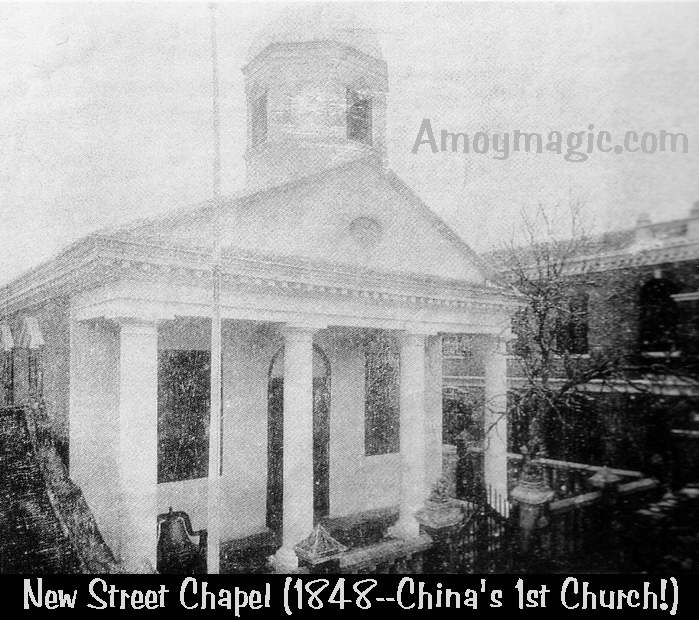
Back to Top
Amoy Mission Main Page
THE FIRST CHURCH OF
AMOY.
First pastor, Rev. Lo Tau, 1863-'70; second pastor, Rev. Chhoa Thian-Khit,
1871-'83; third pastor, Rev. Ng Ho-seng, 1885.
In January, 1844, two rooms were rented in the city of Amoy,
one being used as a chapel for regular preaching services, and the other
as a dispensary, in the charge of Dr. Cummings,
and in both these places the natives were taught both by minister and
physician the way of eternal life. The people were eager to listen to
the "good news," and so at the first service a congregation
of seventy "met to worship the true God." The size of the audiences
never diminished. butt frequently they numbered two hundred eager listeners.
On March 21st, 1844, a Bible class of twelve scholars was organized, and
maintained with increased interest and blessing.
On December 16th, 1845, a special meeting for women was instituted, and
has been maintained till this day with unabated zeal by the ladies of
our mission.
In December, 1845, the growing congregation moved out of their small room
into a more commodious and newly rented chapel.
On the 5th of January, 1846, the first Chinese monthly concert was held,
consisting of a morning and evening session. The morning was devoted to
prayer and the afternoon to discussing matters pertaining to methods and
plans of work and missionary news in general.
It was a Union Service of all Protestant missionaries: Reformed, English
Presbyterian and London Mission, and all the native converts connected
with these societies.
The concert is still maintained once a month. And it is a blessed bond
of union that we trust will never be broken. It. has bound us one in spirit,
if not one in name, as we have endeavored to preach the Word, and sought
to bring the knowledge of its everlasting fullness to the people committed
to our charge.
Back to Top
Amoy Mission Main Page
THE FIRST CONVERTS.
Four years thus rolled by whilst the harvesters had gone forth to scatter
the seed, patiently waiting the first signs of reaping. Dr. Abeel
passed away before he could thrust in his sickle to gather in the sheaves,
but on the first Sabbath of April (5th inst.), 1846, Mr. Pohlman
had both the honor and the pleasure of baptizing and receiving into full
communion the first converts of the Gospel at Amoy.
A letter received by the A. B. C. F. M. from Mr. Pohlman
regarding these aged converts will prove of interest. The name of one
was Hok Kui-peh, and the other Un Sia-peh, both over fifty years of age.
"Hok Kui-peh is a native of Lam-an, about twenty-five miles from
Amoy, and came to this city at the age of
seventeen. His first employment was that of a mill grinder, at twenty-five
cents a month and food. At the age of twenty-two he enlisted as a soldier,
and now bears the scars received in the battle fought with the pirates.
When nearly fifty, he opened a shop for the manufacture and sale of idol
paper. After the first missionaries, Messrs. Abeel
and Boone, had been at Kolongsu about six months, he was brought to the
preaching service by a friend, and was at once impressed with the reasonableness
of the truth and the utter folly of idolatry. For three years and a half
he has been a steady attendant on the means of grace and a diligent seeker
of salvation. The change in him has been gradual, but marked. His employment
causing him great uneasiness, he abandoned it.
"Un Sia-peh is a native of Tong-an, ten miles from Amoy,
and he came to this city about seven years ago to take the store of his
brother, who had died. He was brought to our chapel by Hok Kui-peh more
than two years ago, and has ever since continued a diligent and devout
hearer of the Gospel.
"At the public examination, these old men referred to Mr. Abeel
as the person from whom they first heard the tidings of great joy. The
idols in the house of Kui-peh all belonged to members of his family, and
he insisted on their removal from the public hall, in which they have
been many years. This, after a long struggle, was done. The only idol
in the house of Un Sia-peh has been formally given to me, and is now in
my possession."
"Amoy, May 1st, 1846."
Back to Top
Amoy Mission Main Page
THE FIRST CHURCH BUILDING.
Three more years passed by, and though the accessions to the Christian
religion were exceedingly few, yet the brethren felt their labor in the
Lord was not in vain.
They had been holding services in rented quarters, and the missionaries
concluded that a home dedicated to God would not only be more appropriate,
but an advantage for the promulgation of the Gospel, "and a valuable
assistant in the prosecution of their labors."
Through Hok Kui-peh, the first convert, a piece of property, with four
small buildings, was secured on September 16th, 1847. One of the buildings
was temporarily fitted up for a chapel and occupied until 1848, when,
through the solicitations of Mr. Pohlman,
$3,000 having been secured, the work on the new and First Church building
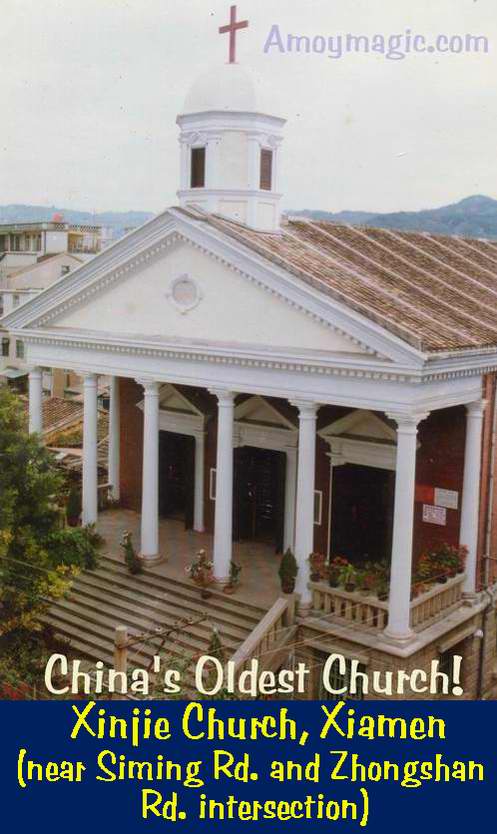
was begun. The building was dedicated February 11th, 1849. The church
is located in the eastern part of the city on New Street, i. e., Sin-Koe-a.
It is usually spoken of as the Sin-Koe-a Church, and so reported in the
Synodical Report of the Amoy Churches. The
dimensions are: Height of ceiling, 19 feet and 3 inches; to top of tower,
50 feet; length: 60 feet; width, 37 feet, and portico, 10 feet. It is
built of brick and after the "Etruscan style of architecture."
The front is stucco work of pure white, and on an oval slab, from the
quarry of Canton, above the front entablature, there is an inscription
in Chinese characters which reads as follows: "A Temple for the Worship
of the True God, the Great Sovereign Ruler." On each side of the
inscription are inscribed other Chinese characters meaning: "The
One Thousand, Eight Hundred and Forty-eighth Year of Jesus' Advent, and
To-Kong the Twenty-eighth Year," and underneath all the figures "1848."
The interior is arranged after the fashion of a Quaker meeting-house,
i. e., a screen separating the men from the women. And everything is as
plain as those places of worship-no cushioned seats, no carpeted floors,
no stained glass windows. In a majority of cases simply benches with no
backs adorn the churches in the Amoy region.
Tile floors always. Back of the church is a building, height 26 feet,
length 40, width 14. The upper part was used as a parsonage until 1892,
and the lower part as a consistory room. A new parsonage was provided
in 1892.
In the erection of this building the Reformed 'Church had the privilege
of establishing the first Protestant church building in the Chinese Empire,
as it had two centuries before of establishing the first church organization
in New York (then called New Amsterdam) in 1628.
The first children of native converts were baptized by Mr. Doty
on May 19th, 1850. At this time he baptized his own son and three children
of native Christians.
Back to Top
Amoy Mission Main Page
THE
FIRST EVANGELIST AND MARTYR.
The first native evangelist employed by the Mission was Mr. U Teng-ang.
He was a native of the Kwang-tung (Canton) Province, and in 1841 went
to Siam, where he came into the employment of a missionary and thus learned
to love and serve the Lord Jesus.
He returned to China in 1S46, and in August of that year arrived at Amoy,
becoming connected with the Mission in March, 1847. He was a faithful
and zealous servant, and useful in conversing with inquirers, holding
meetings and touring in the country. In May, 1853, he went to Chiang-chiu
in company with a colporteur to see about opening a new station there.
It was during the period of the Tai-peng rebellion, when the insurgents
had captured the city. The people of Chiang-Chiu suspected that these
two were spies of the enemy, and the authorities commanded their arrest.
The colporteur escaped, but Mr. U Teng-ang was seized and beheaded, May,
1853. A letter from Mr. Doty at this time speaks
of this sad affair in these words: "From all we can learn, it appears
that our friend fell a sacrifice to the violence of an aroused and suspicious
populace, who were beyond the control of both reason and law. The evangelist
had mingled with the spectators at the examination of several mandarins,
who had been taken by the insurgents at the capture of the place. A mandarin
of low rank happened to be questioned by the acting insurgent chief, who
could only speak the local dialect, while the mandarin under examination
could only communicate through the court language, not understanding the
local. The evangelist was standing near, and, seeing the difficulty, voluntarily
spoke out as an interpreter between the parties. Upon this, the insurgent
chief, in some polite manner, expressed to the evangelist his approbation
and acknowledgment. It is also reported that the evangelist interested
himself in behalf of two or three small mandarins, and prevailed with
the insurgent to spare their lives.
"Next day the populace arose and recaptured the city. Every stranger
in and about the place became an object of popular suspicion. The part
which the evangelist had acted was construed into evidence that he must
have an intimacy with the insurgent chief, and was himself one of the
rebels. Hence he was seized and brought before the acting magistrate.
This person, for aught we know, may have owed his life to the interference
of the evangelist. Be this as it may, the magistrate was convinced of
his innocence and wished to set him at liberty. But the mob had the ascendancy.
Death to the evangelist had been determined upon; they at once executed
their purpose."
Back to Top
Amoy Mission Main Page
The First Church of Amoy
was fully organized in 1856 "by the setting apart of elders and deacons."
The first pastor, Rev. Lo-Tau, was installed March 29th, 1863, and received
a salary of twelve dollars per month (this is the maximum sum paid the
pastors of to-day). He was. a faithful and devoted minister of the Gospel,
and passed to his reward in the Kingdom above in the year of our Lord
1870.
The progress of this church has not been what might have been hoped for.
After a period of nearly forty years from its organization, its present
membership only numbers seventy. This, to say the least, is disappointing
and discouraging. Yet, there remains the comforting fact that from this
sanctuary for two score years the invitation has been extended to these
poor perishing ones in Amoy city to come to
Jesus and be saved. Moreover, the seed has been scattered, and, though
the sowers knew it not, may have sprung up to fruitful harvest. Such labor
is not in vain, and the Lord of the harvest knows when it is best to show
the results of this blessed work done by this old historic church in the
Kingdom of China. Maybe it will be one of the brightest gems.
The second pastor was the Rev. Chhoa Thian-Khit. He was installed in 1871,
and served the church twelve years, when he accepted the call to Chiang-Chiu.
Rev. Ng Ho-Seng was installed in 1885, and still continues in the pastorate
(1892).
Rang-thau and O-pi, before the church organization of O-Kang, were out-stations
of this
church.
The first and second churches, since 1890, have supported a mission and
native evangelist at Chhan-chhu-oa, on the Island of Amoy.
Back to Top
Amoy Mission Main Page
THE SECOND CHURCH
OF AMOY. [Today, we call it the Bamboo Church]
First pastor, Rev. Iap Han-chiong, 1863-'83; second pastor, Rev. Ti Peng-teng,
1884. 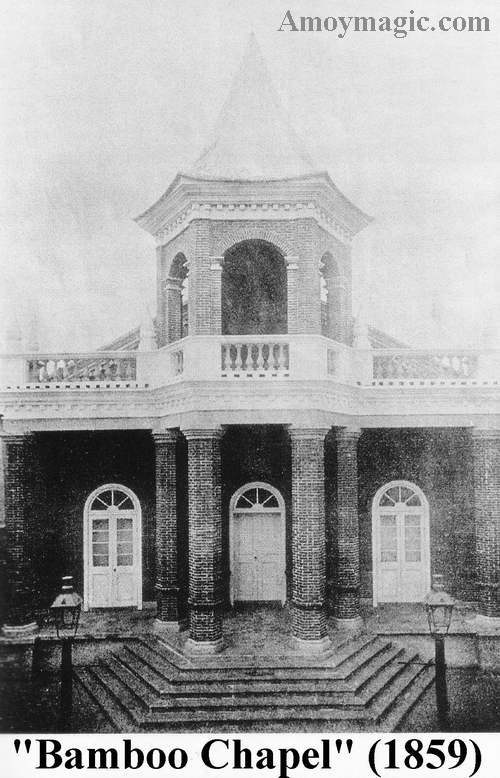
Dr. Talmage arrived in Amoy,
on his return from America, July 16th, 1850. On December 22d following
he preached his first regular sermon at the opening of a. new place of
worship in rooms connected with his own house at Tek Chhiu-Kha, Amoy¡ªthe
site of the present Second Church's building.
The room was crowded with curious, if not eager, listeners, and the average
attendance ranged thereafter from 100, 150 to 200. Thus was inaugurated
an enterprise under most favorable circumstances that resulted in the
organization of the Second Church of Amoy
at Tek-Chbiu-Kha, i.e., "Foot of the Bamboo Tree," in A. D.
1860. It is called in the synodical Report of the Amoy
Churches "The Tek-Chhiu Kha Church."
The church has been more prosperous than the First, or Sinkoe-a Church.
This may in a measure be accounted for by the fact that it is in close
proximity to the English Presbyterian Hospital, located at the same place,
and thus was brought into greater prominence. But there has been, as well,
a more consecrated and spiritual life manifested amongst her members.
The present church building was constructed in 1859, and dedicated October
30th of that year. It is entirely surrounded by other Chinese shops and
houses, and so almost entirely hidden from view¡ªmaking it impossible to
be photographed. Both of these churches (like all the country churches)
have day schools for the instruction of the children of the church and
for all the heathen children who may choose to come. The two churches
together have organized a Dorcas Society, which has contributed as much
as $60 cash in one year for benevolent purposes, and distributed numerous
garments for the 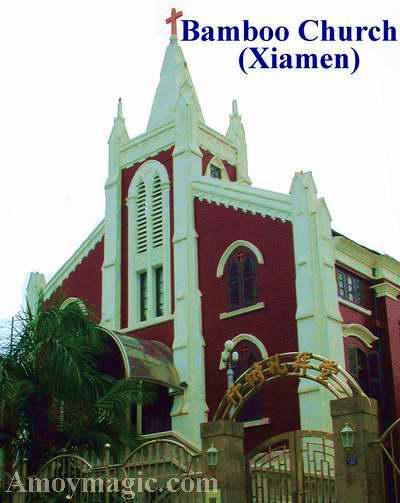 poor.
poor.
The first pastor, Rev. Iap Han-chiong, was ordained and installed on the
same day, March 29th, 1863, as Rev. Lo Taw was over the First Church.
He served the church with great acceptance for twenty years, when he received
and accepted the call to the new organization at Sio-Khe, 1884. The second
pastor, Rev. Ti Peng-teng, was called from the Chiang-Chiu Church and
installed in 1884.
Tong-an, Te-Soa and Aug-tung-thau, before they
became separate church organizations, were out-stations of this church.
The present membership of the Second Church is 135.
Back to Top
Amoy Mission Main Page
CHIOH-BE CHURCH.
First pastor, Rev. Tiong Lu-li, 1872-'82; second pastor, Rev. Lim Khiok,
1886.
The Gospel message was brought to this place by Christians from Peh-chui-a
in 1854. They had gone to Chioh-be to do some business, and when that
was accomplished, they occupied a few moments in telling the people of
Chioh-be about the wonderful message they had already received and believed.
The missionaries and native Christians of Amoy
followed this up with as frequent visits as possible. Even sooner than
they had faith to expect, the first harvest of twenty or more converts
was gathered in 1855. In 1859 the organization of the church occurred,
being set off from the First Church of Amoy.
On February 13th, 1872, the first pastor, Rev. Tiong Lu-li, was ordained
and installed.
The history of the church has been one of almost ceaseless struggling.
It met with violent opposition from the first, both from the officials
and the people, who did all in their power to banish it from their midst.
For some reason, a wonderful change had taken place in the minds and feelings
of the officials and the people toward Christianity and missionaries.
Certainly this was not the animus displayed when the missionaries first
arrived in 1842. Then officials and people strove to win the favor of
the ambassadors of Christ, and, it would seem, to establish His cause
in their midst as well. Yet, a dozen years after (1854), we have to witness
this bitterness and hatred, breaking out in violent persecution.
Was it the Tai-peng rebellion (inaugurated by a religious fanatic and
a supposed Christian convert, who assumed the title of Emperor by the
designation of "Grand Pacificator," whose dogs of war had already
been let loose against the gates of the city of Chiang-Chiu, and whose
object was to sweep away with one mad stroke the idols and temples of
the nation, as well as the Dragon Throne itself,) that aroused all this
bitterness and hatred against Christianity? Perhaps it was. We know no
other reason. And for fourteen years the "test of loyalty to the
throne" was manifested by "trampling on the cross," and
by their efforts to stamp out the little church already established. But
the church at Chioh-be suffered internally as well as externally. The
members became spiritually dead. Stroke after stroke fell, adverse fortune
followed hard and sharp in the track of severe persecution, until there
was but a flicker left of the flame. And when the pastor fell into grievous
sin by the use of spirituous liquors, and for which he was deposed by
Tai-Hoey in 1882, it seemed that the flame must cease burning longer.
In 1886 a new pastor, Rev. Lim Khioh, was called to take charge. He was
young, intelligent, commanding respect, earnest, and with zeal according
to knowledge. Under his administration a new order of things has taken
place. They have awakened to new life and new activity.
Back to Top
Amoy Mission Main Page
That flame, nearly quenched, no longer flickers but is burning brighter
than ever in the history of the church. Thank God, the church has passed
through the fires. And may it be like the refiner's fire, cleansing her
from all the dross, leaving only the purified gold. This church had for
a number of years an out-station at An-liau, but persecution banished
that.
To-day they have an out-station at Hai-teng, and history is repeating
itself there in the effort the Church is making to get a foothold. The
rent for the rooms at Hai-teng has been supplied for two years by the
King's Daughters of the Second Church of Poughkeepsie, N. Y.
The present membership of the Chioh-be Church is 71. That shows its history.
After thirty-five years of toiling, and such results. Enough to discourage
any worker. Over the tumult and above the raging storms we hear the voice
of Him who is mighty to save saying: "Not by might nor by power,
but by My spirit," in His own good time.
O-KANG CHURCH.
First pastor, Rev. Li Ki-che, 1889.
This church is composed of two congregations, viz.: one at Kang-thau and
the other at O-pi (more commonly called Kio-thau). The missionaries and
the native Christians began early to sow the seed in these fields, and
in 1863 rooms were rented in Kang-thau, when it became a regular appointed
out-station of the First Church, Amoy. O-pi
followed in 1865.
In 1868 the organization into a regular church occurred, with thirty members,
two elders and one deacon, and put under the care of native helpers, among
whom were Mr. Ong Ki Siong, present pastor of the new church organization
west of Sio-Khe, and Mr. Li Ki-che, present pastor of the O-Kang Church.
About 1887, after repeated delays and vexing negotiations, a piece of
land was secured at Kang-thau, close by the sea, upon which was built
the first chapel (previous to this, as we still do at O-pi, we rented
a house for public services[a new chapel is to be built in 1893]). Dr.
Talmage spent much of his time there, and
not a little of his finances toward the building of this church and chapel.
The ground and building cost $665. The native church provided $316, Dr.
Talmage and the other missionaries the balance.
Rev. Li Ki-che, the first pastor, was ordained and installed in 1889,
and ever since has preached the Word boldly and with power, and, we believe,
with blessing.
Back to Top
Amoy Mission Main Page
Cottage prayer meetings and seed-sowing amongst the neighboring villages
have been carried on constantly by pastor and people. There has been much
weeping and many sore hearts on account of persistent rejection and stolid
indifference to the Word of Life. Yet their trust is in Him who hath promised:
"They that sow in tears shall reap in joy." The time is not
yet, but we patiently wait His own good time.
The present membership is 103.
HONG-SAN CHURCH.
First pastor, Rev. Tu Ho-sui.
This church also has two separate congregations, one at Te-soa and the
other at Ang-tung-thau. The origin of this organization is given in the
following narrative:
Thirty-five or forty years ago a poor widow, Mrs. Lee, residing at Te-soa,
who had been robbed of all her husband's possessions by his relatives
and friends, save the house in which she lived, was compelled to go down
to the city of Amoy every day to peddle cloth
and notions in order to gain a living for herself and family of small
children.
One day as she was passing through the narrow thoroughfare she met an
acquaintance, who invited her to go with her and hear the foreigner preach
the "to-li" (doctrine). So on they went together until they
came to a place where a small crowd was collected about an open door.
Immediately her attention was arrested by the wonderful message brought
to her hearing: "God so loved the world that He gave His only begotten
Son, that whosoever believeth in Him should not perish, but have everlasting
life." Oh! that was just what she was looking for: love. No one loved
her. Her friends had robbed her, and her portion had been only hatred
and abuse. But here was One who loved indeed. Ah, it was a too wonderful
message¡ªtoo marvelous for this poor soul, so buried in ignorance, to understand
all at once. Nor is it to be wondered at. Think of the thousands of generations
that have passed away, and they (this nation) dwelling in total darkness.
In addition to the darkness that surrounds their very souls, think of
the difficulty we have in conveying the message of the cross through the
medium of the Chinese language--a language than which in the whole world
there is none other so different from all others; "none other acquired
with so much difficulty by foreigners, or employed by them with so little
facility."
Whether it be supposition or fact that Satan was the author of the Chinese
language or not, it is nevertheless true that there is no other nation
that has been so long and so completely under his sway as China. The language
has been one of the highest and strongest walls that has surrounded this
nation. Until a little more than a half century ago, so-called natural
religion and earth-born systems and false philosophies have had full sway.
This could not have occurred had there been more affinity between the
Chinese and the languages of Christendom. Now try to convey your ideas
of a Saviour¡ªor the doctrines of the Bible--and you are met at the very
threshold of your undertaking with the barrier of an unknown tongue. In
translation, the task is no less difficult.
Back to Top
Amoy Mission Main Page
The processes employed in other translations must be abandoned here. Words
cannot be transferred nor new ones coined. "Here the translator must
seize fast hold of the sense of the original, and then, casting into oblivion
the old custom, strive to express the same sense in the Chinese characters."
Then the message is so new¡ªso out of their way of thinking. Of a Saviour,
of remission of sins by blood, of redemption through a crucified Christ¡ªthey
have not the remotest idea. Begin to tell them this wonderful story and
you receive at first stares and irresponsive hearts. They cannot comprehend
it. It goes in one ear and out of the other.
It demonstrates how we have to preach Jesus, and Him crucified, to such
a people, i. e., like to little children. Once will not do, but time and
time again is required before they can take it in. It demonstrates, too,
why so few come to understand it. They hear it once, go to their homes,
and because the laborers are so few, with no one to teach them, they never
come to a knowledge of full salvation in Christ Jesus. No other result
can be expected when the Church places twenty missionaries in the midst
of 3,000,000 souls. That is 150,000 souls to one missionary. Think of
it. With this little diversion, we now turn to the story.
So, this soul, longing for that love that passeth understanding, for that
peace that floweth like a river, for that comfort that quieteth the heart,
wended her way homeward, conscious only of some sweet music, as that ever
old yet ever new song was borne and swept along through the darkened chambers
of her soul: God so loved the world that He gave His Only begotten Son.
Another day, a short time after this, we find her again sitting at the
feet of dear, now sainted, Dr. 'Ialmage, learning the story of the cross,
as he unfolded it, in all its simplicity and beauty. From him she learned
the meaning of that message more fully, and so learned until the time
came that she committed her soul and life into the keeping of her Blessed
Saviour. "Ihus her life, her Christian experience, ever flowed on
peacefully and quietly like a great deep river.
Indeed, it was a beautiful life. We can see her now, at eighty years of
age, a dear old mother in Israel. How glad she was, what a cordial welcome
she gave us, when we missionaries visited the little church at Te-Soa,
which she loved, and where she loved to meet with God's children and worship
Him. She was the first convert to Christianity in Te-Soa. She it was who
first invited the missionaries to come there and tell of the love of the
wonderful Saviour, whom she already learned to love and follow. To her,
we may say, we owe the Hong-San Church, and whose future prosperity and
welfare was her deepest concern. God blessed her life, crowned her with
His loving favor, granted her long years, permitted her to see the walls
of her Zion strengthened¡ªand all her children and many of her grandchildren
and neighbors gathered into the fold. No disease had carried her away.
She was just tired out, and she laid down and slept in the arms of Jesus.
A calm and peaceful end of a sweet and gentle life.
Such was the origin of the church of Hong-San. Had all the other souls
in Te-Soa and Ang-tung-thau been as anxiously concerned about their salvation
as Mrs. Lee a larger membership would be recorded than is now afforded.
Planted in the midst of rankest idolatry, every effort was made by the
people to choke rather than to encourage the Word that was being sown
in their midst. Thank God the church is planted upon the solid rock,¡ªand
she can never be moved. And the Word shall accomplish that which He pleaseth.
Te-Soa became a regularly appointed out-station of the Second Church of
Amoy, in 1862, and the present chapel built
in 1874.
Back to Top
Amoy Mission Main Page
Ang-tung-thau became an ont-station in 1865, and its present chapel erected
in 1867, the congregation bearing one-third of its cost.
The church organization occurred on November 27th, 1870.
The present pastor, and the first to be installed over this church, the
Rev. Iu Ho-Sui, was ordained and installed in 1889.
There is one out-station connected with the church, viz.: Te-thau.
The present membership is 59.
CHIANG-CHIU CHURCH.
[Aka Zhangzhou Church]
First pastor, Rev. Ti Peng-teng, 1882-'84; second pastor, Rev. Chhoa Thian-Khit,
1884.
The Chiang-Chiu Church is located in
the city of Chiang-Chiu, an important
centre of a large district, equal in size to Schoharie County, N. Y. With
a population of its own of 200,000, and with five towns and 200 villages
with an estimated population of 100,000, lying within easy distance to
the city, and at the same time being one of the chief commercial ports
(native) of this whole territory, and also a seat of learning where the
annual examinations occur, bringing thousands of students within its limit,
makes it one of the most strategic and commanding centres that any mission
might well congratulate itself in being able to occupy.
Yet, we have been slow in occupying it as we should. True, we have a church
there, but we should also have a missionary and his family there to superintend
this vast field of usefulness. The London Missionary Society has been
less slow in comprehending the situation. They have put a large double
house on some land they bought five years ago (1888), and have located
there a missionary and his family, and a doctor and his family. Our work
is neglected, and has been neglected for twenty years.
Permanent work was begun here under the supervision of Rev. Wm. C. Burns,
of the English Presbyterian Mission, in 1853. Preparations were being
made at this early date to occupy a place in the city as a regular preaching
place, and the native evangelist, Mr. U. Ten-ang, had been sent there
with a colporteur for that purpose. The results of that undertaking have
already been recorded in a former chapter.
Midst wars and rumors of wars, both the Reformed (Dutch) Church Mission
and the E. P. Mission jointly continued the work in the city. In 1863
it was made an out-station of the Chioh-be Church.
Early in the '60s the hottest fires of the dire "rebellion"
came sweeping up against the city with all its fierceness and fury. The
city was again captured, and a terrible massacre nearly wiped out the
little congregation and left the greater part of the city in ruins. In
1865 the work was committed entirely to our care, and from the ashes of
this severe persecution we may say the present church has risen. In 1868
lots were purchased and a building contemplated. Three years after, in
1871, the church organization occurred, being set off from Chioh-be. A
small chapel was then erected and public worship begun in it. In 1874
the present commodious church was erected. The old chapel was converted
into a schoolhouse. The first pastor, Rev. Ti Peng-teng (licensed in 1873),
was ordained and installed in June, 1882. The second pastor, Rev. Chhoa
Thian-Khit, called from the First Church of Amoy,
was installed in 1884. There is one out-station at the present time connected
with this church, viz.: Chhoa-poa. Before the Thian-San Church was organized,
the congregation at Thian-po and Soa-sia were members of this church,
and these places out-stations. The present membership is 98. Thian-San
took sixty or seventy of her members.
Back to Top
Amoy Mission Main Page
TONG-AN CHURCH.
First pastor, Lim Chi-Seng, 1890.
Tong-an is another centre of a wide and fertile valley. Standing on a
hill near the city, as far as the eye can reach in almost every direction,
village after village may be seen, with their teeming population. There
is no foreign missionary residing here. There should be one.
Rev. Wm. C. Burns, in his indefatigable zeal
to preach the Gospel in every nook and corner of this territory, it would
seem, pushed on until his feet stood within this city too, and thence
proclaimed the Gospel message (1853).
In the year 1866 our Mission began negotiating for a room or two, in which
they wished to hold public services for the worship of the true God. In
the following year a house was rented, and Tong-an became an out-station
of the Second Church of Amoy. The first converts
were baptized by Rev. Iap Han-Chiong in 1870.
In 1871 larger quarters were secured and a. church organization was formed
with thirty-four members. In 1887 the church succeeded in buying the property
they had been renting for six years. In 1891, with some funds that a servant
in Dr. Kip's family in America had willed to
be used for such purpose in Amoy, a new and
large church was erected.
The first pastor, Rev. Lim Chi-seng, was ordained and installed in 1890.
There are two out-stations connected with the church, viz.: Poa-thau-chhi
and Ko-Soa. The present membership is 99.
Outside the city of Amoy probably there was
no new enterprise but what met with bitter opposition. The same spirit
was manifested at Tong-an as elsewhere. Once they set the old chapel on
fire, but it was discovered and extinguished before much damage was done.
And our presence has been more or less resented ever since. It is not
the first time that the Ark of the Lord has awakened opposition amongst
His enemies. And as in the days of old, so will the day come when Dagon
shall fall, and all this opposition shall forever cease, not only in Tong-an,
but in the whole of China.
Back to Top
Amoy Mission Main Page
SIO-KHE CHURCH.
First pastor, Iap Han-chiong, 1884.
Sio-Khe church is located on a branch of the West River, in a little market
town or village of Sio-Khe. It has only some seven or eight thousand inhabitants,
but it is the largest town of a populous valley twelve miles long and
three to four miles wide. It is a beautiful plain, lying at the foot of
high mountains, thickly populated and well cultivated. The people are
all industrious and quiet, and apparently to-day well disposed toward
the Gospel. There are more than 360 villages scattered throughout the
plain, bringing the church in touch with thousands of souls. Twenty-five
years ago two men came from Chha-thau-po, some ten miles east of Sio-Khe,
down to the Amoy hospital for treatment. While
there they for the first time heard the Gospel and believed, and on their
return home decided to give up the worship of idols and to worship the
true God. Not only so, but they began telling others the "good news,"
and soon they had a little company of believers. These two men told all
they could remember of what they had heard in Amoy,
when they sent to Chiang-Chiu for some one to come and teach them further.
Among others who responded to the call was Dr. Kip,
who found there ten persons who had renounced idolatry and were worshipping
God, the best they knew how. Soon after a small building was rented, and
the place became an out-station of Chiang-Chiu. Alas, the little company
could not withstand the severe trials and persecutions that were visited
upon them, and all that remains of this enterprise is the deserted house,
where the little body of Christians were wont to worship. And yet it was
not all in vain. While the Gospel was being preached in Chha-thau-po,
some strangers from Sio-Khe were listening. They in turn became converted
and believers, and then they desired that the people in Sio-Khe should
hear the good news too. But the people of Sio-Khe said they did not wish
to hear, and if they attempted to preach they would be driven out. Finally
they said: "Let us try; let us go and preach, and see if they will
stone us." They secured a small room and preached the whole day unmolested,
and the place soon after came under the charge of the Chiang-Chiu Church.
Such was the introduction of the work at Sio-Khe, whose usefulness and
success has ever been assured.
In 1876-'77 the first small chapel was built and occupied seventeen or
eighteen years for regular preaching and other religions services. In
1881 the church organization occurred with seventy members. The present
and first pastor, Rev. Iap Han Chiong, was called from the Second Church
of Amoy and installed in 1884. The present
large church was built in 1884-'85, the money for it being largely contributed
by the Sunday-schools of America. At the same time a house for the pastor
was built next to the church. In 1886-¡¯87 a missionary's residence was
built adjoining the church property. Dr. and Mrs. Kip
were the first to occupy it permanently.
In 1888-'89 Dr. Otte's house and hospital were built, when he and Mrs.
Otte also took up their quarters there, and thus by the introduction of
medicine, the field was better equipped for greater usefulness. Upon Dr.
and Mrs. Kip's return to America, Mr. and Mrs.
Van Dyck occupied the missionary's house for about two years. And when
they returned to America, Mr. and Mrs. Fagg took up their habitation there.
Subsequently Mr. Fagg took charge of the work in the theological seminary,
when Dr. and Mrs. Kip again moved in. Miss Nellie
Zwemer joined the forces at Sio-Khe in 1892, and is living with Dr. and
Mrs. Otte. She, with Mrs. Kip, have charge of
the girls' school there, and together visit the women of that region.
In 1891 (end) the Sio-Khe Church had a membership of 240, and with a glorious
history back of her and a bright future before her, what more can be asked
than God's continued favor.
There are six out-stations, viz.: Lam-sin, Poa-a, Toa-Khe, Soa-pi, E-che,
and Toa-Io-teng, and Ko-Khi.
Back to Top
Amoy Mission Main Page
THlAN--SAN CHURCH.
First pastor, Tiong Lu-li, 1891.
Thian-po and Soa-sia were out-stations of Chiang-Chiu from 1876-'91. The
Thian-san Church was organized iu 1891, and has one out-station, viz.:
Leng-Soa. A new chapel and pastor's house was built with the remaining
money of the legacy that that servant woman bequeathed to the Mission
(the other portion, as already stated, being used to build the church
at Tong-an).
The first pastor, Tiong Lu-li, formerly pastor at Chioh-be, was installed
in 1891. A complete change had taken place during the twenty years. He
had been thoroughly humbled, and has ever since manifested a truly humble
and consecrated life. And the Church rejoices that he could be welcomed
back to his holy office. The future of the young enterprise is bright;
her history is yet to be written. The present membership is 73.
UNORDAINED EVANGELISTS
AND OTHERS.
Connected with this organized work, reviewed in the foregoing pages, the
names of the helpers, teachers and Bible women should be enrolled. Their
labors are confined for the most part to the out-stations and the outlying
regions. Some .of them are school-teachers of the parochial schools.
Li Seng-Hong, Tan Thong-lo, Si Kui-lo, Tan Oan-lai, Kho Bok, Tan 'I'ui-goan,
Ong Ki-Siong, Tan O-ti, Tan Nui-lo, Ang Chioh, U Pek-Io, Ang Thun, Khng
Khoan-ju, Ang Ek, Li Biau-Io, Li Chhun-hiong, Lo Kan-chek, Iu Iok-han,
Keh Tong-eng, Lim Put-chai, Keh Thai-Chhong, Chhoa Bian-Seng, Te Chhin-lo,
Kho Lin-bin, Lim Kui-Io, Keh Un-tian, Lim Po-tek, Keh Boah-chui, Li Siong-Chhi,
Iu Sui-Kiu, Ng Ma-hui, Iu Iok-lai,
BIBLE WOMEN.
Mrs. Kho [wife of evangelist], Mrs. Iu Siu-a, Mrs. Iu Giok-tong, Mrs.
Tan [wife of evangelist]
TABLE SHOWING COMPARATIVE INCREASE IN THE WORK, UNDER THE PATRONAGE
OF THE REFORMED (DUTCH) CHURCH.
A.D. A.D. A.D. A.D.
1857. 1864. 1879. 1890
Churches 1 3 7 9
Out-stations 1 3 11 12
Communicants 172 348 686 968
Scholars 10 37 143 240
Contributions $930.87 $1,219.99 $3,382.08
Back
to Top Amoy
Mission Main Page
CHAPTER XII. THE BENEVOLENCE OF THE AMOY
CHURCHES.
Not only for its wonderful
growth, not only for its marked spirituality and solid orthodoxy, has
the history of the Amoy Church, i. e., the
Church of Christ in China, been a remarkable one, but also on account
of its consecrated spirit of liberality.
To pause for a moment to consider the amount of money contributed by these
native Christians for the past ten years¡ªless than one thousand Christians
giving $23,702.94¡ªis a sufficient proof that these are no empty words,
but most profoundly teaching that they have in some measure received the
sublime inspiration of the gentle command of their Lord and Master: "Freely
ye have received, freely give."
If you will turn to General Synod Report of 1892 you will see that the
Christians connected with our Amoy churches
contributed during the year 1891 the sum of $3,382.08. As 968 members
gave this sum, it amounts to very nearly $3.50 per capita.
At first sight, that may not seem very startling. But one or two things
must be understood before we can appreciate those figures.
First of all, a Chinaman's estimate of a dollar is about ten times as
high as ours, simply because it is ten times as difficult for him to make
a dollar. So, really it stands for $35. And this fact we will endeavor
to demonstrate. The medium of exchange in China, i. e., the national currency,
is a copper "cash" (the only coin the Government issues), equal
in our currency to one mill. This is the coin for which they toil¡ªthis
their medium for buying and selling.
When I tell you that a good mechanic, a carpenter, or mason, earns only
three hundred of them a day, and many classes of laborers earn no more
than one hundred (i. e., thirty and ten cents respectively), and that
it requires 1,040 of them to make a Mexican dollar (i. e., about 1,200
to make an American dollar), and that it requires thirty-six hundred of
them to make $350, you may be able to get some idea what it means when
they contribute this amount. Three dollars and a half does neither represent
the sum or the sacrifices made to accumulate it. Compared with our own
country, the struggle for existence and the maintenance of a bare subsistence
is tenfold intensified, and the accumulation of fortunes well nigh impossible.
Compare these daily wages with the daily wages of the mechanic, the carpenter
and the common laborer of this country (and the income of the wealthy
as well), viz.: $3 and $1.50 per diem, and can anyone say that it is an
exaggeration to place this sum per capita at $35?
The labor markets and all avenues of business are crammed and jammed because
there are no outlets provided for the mighty army of strugglers. Not because
there are no avenues. Natural resources abound in this "flowery land."
Coal mines, silver mines, and even gold mines, lie buried and untouched.
But just on account of that antiquated superstition of an old dragon that
is slumbering underneath the soil, whose majestic silence must not be
disturbed, they everywhere remain hermetically sealed. Touch them with
pick or spade, and dire calamity would sweep over the land from the desert
to the sea¡ªso the everlasting grind goes on.
That¡¯s what it means¡ªall this apprehension, all this superstition, besides
a hundred other ills with which to combat. Taking our circumstances in
consideration, our advantages, our open avenues of industry, our supply
and demand, we venture to say that it is as easy for us to contribute
$35 per capita as it is for the Christians of Amoy
to contribute $3.50.
And so, in the second place, it follows at the lowest estimate, we have
ten dollars to use where they have one. Moreover, the Chinaman considers
spending one dollar of as much importance as we do spending ten. And where
we would hesitate in spending a cent, they wrangle and fuss over a cash
(one-tenth of a cent). So it is in all their monetary affairs, whether
it be a dollar or a cash, as daily intercourse with them bears painful
testimony.
Back to Top
Amoy Mission Main Page
Bearing in mind, then, some such relative estimations of money value,
do we overstate it when we say that the sacrifice is ten times more, and
the real amount ten times more than the figures show? Ah, but some one
says, that is all very well; but, excuse me, you have most grievously
failed to consider that the Chinese have not so many wants as we have;
he does not require the food, the homes, nor are the necessities such
as ours.
Very good. Shall we say that their wants, needs, etc., etc., are five
times less than ours? Oh! more than that. WeIl, then, let us maintain
the same comparison here as above, and we will say they are ten times
less in every count. But does this alter the situation? The Chinaman,
you say, has wants and needs, etc., etc.. be they what they may, ten times
less than yours. Still, you make a sad and fatal mistake if you do not
remember that they have ten times less capital to supply them. So, too,
we must remember that with needs ten times less than ours, and with ten
times less capital to supply them, somehow they manage to give $35 (equivalent)
per capita to the Lord.
Now. if the Chinamen have wants ten times less than ours, it must follow
that we have wants. needs, etc., etc., ten times in excess of theirs,
and having ten times as much capital to supply them, we should maintain
something like an equality in our benevolence. But the fact is, we do
not. For all purposes, foreign, domestic, ministers¡¯ salaries, etc., etc.,
we somehow manage to give barely $15 to the Lord per capita.
But this is no argument, for we have never yet become acquainted with or heard of a China-man whose wants, needs, etc., etc., .lid not com-pare favorably with ours. The fact is, that our old Edenic grandfather made us all alike. We all have wants like Babel towers, and our needs and necessities are sometimes aggravated by circumstances alone. Be that as it may, let me say to you that the Chinaman has needs and necessities that are never supplied, and never will be until he reaches the better land. Please remember this while you read these figures. That this giving of the Chinese is no spasmodic attack of benevolence, but the steady, healthy growth in their spiritual life, the following table amply testifies:
In 1882 759 Church Members
(net) gave $1,877.32
In 1883 758 ¡° ¡° ¡° $1,958.75
In 1884 742 ¡° ¡° ¡° $1,631.77
In 1885 783 ¡° ¡° ¡° $2,107.37
In 1886 804 ¡° ¡° ¡° $2,076.29
In 1887 835 ¡° ¡° ¡° $2,836.70
In 1888 861 ¡° ¡° ¡° $2,367.66
In 1889 855 ¡° ¡° ¡° $2,535.00
In 1890 899 ¡° ¡° ¡° $2,900.00
In 1891 968 ¡° ¡° ¡° $3,382.08
Net total..968 23,702.94
In 1892, 1,008 Church members gave $23,702.94
Yearly average, $2.80
Back to Top
Amoy Mission Main Page
THE NATIVE HAKKA MISSION. [See "Hakka
Roundhouses"; Note: the Hakka are not aborigines or minorities
but Han Chinese]
To further demonstrate the characters of the Chinese Christians, we bring
this part of the review to a close by a brief mention of their missionary
spirit. Having acquired a knowledge of the blessed Gospel themselves,
they are endeavoring to carry the "good news" to their brethren
still in darkness.
The Hakkas
are a race of people (perhaps aborigines) living by themselves and under
their own laws, some twenty miles west of Amoy,
speaking an entirely different dialect, and, on the whole, a different
race from the Chinese. In 1881 a committee was appointed to bring the
subject of establishing a mission amongst this people before Tai-hoey.
In 1882 $200 was subscribed by the native church for its support and the
work begun. The progress has been slow and often discouraging. In 1891
there was a church of eighteen souls; three had been received on confession,
two died, one excommunicated, one suspended, three adults baptized and
$17.10 contributed.
In one other way do the native Christians seek to make known the message
unto their brethren. Every Tuesday at Amoy
(and once a month in the country) a company of Christians and missionaries
(male and female) meets in one of the chapels, where they hold a short
service of prayer, then go out by twos or threes and preach in the streets.
The ladies visit the homes and tell the Gospel story there. This is called
the Po-to-hoe, which means, "The Proclamation of the Gospel Meeting."
Thus in these ways the Gospel is being made known. But there are other
ways which we must also consider.
Back to Top
Amoy Mission Main Page
CHAPTER
XIII. TWO NOTABLE POLITICAL EVENTS
The two political
movements alluded to in these pages, viz.: "The Tai-peng Rebellion"
and "The Anti-Missionary Movement in South China," inasmuch
as they both played a part in the history of religious events in the district
and city of Amoy, may well claim a special
though brief consideration in this narration.
THE TAI-PENG REBELLION.
The reign of Ham-hong, the seventh Emperor of the Manchu Dynasty (1850-'64).
Was established upon a crumbling and disintegrating Empire. The affairs
of the nation had reached a crisis. The old ship of state had been about
stranded by the preceding Emperor, To-Kong, and when Ham-kong took the
reins of government, the political affairs of the nation were in a greatly
unsettled condition.
His father had been most profuse in his promises of reformatory measures
for the good of his subjects, but they had failed to materialize. This
made the clamoring of the people still louder and still mere urgent upon
the advent of the new arid young Emperor. For thirty years the people
had been pleading for justice, and that cruel oppression and abuses might
cease. For thirty years they had pleaded in vain. So now at the very threshold
of the new order of events the voice of the people was heard in no uncertain
sound asking again for reform in order that the ship of state might not
become a total wreck.
At first the young Emperor professed to take a deep interest in these
demands, and, like his predecessor, promised much, and, like him, performed
little for the redress of the people. He soon lapsed into the ways of
his fathers. By surrounding himself with wives and concubines, and by
indulging in all forms of sensual pleasure and amusement, the nation's
welfare and the people's interest were furthest from his thoughts and
apparently soon entirely forgotten.
When the people saw their rights thus deliberately trampled in the dust,
and seeing at the same time no hope of realizing the needed reform from
that source from which they sought it, and had every reason to expect
it, their passions were wrought up, and to the highest tension.
Under such a condition of affairs it was not long before the spirit of
insurrection against the Government began to manifest itself, especially
in the Kwang-si Province. The spark was soon kindled into a flame, until
not only Kwang-si, but Hu-nan and Hu-peh were afire with the spirit of
rebellion. Now the cry was not only for reform, but the banishment of
the Tartar Emperor and the establishment of a purely Chinese Dynasty instead.
As a leader in this cause, one who claimed to be a descendant of the Mings
(the preceding Dynasty, 1367-1644), presented himself, and under the title
of Thian-te, "Heavenly Virtue," undertook to drive out the Tartar
and re-establish the Mings in power.
Such was the condition of the country when we make the acquaintance of
Hung Su-chuen, the leader of what has become the notable "Tai-peng
Rebellion (1850-'64). In view of the fore-going, it will be readily seen
that the time was ripe for such a conflict.
It is now necessary to demonstrate, if possible, how Hung Su-chuen became
identified with and the leader in this insurrection, the most marvelous
that has engaged the attention of men.
Hung Su-chuen had nothing to do with the movement in behalf of that reform
that was started by the people, and of which Thian-te assumed the leadership,
but on account of events that he was unable to control, he was obliged
to cast in his lot with the insurgents, and finally became the leader.
Hung Su-chuen was a native of the Kwang-tung Province, and at the time
of these events was about forty years old, having been born near Canton
in 1813. He was a literary graduate and a teacher by profession.
During one of his examination periods at Canton, portions of the Old Testament
and some Christian tracts fell under his notice. At the time, the contents
of these books made but little ifany impression upon him. In 1837, after
failing in an examination, he became despondent, which finally ended in
a serious siege of illness. While he was ill he had a most vivid dream,
which made such a deep impression upon his mind that he could not forget
it. In his dream he was caught up into Heaven and stood in the presence
of God and Jesus, "who exhorted him to live a virtuous life,"
and exterminate imps from the nation. He claimed to be washed from all
the impurities of his nature, and to be possessed of a new heart. He spoke
of God as "Heavenly Father," and of Jesus as "Heavenly,
or Celestial, Elder Brother."
Six years after this passed away, yet no change in his outward life is
apparent. He still pursues his literary course and performs the duties
of a village schoolmaster in the Province of Kwang-si. But in 1843 his
attention is once more directed, by a friend, to the books he had abandoned
and shelved some six or seven years before. In them he was led to believe
that he had found an interpretation to his dreams. Perceiving the fearful
denunciations thundered against all forms of idolatry, he concluded that
"the imps" referred to in his dream must be the idols of the
land.
He then embraced Christianity as he understood it. Some historians affirm
that he was baptized by the missionary Gutzlaff; say he and this "friend"
baptized each other and then began to propagate his system of religion,
"containing a modicum of Christian truth, together with many singular
misconceptions and vagaries of their imaginations."
Hung Su-chuen began his iconoclastic campaign by demolishing the tablet
of Confucius that was standing in the village school-room. Such an act
created a tremendous furor in the little hamlet where he was teacher.
Parents whose children were under his instruction became alarmed and greatly
excited; sought an explanation of such startling innovations. His reasons
were frankly given. and they proved so sufficient that they became his
ardent supporters and followers.
Then came the elders, or headmen, of the village with their remonstrances,
but they like-wise fell captive to his arguments and enlisted under his
banners. From village to village the new religion spread, until within
a very short period the number of converts had swelled to the marvelous
number of 5,000, and in 1851 the number had increased to 12,000.
Temples, idols and all forms of idolatry began to fall before the enthusiastic
host like grass before the mower. And when it seemed as though the ancient
system and customs of 5,000 years were to be swept away without a moment's
notice, the officials began to be alarmed and sought to put a stop to
this awful desecration. A price was set upon the head of Hung Su-chuen.
Dead or alive, the officials wanted him. True as steel were the people
to the leader, and rather than betray him to the authorities they would
die first. Failing in this, the provincial authorities of Kwang-si sent
the Imperial forces against the new sect to exterminate it. Even their
effort met with ignoble failure, for it resulted in the total destruction
of the provincial troops.
Back to Top
Amoy Mission Main Page
Up to this time it is fair to assume that Hung Su-chuen and his followers
had no other motive than the desire for freedom of worship, and to worship
according to the dictates of their conscience.
But now a crisis was at hand. Events that he could not control were changiug
the character of his movements. He had not only routed, but he had slain
the Imperial guardsmen, and now he assumed that the whole Government would
oppose him, and if he expected to succeed he must fortify himself behind
stronger barricades than were now in his possession. It was probably then
at this time he joined forces with the reformers and became the leader
of that greater movement, whose aim was to drive the Manchus from the
dragon throne. Be that as it may, he now, at any rate, assumed the name
of Tai-peng, "The Grand Pacificator," and proclaimed himself
the head of the new Dynasty-Tai-peng thian Kok, i. e., "The Peaceful
Heaveny Kingdom."
The Pretender was not popular, and under his leadership the cause made
no progress. But when Hung Su-chuen, endowed both with religious as well
as with political enthusiasm, became the commander-in-chief of the movement
another condition of affairs immediately occurred. He speedily won the
affection of all the enlisted troops, and so fired them with his enthusiasm
that victory perched upon their banners all along their way from Kwang-si
in the southwest to Keang-se in the northeast. Various secret societies
joined the movement until there was an army of about 50,000 enlisted men
in the field.
This army soon received the sobriqnet of "The Long-haired Rebels,"
because they cut off their cue (a token of subjection imposed upon the
Chinese by the Tartars), ceased to shave their heads and allowed their
hair to grow naturally.
The religious tone of the movement was still maintained. Worship of God
was observed in every encampment. The camps were made to resound with
religious hymns of praise. Frequently before engaging in battle the troops
would have a service of prayer. A proclamation was issued setting forth
their belief. Among the many documents issued during the period of this
notable movement it is difficult to say which are genuine and which are
apocryphal. The two inserted here, if not genuine, will give at least
some idea of the beliefs of "The Tai-peng" and his followers:
¡°According to the Old Testament, the Supreme Lord, our Heavenly Father,
created in the space of six days heaven and earth, mountains and seas,
men and things. The Supreme Lord is a spiritual, invisible, omnipotent
Father, knowing everything and everywhere present.
"There is not under Heaven any nation which does not know his power.
"On referring to the reminiscences of past times, we find that since
"the creation of the world the Supreme Lord has often manifested
His displeasure. How is it then that you people of the earth are ignorant
of Him still?
"On the first occasion, the Supreme Lord displayed his wrath by causing
a great rain to fall forty days and forty nights, which caused a universal
deluge.
"On a second occasion, the Supreme Lord manifested His displeasure
and brought Israel out of Egypt.
Back to Top
Amoy Mission Main Page
"On a third occasion He displayed His tremendous majesty when the
Saviour of the world, the Lord Jesus, became incarnate in the land of
Judea and suffered for the redemption of the human race. And of late again
showed His wrath when, in the year 1837, he sent a celestial messenger,
whom he appointed to slay the infernal bands. Moreover, he has sent the
celestial King to take the reins of empire into his own hands and save
the people. From the year 1848 to that of 1851 the Supreme Lord has been
moved by the misfortunes of the people who were entangled in the snares
of the Evil One. In the third moon of last year the great Emperor appeared,
and in the ninth moon Jesus the Saviour of the world, manifested Himself
by innumerable acts of power, and by the massacre of innumerable numbers
of the ungodly in many pitched battles. How then can these children of
Hell resist the majesty of Heaven?
"How, we add, could the wrath of the Supreme Lord be otherwise than
kindled against men who worship corrupt spirits, who give themselves up
to unclean actions, and thus deliberately violate the Commandments of
Heaven? Why do ye not wake, all ye inhabitants of theearth? Why do ye
not rejoice to be born in a time when you are permitted to witness the
glory of the Most High?
"Since you fall into an epoch like this, where you will have the
surpassing peace of heavenly days, it is time for you to awake and be
stirring. Those who fulfill the will of Heaven shall be preserved, but
those who disobey shall he torn in pieces.
"At this moment the diabolical Tartar, Hien-foung (Ham-hong), originally
a Mantchou (Man-chu) slave, is the sworn enemy of the Chinese race. More
than this, he leads our brethren to adopt the habits of demons, to adore
evil, to disobey the true Spirit, and thus to rebel against the Most High.
Therefore Heaven will not suffer him any more, and men will not fail in
their resolution to destroy him. Alas! body of valiant men as ye are,
ye appear not to know that every tree has its roots, every brook its source.
You seem as though you wish to reverse the order of things, for while
running after the least advantage you so turn about that you serve your
enemies, and being ensnared with the wiles of the Evil One, you ungratefully
rebel agaiinst your rightful Lord. You seem to forget that you are the
virtuous students of the Chinese Empire and the honorable subjects of
the Celestial Dynasty, and thus you easily stray in the path of perdition
without having pity on yourselves.
"And yet, among you courageous men there are many who belong to the
Society of the Triad, and have made the compact of blood that they will
unite their strength and their talents for the extermination of the Tartar
Dynasty. After so solemn an engagement, can there be men who would shrink
from the common enemy of us all?
"There must be now in the provinces a great number of resolute men,
renowned men of letters, and valiant heroes. We therefore call upon you
to unfurl your standard to proclaim aloud that you will no longer live
under the same Heaven as the Tartars, but seek to gain honor in the service
of the new sovereign. This is the ardent wish of us who are his generals.
"Our army, desirous to act upon those feelings of kindness through
which the Most High is pleased to spare the life of man, and to receive
us with a kiss of compassion, have shown clemency on our march, and have
treated all with mercy. Our generals and our troops observe the greatest
fidelity with respect to the rewards due to the country. These intentions
are known to you all. You ought to know that since Heaven has brought
before you the true sovereign to govern the people, it is your duty to
aid in establishing His dominion. Although our diabolical enemies may
be counted by millions, and their crafty plans by thousands, they cannot
resist the decrees of Heaven.
"To kill without warning is contrary to our feelings; and to remain
in a state of inaction, without attempting to save the people, would be
contrary to humanity. Hence, we publish this proclamation, urging you,
O people! to repent in all haste, and to awaken with energy. Adore the
true Spirit and reject impure spirits; be men for once and cease to be
imps of the Devil if you wish for length of days upon earth and happiness
in Heaven. If you persist in your stupid obstinacy, the day of destruction
will arrive, as well for the precious stones as for the pebbles, and then
you will vainly gnaw every finger in despair; but it will then be too
late to repent."
The second one, it will be observed, was issued for the benefit of foreigners:
"The Heavenly Father, the Supreme Lord, the Great. God, in the beginning
created heaven and earth, land and sea, men and things, in six days; and
from that time to this the whole world has been one family, and all within
the four seas, brethren; how can there exist, then, any difference between
man and man, or how any distinction between principal and secondary birth?
But from the time that the human race has been influenced by the demoniacal
agency which has entered into the heart of man, they have ceased to acknowledge
the great benevolence of God, the Heavenly Father, in giving and sustaining
life, and ceased to appreciate the infinite merit of the expiatory sacrifice
made by Jesus, our Celestial Elder Brother, and have, with lumps of clay,
wood and stone, practiced perversity in the world.
Back to Top
Amoy Mission Main Page
Hence it is that the Tartar hordes and Elfin Huns so fraudulently robbed
us of our celestial territory (China). But, happily. our Heavenly Father
and Celestial Elder Brother have from an .early date displayed their miraculous
power amongst you English, and you have long acknowledged the duty of
worshipping God the Heavenly Father, and Jesus, our Celestial Brother,
so that the truth has been preserved entire and the Gospel maintained.
Happily, too, the Celestial Father, the Supreme Lord and Great God, has
now of His infinite mercy sent a heavenly messenger to convey our royal
master, the Heavenly King, up into Heaven, and has personally endowed
him with power to sweep away from the thirty-three heavens demoniacal
influences of every kind, and expel them thence into this lower world.
And, beyond all, happy it is that the Heavenly Father and Great God displayed
His infinite mercy and compassion in coming down into this our world in
the third month of the year 1848, and that Jesus, our Celestial Elder
Brother, the Saviour of the world, likewise manifested equal favor and
grace in descending to earth during the ninth month of the same year,
where for these six years past they have marvelously guided the affairs
of men, mightily exhibited their wondrous power, and put forth innumerable
miraculous proofs, exterminating a vast number of imps and demons, and
aiding our Celestial Sovereign in assuming the control of the whole Empire.
"But now that you distant English have not deemed myriads of miles
too far to come and acknowledge our sovereignty, not only are the soldiers
and officers of the Celestial Dynasty delighted and gratified thereby,
but even in high Heaven itself our Celestial Father and Elder Brother
will also admire this manifestation of your fidelity and truth. We therefore
issue this special decree, permitting you, the English chief, to lead
your brethren out or in, backward or forward, in full accordance with
your own will or wish, whether to aid us in exterminating our impish foes
or to carryon your commercial operations as usual; and it is our earnest
hope that you will with us earn the merit of diligently serving our royal
master, and with us recompense the goodness of the Father of Spirits.
"Wherefore we promulgate this new decree of (our Sovereign) Tae-ping
(Tai-peng) for the information of you English, so that all the human race
may learn to worship our Heavenly Father and Celestial Elder Brother,
and that all may know that, wherever our royal master is, there men unite,
congratulating him on having obtained the decree to rule."
The leader, it will be observed, still professed to abhor all forms of
idolatry and called upon all the good people of the Empire to unite with
him in this crusade of exterminating the idols and temples as well as
the rulers, whose laws and actions were vile and inhuman.
The ever-victorious army swept everything before it, and after three years
it was in possession of Nankin, the old capitol, and which was immediately
proclaimed to be the new capitol of the Tai-peng Dynasty. The slaughter
that followed the capture of Nankin was something frightful.
According to the accounts, the army of the Manchus, though well armed
and trained, did not strike a blow in self-defense, "but, throwing
themselves on their faces and imploring mercy in most abject terms, submitted
to be butchered like so many sheep."
Back to Top
Amoy Mission Main Page
Out of a population of more than 20,000 only about 100 escaped, men, women
and children being mercilessly put to the sword.
Amoy, Chiang-chiu and Tong-an all succumbed
to the insurgents, and much anxiety was at one time felt concerning their
ulterior measures. Some portions of this district still bear the marks
of the rebellion to this day, and many years will pass before final restoration
is accomplished.
An account of an attempted recovery of Amoy
by the Imperialists is before me. It says: The Imperialist admiral, with
his fleet of thirty junks, appeared in the harbor. He immediately landed
1,000 men, who marched steadily toward the citadel for two miles, when
the rebels made a rush and drove them back to their boats with a loss
of about twenty or thirty killed and from twenty-five to fifty prisoners.
Next day the rebels began trying the prisoners with great formality. They
were exceedingly civil to the Europeans, placing chairs for all who would
like to attend.
All the Tartars taken were immediately beheaded, the insurgents making
no secret of their intention of utterly exterminating the whole race.
The other important cities that fell into the hands of the insurgents
were Soo-chow, Ning-po, Kiu-Kiang and Chin-Kiang. Shanghai was threatened,
but on account of foreign protection resisted invasion.
For many years it seemed possible that the Manchus would be overpowered,
and that the Tai-peng Dynasty would become established. Nothing seemed
possible to stay the tide of success that was ever bearing along the army
of the insurgents toward the capital, Pekin.
From Canton in the south to Nankin in central China, the Imperialists
had fallen before the conquering army of the insurgents.
And the sympathy of many foreigners, at the beginning at least, was with
the Tai-pengs. They hoped that by their advent to power a new order of
things would be established and more friendly relations between foreigners
adopted. But in these hopes they were to be disappointed. The sequel of
the story may be soon told.
After the capture of Nankin, the army of the insurgents was divived and
sent into different parts of the Empire in order to subjugate the whole
Empire to the Tai-pengs.
One portion of that army marched forward toward Pekin, but it never reached
the capital. Within 100 miles of the city it was turned back. From this
time the cause of the "Long-haired Rebels" began to decline.
Being separated from their leader, the troops soon lost the religious
discipline that had been instituted by the Grand Pacificator.
Inferior classes of men were also brought in to take the place of those
who had fallen in the conflict, and shortly the religious element which
was their chief source of strength, became weaker and weaker, and finally
departed altogether.
Hung Bu-chuen became despondent, and even fanatical in the extreme. The
military chiefs became suspicious of each other's motives and began quarreling
amongst themselves. Corruption and dissatisfaction soon became manifested
among the subordinates and soldiery. Then the whole movement collapsed.
In time it became nothing more than a guerilla warfare. Commerce became
greatly disturbed. The nation was in a great turmoil, and finally all
trade was stagnated. Foreigners, though not pleased with the relations
that existed between them and the Chinese Government, were compelled to
recognize that after all the Pekin Government represented law and order,
and its overthrow under the present circumstances would be disastrous.
to natives and foreigners alike.
It was for these reasons that the English Army, under Gordon, was sent
on its mission to assist the Imperialists to put down the rebellion that
had continued for nearly fourteen years. 'With the "ever victorious"
army of "Chinese Gordon" (he received this title at this time)
the insurgents were driven out of all their strongholds, until finally,
in July, 1864, Nankin, the last stronghold that represented a struggle
of a decade and more for an empire, fell, and with it the last hope of
the Tai-pcngs. With his cause lost, Hung 8u-chuen had no heart to live,
so he died by his own hand-a suicide.
Such a movement, so vast, so momentous, though it failed in its special
purpose, could not fail in producing many beneficial results in such a
conservative and rut-bound nation as China.
The best result of all was the blow directed against the idolatry of the
land. That blow was for a time well directed and shook the ancient systems
of worship to their very foundation.
Back to Top
Amoy Mission Main Page
What an eye-opener it was to these befogged and benighted souls of the
Orient! To those who would see, it was evident that their gods were useless
and powerless, and could not even save themselves from insults or their
places of abode from demolition. Such was the feeling that they lost the
confidence they formerly had in these gods, for when they saw "the
wholesale destruction of their finest temples and largest idols, and they
had not sufficient faith in them to restore them," "even when
the people went to existing temples, where in many cases they had only
extemporized idols, they worshipped with the sense of the fact that the
gods had been vanquished, and that their prestige had passed away."
Insofar as this, then the revolution did accomplish one of its aims. In
a measure, it did destroy some of the power of the "imps," if
not all of the "imps."
Twenty-five years and more have passed since these events recorded here
and those "imps" still reign over this immense nation. No such
Christianity as Hung Su-chuen promulgated can ever destroy them, but only
the pure and undefiled Gospel of Jesus Christ.
This is the power, and the only power, that will sweep them from the Empire.
THE ANTI-MISSIONARY
MOVEMENT IN SOUTH CHINA.
This movement was confined especially to the Amoy
district and adjacent localities, and is therefore of particular interest
to those considering the history of the events of the Amoy Mission.
At the time it created a great excitement amongst the missionaries and
foreign residents at Amoy. For a time the
affair looked very serious and the final issue extremely uncertain.
An account of this movement, its cause and effects, has been well sketched
in a letter addressed to Gen. C. W. LeGendre, United States Consul at
Amoy, by the Rev. J. V. N. Talmage,
September 22d, 1871.
This letter was published in pamphlet form, and we can do no better in
sketching this event than to embody parts of it here:
"In July, 1871, inflammatory placards were extensively posted throughout
the region about Canton, stating that foreigners (some of them especially
designated the French) had imported a large quantity of poison, and had
hired vagabond Chinese to distribute it among the people; that only foreigners
knew the antidote to this poison, and that they refused to administer
it except for large sums of money, or to such persons as embraced the
foreigners' religion, and in this latter case, if the patients were women,
only for the vilest purposes. Of the intense excitement produced by these
vile statements in the Canton province, and of the manner in which it
was checked, you are as well informed as we.
"In the latter part of July some of these placards and letters accompanying
them were received by Chinese at Amoy from
their Canton friends. They were copied, with changes to suit this region,
and extensively circulated. The man at Amoy
who seems to have been the most active in their circulation was the Chham-hu
(highest military officer at Amoy under the
admiral). Almost immediately he united with the Hai-hong (highest civil
officer at Amoy under the Tau-tai) in issuing
a proclamation, warning the people to be on their guard against a poison,
which wicked people were circulating. This proclamation was not only circulated
in the city of Amoy, but also in the country
around. It did not mention foreigners, but the people by some other means
were made to understand that foreigners were meant.
"Thus, in the city of Chiang-chiu (about thirty miles west of Amoy)
there was much excitement produced on the first receipt of the news from
Amoy about the poisoning. Whether this was
caused by the letter of the Chharm-hu to the District Magistrate (its
contents having been made public through the underlings of the Magistrate's
office), or whether it was caused by other letters from Amoy,
we cannot decide with certainty. But, however caused, as the people saw
no evidence of the distribution of poison, it gradually subsided. Then
it was that the District Magistrate issued his proclamation, informing
the people, on the authority of the Ohham-hu of Amoy,
of the danger of poison, and putting them on their guard especially against
poison in their wells. In this proclamation the word foreigner is not
mentioned, but, as at Amoy, the people were
otherwise informed that foreigners were meant.
"Two days later the District Magistrate issued another proclamation,
reiterating his warnings, and informing the people that he had arrested
and examined a man, who confessed that he, with three others, had been
employed by foreigners to engage in this work of poisoning the people.
Their especial business was to poison all the wells. The Magistrate cautioned
the people against using water for a few days, enjoining on them to clean
out and guard their wells. This so-called criminal was speedily executed.
"A few days afterward a military officer at Chiang-chiu (nearly of
the same rank with the Chham-hu at Amoy) also
issued a proclamation to warn the people against poison, and giving the
confession of the above-mentioned criminal with great particularity. The
criminal is made to say that a. few months ago he had been decoyed and
sold to foreigners. In company with more than fifty others, he was conveyed
by ship to .Macao. There they were distributed among the foreign hongs,
one to each hong; that afterward he, with three others, was sent home,
being furnished with poison for distribution and with special directions
to poison all the wells in their way. They were to refer all those on
whom the poison took effect to a certain individual at Amoy,
who would heal them gratuitously, only requiring of them their names.
This doubtless is an allusion to the Chinese Hospital at Amoy,
where the names of the patients are of course recorded, and they receive
medicine and medical attendance gratuitously.
"In this confession foreigners are designated by the opprobious epithet
of "Little (i. e., contemptible,) Demons." This, by the way,
is a phrase never used to designate foreigners by any people in this region
except those in the Mandarin offices. Besides the absurdity of charging
foreigners with distributing poison, the whole confession bears the evidence,
not only of falsehood, but, if ever made, of having been put into the
man's mouth by those inside of the Mandarin office, and forced from him
by torture for the express purpose of exciting the intensest hatred of
the people against foreigners.
Back to Top
Amoy Mission Main Page
"At the city of Tong-an (some twenty miles north of Amoy)
the District magistrate also issued a proc1amtion warning the people against
poison, and giving the Chham-hu of Amoy the
authority for the danger. The District Magistrate in the city of Chin-chin
(some fifty or sixty miles northeast of Amoy)
issued a similar proclamation, giving for his authority the magistrate
of Tong-an and the Chham-hu of Amoy.
"In consequence of these proceedings of the magistrate, the excitement
and terror and hatred to foreigners, and consequently to the native Christians,
on the part of the people, became most intense, and extended from the
cities far into the country around. Wells were fenced in and put under
lock and key. People were called together by the beating of gongs to draw
water. The buckets were covered in carrying water to guard against the
throwing in of poison along the streets. At the entrance of some villages
notices were posted warning strangers not to enter lest they be arrested
as poisoners. In various places strangers have been arrested and severely
beaten on suspicion merely because they are strangers.
"The native Christians everywhere were subjected to much obloquy
and sometimes to imminent danger, charged with being under the influence
of foreigners, and employed by them to distribute poison. From various
mission stations in the country letters were written by the native Christians
to the missionaries at Amoy, advising them,
in consequence of the intense excitement against foreigners, not to run
the risk of visiting them for a season. Even at the Amoy
Hospital, which has now been in existence for thirty years, the number
of patients applying for medical treatment greatly decreased. Some days
there were almost none.
"Letters and placards were sent from Amoy
(and perhaps also from Canton) to Foochow. The excitement there, especially
in some parts of the country around, became even more intense than at
Amoy. At least two foreigners, one of them
an English missionary, and a number of native preachers were very badly
treated by mobs, and narrowly escaped death."
Thus, we see that great excitement prevailed over the whole region, and
not only the lives of the native Christians were endangered, but the lives
of the foreigners as well. As it was, some of the native Christians had
to suffer severely from the intrigues of their enemies.
It is presumed, and on good authority, that the whole movement originated
with the Mandarins, not with the people. It was a political scheme of
theirs whereby they hoped to banish the obnoxious foreigners from their
domain. And the way they were to begin this "retrograde policy"
was to open the attack upon the missionaries. And they imagined this would
be the easiest way, for they considered that such a policy would meet
with "the least opposition from all foreign nations except France."
The purpose, then, was to embroil the nation in a war with foreigners,
with the ultimate hope, in some inexplicable manner, of conquering and
driving them out.
In those days the officials were ringing the changes on foreigners pretty
much as in these days our American officials are upon the Chinese. Then
it was, "the foreigners must go." Now it is, "the Chinese
must go."
And the method the Chinese were to employ was to first get the missionaries
on the run and all others would follow.
The great objection of the ruling classes of China to Christianity (at
least Protestant Christianity) is, that it is a foreign religion. Those
officials who have residences near where Protestant missions have long
been established must be acquainted with the good character of missionaries,
and with the fact that Christianity tends to make better subjects of those
who embrace it. But they regard missionaries as the pioneers of foreign
civilization. They know that, so far as missionaries are successful in
their labors, they are preparing in the minds of the people a better feeling
toward foreigners, and thus preparing the way for the extension of foreign
intercourse and the introduction of foreign improvements. A few years
ago, on the opening of a Christian chapel at the neighboring town of Tong-an,
the literati, in order to excite a riot, reviled Christianity as being
deficient in the matter of filiality, but they stated as their strong
argument against the chapel that if it were allowed to remain, soon the
foreign merchants would also establish themselves there as they had done
at Amoy.
Back to Top
Amoy Mission Main Page
The ruling classes also know that, when the time comes "at a given
moment to dispose of the fate of foreigners," the greatest obstacle
in their way will be the missionaries and the native Christians. Hence,
when a few years ago an attempt was made to get up a riot against the
missionaries at Foochow, the placards stated that the missionaries were
the "eyes and the ears" of the other foreigners, and that if
only these could be got rid of there could be no difficulty in disposing
of the rest. No doubt the recent affairs have made the ruling classes
here dislike missionaries more than ever.
They know well that the information, by which the foreign Consuls were
able to check-mate them, must have come from the missionaries. In so far
as this only was it in any way anti-missionary-its ulterior purpose was
far-more reaching.
And how was this movement suppressed? How was this disastrous war avoided?
How came it about that the foreigners did not go?
In the first place, the matter was presented to the attention of the different
Consuls of foreign nations, and they in turn placed the state of affairs
before the Chinese authorities. All disastrous results were avoided on
account of the firm stand the foreign Consuls took for the observance
of treaty rights. They demanded that they should be and must be observed.
And be it said to the credit of those heathen officials, those demands
were respected.
In view of such facts, what a spectacle this American Christian nation
must present when this Chinese people come in turn to us and ask us to
respect the treaties we have made with them, and we in turn face about
and break the sacred obligations without the least compunction!
Supposing the Chinese officials had not listened to the demands of the
foreign Consuls, what would have been the result? Simply this, that the
foreign Powers would, altogether, likely, have swept the whole Chinese
Empire with shot and shell, if necessary, until their demands were granted.
It might be a grand, good lesson, and it might have a purifying effect
upon some of our thoroughly diseased body politics, if a dose of shot
and shell were administered unto them.
But the Chinese are more patient than we are, and whether they know it
or not, it is not shot and shell that makes right, nor will such forces
in the end prevail, nor any nation built on such combustible materials,
but only truth and righteousness will endure to the end, and the nation
whose foundation are these.
Back
to Top Amoy
Mission Main Page
CHAPTER XIV. MEDICAL WORK.
Medical work
in China has long been proved to be indispensable in carrying on a missionary
enterprise successfully. In many instances it has been the thinnest edge
of the wedge that has finally cleft the hard and conservative hearts of
these China's millions. It has "gained privileges" that no other
agency has been able to as yet, and has risen rapidly in esteem and estimation
of the natives. The hope of obtaining bodily relief for all their sufferings
has been and is inducement sufficient for them to lay aside all their
prejudices that they may entertain in regard to the foreigner and his
religion and come to the hospital for treatment. But by thus coming they
are brought in contact with the Gospel and led to know of a deeper malady,
and of Him who is the Great Physician. This has ever been the purpose
of this agency, and it is not too much to say that in this way souls have
been won for Christ whose salvation we could never have looked for without
this open door, through which they have walked into the Kingdom. Of course,
this is human language, and yon will understand the meaning it is intended
to convey.
Medical work at Amoy began June 7th, 1842,
when Dr. Cummings, a self-supporting missionary,
under the patronage of the A. B. C. F. M., opened a dispensary in one
of the rooms of Dr. A beel's house, on Kolongsu.
In January, 1844, Dr. Cummings moved his
dispensary over to Amoy, into one of the two
rooms that the Mission (Reformed) had rented for Gospel services.
Daily he ministered unto the sick as they came to him "for medicine
and medical advice," both as regards spiritual and bodily diseases.
Dr. Cummings was obliged to leave Amoy
on account of ill-health in 1847.
Dr. J. C. Hepbnrn, under the patronage of the American Presbyterian Church,
was engaged in medical work at Amoy from November
23th, 1843, to 1845. He was a co-laborer of Dr. Cummings.
In July, 1850, Dr. James Young, of the English Presbyterian Church, arrived
and conducted the medical work until 1854, when ill-health banished him
also from the field. From that time until about 1862 medical work was
carried on under the co-operation of the three societies represented at
Amoy.
Back to Top
Amoy Mission Main Page
At this time the foreign merchants offered to relieve the missionary bodies
of all pecuniary support and to carry on the hospital work at Amoy
on the old religious basis. Still, the missionaries maintained their interest
in the work, both by financial support and by individual service in ministering
the Word to the patients in the wards.
A Community Doctor was put in charge. In 1877 or '78 they began to secularize
the work, until 1879 it was decided by the foreign merchants (the principal
supporters) to withdraw or dispose of any religious character that might
have been attached to the institution and make it an entirely secular
institution.
Under these circumstances the missionaries felt obliged to suspend their
interest.
However, medical work was not abandoned. Four years later the English
Presbyterians built a hospital of their own in another part of the city,
which was opened for the reception of patients in 1883, under the care
of Dr. A. L. Macleish. In this institution our Mission felt that it held
almost an equal interest. The hospital was built on some land owned by
our Mission in close proximity to our Tek Chhiu Kha Church (Second Church
of Amoy). More-over, we contributed largely
(until we began work at Sio-Khe) toward its financial support. We also
took a deep interest in the spiritual welfare of the institution, as both
the female and male members of the Mission visited the hospital frequently
to talk with the patients upon their spiritual condition, as well as taking
a share in the other regular religious services of the hospital. In October,
1887, the 'Woman's Board of the Reformed (Dutch) Church commissioned and
sent out Dr. Y. M King, a Chinese lady, who had been adopted in childhood
by Dr. MacCartee, to begin medical work among the women of Amoy,
China.
She seemed well fitted for the work, and we considered that it was a long-felt
need supplied when she began such a work. She had already entered upon
what promised to be a most useful and successful work, when, for reasons
we need not mention here, she transferred her efforts to Kobe, Japan (Autumn,
1888).
Thus our hopes, which we had every reason to suppose were to be realized,
were suddenly dashed to pieces.
Only one who resides in China, and is acquainted with the seclusion of
the Chinese women, can ever fully know what grand work a Chinese woman's
hospital can accomplish in Amoy. May the day
not be far distant when the Board may be able to send out a consecrated
woman to take up this important work at Amoy
and make a success of it.
In 1889 what we may call our independent medical work was begun at Sio-Khe,
sixty miles inland from Amoy. In the fall
of 1887 the Board of Foreign Missions commissioned and sent out Dr. J.
A. Otte, who arrived in Amoy January 13th,
1888, to take charge of that work.
After much bickering and fussing with the natives of Sio-Khe, who did
not like our company very much (they have learned to think more of us),
a site was secured, the Neerbosch Hospital erected, and openod for the
treatment of patients in 1889. The next year enlargements and improvements
were necessary, and the present dimensions of the hospital are about 65x30
and two stories high.
Back to Top
Amoy Mission Main Page
On the lower floor are the chapel, dispensary, consultation room, woman's
ward, store-room and kitchen.
On the upper floor are the general ward, eye ward, ulcer ward, opium ward,
and two students' rooms.
The wards can accommodate 46 single beds and nearly all have been supported
by friends in America at $35 each. Outside the hospital are two large
open courts, the one for men and the other for women. The upper story
has a nice wide veranda.
Natives as well as foreigners have joined in making the work a success.
Both the civil and military Mandarins of Sio-Khe and vicinity are good
friends of the institution, and take a deep interest in the work by contributing
liberally to its support and by frequent visits. And, moreover, the work
has lately won the favor of the District Magistrate. Better still, a Military
Mandarin was won for Christ. Only a few years, ago some of these same
officials were bitter enemies of Christianity in general, and the hospital
in particular. It is none to high praise to say that such happy and blessed
results are due in a large measure to the skill and Christian courtesy
of Dr. Otte.
In 1891 the Chinese alone contributed $200 to the hospital. Besides this,
native Christians and foreigners contributed in the same year $378.20
for building the opium refuge.
THE MEDICAL STAFF.
John A. Otte, M. D., Physician in Charge; Iap Chi-seng, Dispenser; Ng
Ma-hui, Evangelist.
MEDICAL STUDENTS.
Ng Ian-gi, Tan Thian-un, Iap Su-an, Tan Khe-ju, Lim Iau-pang.
The design of the institution is medical, evangelistic and educational.
1. According to the Annual Report of the Hospital for 1891-'92, 1,774
new names (male) were enrolled on the register, 283 female; total, 2,057;
533 patients were admitted for treatment, 2,735 new cases were treated,
197 old cases continued, 6,892 return visits were made by patients; total
9,844; 225 patients were visited in their homes, 201 patients underwent
surgical operations.
2. Thus we see that several thousand souls were brought in touch with
the Gospel message not once; but many times. The students, as well as
the evangelist, have been most devoted, not only in dispensing medicine,
but in their spiritual ministrations as well. They have manifested the
true missionary spirit, not only in preaching the Gospel to their countrymen
lying in wards in the hospital, but by going out one evening of each week
into the neighboring towns and villages to tell the story of redeeming
love.
Back to Top
Amoy Mission Main Page
Such work cannot fail of blessed results, and there are signs of abundant
"showers of blessings"; the first droppings are already falling.
In 1891 four of the former patients were admitted in the full communion
of the Sio-Khe Church. Among the four was "the very first patient
who received treatment in the hospital." And tidings come of those
who, having returned to their homes, have not only made an open profession
of their faith in the Gospel of Jesus Christ, but are telling others the
story.
3. Another object of the institution is to train up native Christian physicians,
who, we trust, will manifest the character of that Apostle who was both
an evangelist, apostle and "good physician." Five, as mentioned
above, are under course of training.
CHAPTER
XV. EDUCATIONAL WORK [Note:
Click Here for more about Pioneering Education in Amoy]
This is another
important agency in our missionary enterprise. It is another line of attack
in the enemy's country, another way of training our guns toward the foe.
It has a double purpose, as it is instructive and constructive. It is
instructive, as it aims to reach the youth, the "literati,"
and the ignorant of China, and constructive, as it seeks to furnish the
Amoy District with a native educated ministry.
I. Instructive.-(a) We listen and catch the sound of the tramp of coming
generations, who, before we can count the time, will take the places of
the present. Boys and girls they are now, but faster than the shadows
climb the mountains they are becoming men and women. What kind of men
and women? Young, misguided, if guided at all, wasting precious moments,
they are following hard and fast in the footsteps of their fathers and
mothers, in hot pursuit of iniquity, superstition and idolatry. Now is
the time to seek them; now is the best time and the easiest time to teach
them better things and lead them in better ways.
This is solid missionary work; and do we magnify the office too much when
we say there is no more powerful advocate or counselor before the bar
of this people's conscience than Christian education? It strikes at the
fountain and root of this Empire in its endeavor to lead the youth "in
the right way"¡ªthe way of truth and righteousness. Are we going to
provide for everything else and make no provision for the youth?
We would not, and do not, maintain that this agency is the only agency,
much less the best or foremost or most important, nor the one to be pushed
vigorously above all others; but we do insist that it is as important
as the next.
The Rev. W. T. A. Barber relates how he once was approached by "a
dear and respected sister," who said: "It surely must be very
refreshing to you when you can get away from your school and preach the
Gospel." "Preach the Gospel!" he replied. "I am preaching
the Gospel ever day. I am not a Christian first and a schoolmaster afterward.
I am a Christian schoolmaster in and through all, trying to bring home
to my pupils the fact that the faith that makes their teacher patient,
that makes him thorough, that makes him true, is founded on Christ, the
incarnate Son of God." And here, as Christian schoolmaster, we add,
are afforded the grandest opportunities, most inspiring of congregations
for preaching Christ as you preach Him elsewhere: the Saviour of their
lost and guilty race; blessed occasions for instilling into their dull,
ignorant, heavily-laden hearts the first notes of that angel song and
story: "Behold! I bring yon good tidings of great joy, ... for there
is born to yon ... a Saviour, which is Christ the Lord." Can we begin
too soon to knock at such hearts, ground and crushed by three or four
thousand years of superstition, ignorance and idolatry, till death-like
stupefaction possesses every chamber of heart, mind, will and conscience?
O! we must strike deep at the foundation, the very roots of this nation,
if we ever hope, by the grace God vouchsafes us, to see China amongst
the redeemed.
(b) Moreover, is not education the very door to the hearts of the upper
classes? We have touched but the fringes of this great garment as yet;
we have succeeded in planting our guns in a few places on the outer boundaries
of this vast domain, but the chief cities and the capital still remain
barricaded fortresses. As we look up toward those heights, higher than
the watch towers of the mountain fortress city of Jebus they seem to us,
and as insurmountable. The besieged¡ªfor besieged they are¡ªare "infinitely
self-satisfied with the accumulated intellectual pride of centuries, infinitely
scornful of all that bears not the stamp of Confucian lore," and
infinitely unconcerned about their ultimate overthrow and eternal doom.
The demands that come from the hosts of Jehovah for an absolute, unconditional
surrender are hurled back with persistent defiance, and even the appeals
to escape from their imminent peril and seek safety in salvation provided
by God, incarnated in the person of Jesus Christ, seems not yet, at least,
to have touched the outermost pickets of their hearts.
There is a certain literary class in China which we can no more hope will
he touched by the churches than we can hope that that other class of sick
and infirm can (humanly speaking). The sick must first feel the physician's
touch; so must these ignorant ones feel the educator's touch before we
can hope to see them forsake their ancient fortresses, before we can hope
that that innate conceit will be broken. And until we have brought all
our instruments of warfare up to the breach already opened can we hope
to take the city?
Back to Top
Amoy Mission Main Page
This upper class, known as the "literati;" profess to be soaked
with knowledge. The Church does not reach them, the hospital cannot, the
school will. The schools will, because the Chinese respect knowledge,
and through this door, over which we will inscribe "True K nowledge,"
must these pass to enter the Kingdom of God.
Is this limiting the power of the Gospel or of the Church? Is this magnifying
the office? Not at all. Far be it from me to attach any such limitations,
orr make any such foolish intimations. But God helps them who help themselves.
He has left us to employ human means in this great work, and here is one
that will bring the Gospel in contact with a certain class that no other
agency has reached as yet. We claim nothing more of it. May God make us
wise to use all things wisely and every means possible to lead this people
to a knowledge of the Truth.
(c) There is still another class to whom education has ever been a boon
and a blessing, viz.: the females of China.
'When we consider the possibilities of this department amongst the girls
and the women of China, and what it has already accomplished, it is something
wondrously grand, and perhaps beyond our conception.
Of the two sexes, woman's mind is the most benighted, as they have no
opportunity to learn. Men may learn, women not. Whilst the Chinese boast
of a civilization, yet the treatment of their women has been litt1e better
than barbarian. Depriving them of souls, they have deprived them of an
education. The Chinese woman has no business to know anything, and few
do. She is little more than a slave of her husband and her mother-in-law.
However much mothers-in-laws may be abused in our own land, it is a painful
truth that in China they are perfect terrors.
Under her dominion the young wife's epitomized history is recorded in
these few words: "Rise, run, work; eat little, spend little, be silent,
obey, bear.¡± Rather bleed, starve, die, than dare complain.
The ignorance of these women is something frightful. And what else could
be expected? That it is a great obstacle in the advancement of our churches
and all that is good, is apparent.
Imagine a woman thus deprived of all advantages of an education being
brought in contact with the Gospel. Nay, more. Imagine a congregation
of women, who cannot read one syllable of their own language, much less
think one intelligent thought, sitting under your ministrations Sabbath
after Sabbath. What kind of impressions could you make upon such minds?
'What kind of improvement could you hope for in their spiritual and intellectual
lives? What of expansion and widening of vision could ?one expect under
such circumstances?
So the story comes freighted with everlasting love and compassion, and
full of food for thought. But how much can such minds drink in? How can
such minds think that have never been taught to think? Why, their husbands
{or their mothers-in-law) do all their thinking, if you please.
Here are some samples of the way they comprehend the Gospel messages.
You repeat the story over and over again, until you imagine they have
it at last. And they will make you feel encouraged by insisting that they
really do understand. "Oh, yes," they assure yon; "we understand
it all." Pleased and satisfied, you go your way rejoicing, until
you are brought face to face with some such facts as these:
A woman was asked if she could tell who composed the Trinity? "Oh,
yes," she could tell. "'Well, who?" She replied: "Mary,
Martha and Lazarus."
Another was asked if she could give the order of creation. With the same
confidence and intrepidity, she assured them that she could. This is the
way she did it. First day: Thou shalt have no other Gods before Me; and
so on to the end of the Ten Commandments. But there were ten days in the
order of her creation instead of six.
A woman was once asked to tell the story of Nebuchadnezzar. She started
in and got on finely until she came to the persons walking in the furnace
that the king hall prepared. These persons she designated as God, Jesus
Christ, and the third she had forgotten, but she guessed it must be Jehovah.
Do you say these are extreme cases? Surely these are, but the sorry fact
is that there are multitudes of these extreme cases. As Dr. Talmage
once wrote, we rewrite: " After our Christian friends at home have
done their utmost to picture to themselves the mental darkness of such
extreme cases, I do not believe that the picture they form in their minds
is more than adequate to represent the mental darkness of the large majority
of the women in our own country churches when they first come under the
power of the Gospel."
Besides all this, think of such mothers. ?What of the children trained
by such mothers? If the destiny of a nation lay in the bosom of a mother,
what destiny are we compelled to have in mind if these mothers are to
be kept in ignorance?
Back to Top
Amoy Mission Main Page
Such questions need no answer; that answer is apparent to every thinking
mind.
It has been the blessed work of Christian education, in these early years
of its work, to change the condition of some of the women in China. It
has raised them from these low depths to which they have been plunged,
and crowned them with true womanhood, and placed them in that position
where God intended them to stand. It has made them useful¡ªuseful in the
whole home, in the whole community, and the whole Church.
The use of the word Christian in connection with education will disabuse
any mind in regard to our view of education. Anything less than a Christian
education is folly. Mere secular knowledge, mere knowledge, is vain and
useless here. But what is brought to these benighted minds along the channels
of knowledge, or, in other words, what true knowledge brings, is the boon
and the blessing of education to these people.
II. Constructive.¡ªThe educational work has another purpose and important
end in view. It looks to the construction of a native educated ministry.
It goes without saying that a native ministry is absolutely essential
to carry the Gospel everywhere, and to establish churches in every town,
city and village of the Amoy District. But,
above all things, an educated ministry is essential. How do we ever hope,
then, to construct such a ministry without well equipped and well furnished
educational institutions? Blind leaders of the blind would conduct them
all into the ditch.
China, boasting over her literary productions and Confucian lore, is no
place for an uneducated ministry. Whatever the Chinaman may be, he has
no respect for ignorance, but a most profound regard for intelligence.
Now, the sooner this educated ministry is provided, so much the sooner
will our forces, and our efforts in China be unnecessary.
These are the aims and purposes of our educational institutions at Amoy.
And having made these observations, we will be able to more intelligently
review these institutions, and what has been done during these fifty years.
in this department.
THE UNION THEOLOGICAL
SEMINARY
The training of young men for the ministry was considered from the beginning
of the Mission to be of the utmost importance. And just so soon as possible
a class of five or six young men was formed and instruction in the Bible
begun. Rooms were provided at first in thy Mission House in Amoy.
In 1866 the young institution moved over to the island of Kolongsu, where
the missionaries had gone. Iu 1867 application was made to the Board for
the sum of $300 to build a theological seminary on Kolongsu. In response,
the sum of money was furnished, and (1869-'70) the first theological seminary
of the Amoy Mission was completed and named "The Thomas DeWitt Theological
Hall." The hall was built of brick, two stories, and about 30x4O,
It contained one lecture room, which was also used as a dining-room, eleven
bedrooms and a kitchen. Besides the missionaries, Ng Chek-teng was employed
as an instructor.
In 1885 the two missions, viz.: the English Presbyterian and the Reformed
(Dutch) Churches, united the theological departments of their educational
work. Previous to this each mission had its own theological seminary.
Under the new arrangement, the English Presbyterian Mission was to provide
a theological seminary building and the Reformed (Dutch) Church Mission
to provide the academy. This was done.
Back to Top
Amoy Mission Main Page
Until 1892 the theological seminary building consisted of a purely Oriental
Chinese house, slightly changed and adapted for such a purpose. But in
this year a new and commodious building has been erected by the English
Presbyterian Mission. It is built of brick and stuccoed cream color, with
trimmings to match, having two recitation rooms and thirty or thirty-five
single rooms for the students.
From this school of the prophets our present ministry has gone forth.
Besides these, many of the native helpers and unordained evangelists have
spent one or two years under a special course of training in the institution.
Each Mission has, in recent years at least, appointed one from its respective
body to the special work of giving instruction to the students of the
seminary. At present Rev. Wm. McGregor, of the English Presbyterian Mission,
and Rev. J. G. Fagg, of the Reformed (Dutcj) Church Mission, hold these
appointments.
Mr. Un Sam-goan, a promising young native Christian, also assists in the
instruction. Others have shared in this important work. Here Dr. Talmage
taught, and left such an impression upon the hearts of those who sat under
his instruction as time will never wear away. Here he labored in all his
aroused enthusiasm as he sought to fit the young men for the responsible
and sacred office of the ministry-yea, and to send them forth imbued with
some of his zeal and spirit to herald the messages of the cross to their
perishing brethren. One could not sit long under his teaching without
discovering how his heart and soul were all aglow with zeal and love for
the messages of Divine Truth he sought to impart¡ªnor long before that
flame was kindling some responsive zeal or love for the same Truth in
his own heart. Such is but a glimpse of the character of the teaching
of Dr. Talmage, and such teaching must leave
an imperishable impression.
Rev. Henry Thompson, Rev. John Watson (E. P.), Rev. Daniel Rapalje and
Rev. L. W. Kip, D. D. (R. C.), have also devoted
not a little of their time to instruction in this seminary, and been no
less zealous in this good work of filling the ranks of the ministry in
the Amoy District.
It is the purpose of those in charge to have all the young men remain
three years, and during that time to pursue a thorough, unbroken course
in theological studies.
On account of the great lack of helpers in the fields, whitening unto
the harvest, such a course up to the present has been impossible. After
a young man has been in the institution a year an earnest appeal comes
from some unoccupied quarter for some young man to come and "hold
the fort," for a time, at least. In response, the young man has to
reluctantly break out from his studies and go in answer to) the call.
But he goes with the promise that as soon as possible he will be allowed
to come back and finish his course. That is the way the young men have
to get their theological training in Amoy.
It is the aim of this institution to provide that educated native ministry
mentioned above. And it is only necessary to say that, having two such
men as Rev. William MCGregor and Rev. J. G. Fagg in charge, just such
work and just such results will be accomplished.
The course at present embraces the following subjects: Old and New Testament
Exegesis, Church History, Systematic Theology, Genuineness and Authenticity
of the Scriptures and Homiletics. Besides these studies, two Chinese tutors
are engaged to give instruction in Chinese classics, "the art of
polite address and composition according to Chinese standards." A
preaching hall, opened on the island of Kolongsu in 1892, affords the
students a splendid opportunity of gaining and developing facility in
addressing their heathen brethren.
During the history of this institution upward of 100 young men have been
under instruction. Upward of 70 have graduated, the majority of whom have
become evangelists. One-third or more have become ordained pastors, and
17 still occupy the sacred office today. To these and those who follow
in the main must be committed the sacred trust of gathering in the heathen,
the organization and development of the native churches of Amoy.
May your prayers ever go up in their behalf.
Back to Top
Amoy Mission Main Page
THE BOYS' ACADEMY.
The Theological Seminary, having vacated the Thomas DeWitt Theological
Hall, an addition of another two-story building, quite as large as the
original building, was made (1885), and it became the home of the Middle
School or Academy of the two Missions, when for two years or more it was
under the care of Rev. A. S. Van Dyck. He then took charge of the Sio-Khe
District, when the school came under its present regime. It was called
the Middle School because it was the school between the parochial schools
and the Theological Seminary.
There is still another name in Chinese attached to it. The building at
the time of its erection was given the name of Sim-goan-tsai, the meaning
of which is: "Seeking the origin .of truth." This name still
clings to it, and the natives know it and speak of it as the Sim-goan-tsai.
The superintendence of this work has been largely placed under the control
of the Reformed (Dutch) Church Mission. Hence, in the year 1885 Rev. A.
S. Van Dyck was appointed by his mission to take special oversight of
the duties connected with the school. His superintendence continued until
he voluntarily offered to transfer his residence from Amoy
to the inland station of Sio-Khe, in order to take charge of the work
already grown to great importance there.
In 1887 Rev. P. W. Pitcher was appointed to take charge of the academy.
Mr. Ang Khek? Chhiong, appointed to be the native assistant in the academy,
has proved an invaluable colaborer. Being chosen instructor of the Chinese
classics in 1885, he has become closely identified with the prosperity
of the school. Faithfulness, devotion and efficiency have characterized
his labor. His high Christian character has won the esteem and confidence
both of missionaries and pupils alike.
Rev. Wm. McGregor and Rev. Henry Thompson (E. P.) and Rev. J. G. Fagg
(R. C.) have also given their assistance in the special branches of mathematics
and history. In this connection it rmay be well to say that the school
at present needs a well-trained teacher, who can devote his time to the
higher branches of education. Under the present regime only the common
high school branches can be handled. Provision should be made for both.
Unlike the theological department, this branch of the educational work
of the two missions has always been united, and the school was first quartered
in a native house on the other side of the island. That building was forthwith
vacated, and the institution began a new period of its existence under
more favorable circumstances in its new quarters in 1885.
This building was occupied by the academy until 1892, when, funds having
been secured from friends in America, principally through the appeals
of the missionary in charge, who was providentially in America in 1891,
a new property was secured, and again the academy began a new period in
its history under still more favorable circumstances in its new quarters.
Of this property only a passing notice can be given. We notice it at all
only for the reason that some day we trust this site will be adorned by
a well-equipped college.
The property comprises a piece of ground 200 feet square, enclosed by
a high brick wall. It is situated in close proximity to the late Dr. Talmage's
residence and the other school buildings of our Mission. Being on a high
elevation, it commands on the one side a full view of the harbor, the
adjacent island of Amoy and the mainland beyond,
and on the other the ocean and the high range of mountains that skirt
its shores. At present there is only a dwelling-house on the grounds,
which is being used for the academy. A project is under way, and an effort.
is being made (1893) to secure $4,000 to erect a dormitory and recitation
hall immediately south of the present building, which is to be named in
memory of Dr. J. V. N. Talmage ¨C"The
Talmage Memorial HalL" And surely the
man who spent forty-five years of his life in connection with the Amoy
Mission is worthy of such a recognition.
It is the purpose of the school to give the lads who come under its instruction
a thorough education, spiritual, mental and physical, and thus to assist
the seminary in the effort to provide an educated ministry. During its
history two or three hundred boys have been under its instruction.
Back to Top
Amoy Mission Main Page
The school has in late years had more scholars than it could comfortably
accommodate. In 1892-¡¯93 there were thirty boys, and in 1893-'94, there
are thirty-five boys in attendance.
The ultimate aim of the institution, as already intimated, is a college,
and when it becomes such we trust it will accomplish its every aim.
It is unnecessary to trace the steps in development, but merely notice
the curriculum already provided. This will give some idea how much of
an advance has been made toward a college, and where we stand today amongst
the educational institutions of China.
The course is divided into four .years, and was put into operation for
the first time in 1890, and all instruction is given through the Chinese
language.
First Year.¡ªScripture: Acts to Revelations; Genesis. Classics: Analects,
Commentary, Vol.
I. Kok-hong (Ode. Subject: Customs, Manners, etc.) lu-hak-su-ti. (Subject:
Ancient Chinese History). Letter Writing: Composition (i.e., learning
to use the Chinese characters). Arithmetic, Decimals and Fractions. Geography:
Asia and Europe, complete. History: China begun. Astronomy: Introduction.
Catechism, 164 questions. Reading and writing the Amoy
Romanized Colloquial. Composition, Map Drawing.
Second Year.-Scripture: Exodus to Judges. Classics: Analects, Commentary,
Vol. II. Tai-sian-nga (Ode.. Subject: Virtues of Kings and Princes). lu-hak-su-ti,
Vol. II. Tso-toan, Vol. I. (Subject: History of Early Feudalism). Tong-si,
Yol. I. (Ode. Subject: Nature). Composition. Arithmetic, finished. Geography:
North and South America, Africa. History: China. Catechism, complete.
Reading and writing the Amoy Romanized Colloquial.
Composition. Map Drawing.
Third Year.-8cripture: Samuel to Esther; Psalms. Classics: Mencius, Commentary.
Siong-su (Ode., Subject: Kingly Government). . Si-keng-siong (Ode., Subject:
Panegyrics). Iu-hak-su-ti, Vol. Ill. Tso-toan, Vol. II. Tong-si, Vol.
II. Composition. Algebra, begun. Physiology, complete. Physics. History:
England, France and Germany. Reading and writing the Amoy
Romanized Colloqnial. Composition. Drawing.
Fourth Year.¡ªScripture: Job; Proverbs to Malachi. Classics: Mencius, Commentary.
Tai-hak (Great learning). Iu-hak-su-ti, Vol. IV. Tso-toan, Yols. III.
and IV. Tong-si, Vol. III. Composition. Algebra, finished. Physics. History:
America, Russia, Spain. Reading and writing the Amoy
Romanized Colloquial. Composition. Drawing.
Since this curriculum has been in vogue a further demand has been made
by the native Christians for the introduction of the study of Mandarin
(i. e., the court language) and English. Probably the first will be allowed
immediately and the latter in the near future.
It is expected that these lads will, in a majority of cases, become ministers,
and thus, after the completion of their course in this institution, they
will pass on into the theological seminary.
In 1891 80 per cent of the boys had the ministry in view, 10 per cent
were expecting to become physicians, while the other 10 per cent were
undecided. The boys are all members of Christian families, and. about
two-thirds (1892) are members of the Church.
Back to Top
Amoy Mission Main Page
PAROCHIAL SCHOOLS.
Each church and some of the outstations have a day school. These schools,
of course, began first, and then followed the Middle School. But we have
not followed any order in the treatment of the educational institutions,
as we preferred to give the larger institutions the more prominent place.
The day schools are nearly, if not quite, as old as the churches themselves,
for just as soon as a church was organized a day school for the children
was instituted.
The names of these day schools of our churches are Sin-Koe-a, Tek-chhiu-Kha,
Chioh-be, Chiang-chiu, Thian-po, Sio-Khe, Poa, Lam-sin, Te-soa, Tong-an.
These schools are all graded, and the course is divided into six years.
Though I¡¯ve mention the parochial schools last in order, yet they are
by no means least in importance. In the first place, they are feeders
of our academy, and in the second place, here is the place where the "good
seed" is implanted for the first time in the child's heart. What
the child is here, such is he or she apt to be in the higher institutions.
Here the seed is sown; in the higher grades we hope to develop it and
watch its growth. Some of the heathen families send their children to
these schools, and thus is afforded an opportunity of reaching homes outside
of the Church that is afforded in no other way.
THE CHARLOTTE W. DURYEE
SCHOOL.
'When the Misses Talmage were home in America
in 1881 much of their time was spent visiting the ladies of the different
churches, giving information concerning "woman's work" in Amoy,
China. At that time, the attention of the ladies of the Reformed (Dutch)
Church was directed by them to the great need of a lady physician, and
a building for teaching the women, in order to carryon the work more successfully
and advantageously than could be accomplished by house-to-house visitation
in the Amoy District.
Among the ladies whose heart and soul gave a glad response to these appeals
was Mrs. Charlotte Duryee. Foreign
Correspontling Secretary of the Woman¡¯s Board of Foreign Missions (1877-'85).
She became especially interested in the woman's school, and became an
enthusiastic advocate for that institution. Mrs. Talmage
also met the Executive Committee of the Woman's Board and placed the matter
before them to consider.
In due time sufficient funds were provided to build the school, and the
building was completed in 1884.
About the time of its completion word was received at Amoy
of the death of Mrs. Duryee. Mrs.
Talmage wrote home immediately to the ladies
in America, proposing that the school be named in memory of Mrs. Duryee.
The proposition met with the hearty approval of all, and hence it received
the name: "The Charlotte W. Duryee
School for Women."
Work among the women of Amoy was commenced
by Mrs. Doty, and has been carried on to the
present day with untiring devotion by the ladies of the Mission.
Back to Top
Amoy Mission Main Page
There is a record of a meeting for women on December 16th, 1845, and another
record of Mrs. Doty having a regular class of
women under her instruction in 1849. Ever since those days Mrs. Talmage,
Mrs. Kip and the other ladies connected with
the Mission have devoted their time to this work, of which the Reformed
(Dutch) Church may well feel proud.. No too high praise can ever be sounded,
either of the workers or of the work.
With the completion of the buildings, this work entered upon a wider field
of usefulness. It is a school for women of the Church ranging from 25
to 50 year of age (and some even older), and its object is to teach them
to read the Bible, and to make them useful in the Church and their houses.
The institution has been greatly favored in being able to retain for so
many years the efficient services of (Mrs.) Bi-So, and the hope is that
many years more may be added to her, and that all of them may be devoted
to this work.
"Many of these women live long distances from any place of worship.
Even though they walk the long distances, they are so ignorant, they understand
but little of what is said by the preacher, and, on the whole, have but
little opportunity of making any advancement in spiritual truth. Some
of these women have entered the women's school more ignorant than one
can well imagine, but after a few months have gone home not only able
to read the Bible in the Amoy Romanized Colloquial,
but also wonderfully brightened up in many ways, especially in their knowledge
of the Bible. Some of them have become very useful Bible women. Since
the school opened nearly 200 women have studied in it, almost all of whom
have learned to read." (Miss M. E. Talmage's
Report.)
THE GIRLS' BOARDING
SCHOOL.
There are two schools for girls in the Amoy
District connected with the Reformed (Dutch) Church Mission, one located
at Amoy and the other at Sio-Khe. The one
at Amoy is under the supervision of the Misses
Talmage, and the one at Sio-Khe under the
supervision of Miss Nellie Zwemer and Mrs. Kip.
The school at Amoy may be said to have begun
in the Tek-chhiu-Kha, or Second, Church of Amoy
(about 1869), where Mrs. Talmage and Mrs.
J. A. Davis would gather all the girls they could get and teach them to
read, write and cipher. Encouraged by the success of their efforts, it
was decided to organize a "boarding school," where the girls
of all the churches, both in the country as well as in the city, might
come and receive an education. Hence this boarding school was opened in
a building adjoining the Tek-Chhiu-Kha Church. (This building was the
home at one time of the missionaries. Today it is serving the purpose
of a hospital and pastor's home.)
The first native teacher employed was an old man named Hap Liong peh,
and a matron, also, was employed to care for the girls. The first female
teacher was Mrs. Lo (widow or pastor Lo). Mrs. Talmage
had charge of the school till 1872. While Miss Van Doren was permitted
to labor in Amoy she had the care of the school.
After she left it came under the direction of Miss M. E. Talmage,
under whose charge it has been ever since, excepting when on furlough.
At present there are two Chinese female teachers, viz.: Mrs. Sia. And
Chhiu Che, who are matrons also. Under all these administrations it has
been a most successful school, doing the same good work among the young
girls¡ªgirls from eight to eighteen years of age¡ªas the woman's school
is doing among the older women.
Back to Top
Amoy Mission Main Page
About the rear 1878 the present building, located on Kolongsu Island,
was erected, and the girls were transferred from their old quarters to
these new and more commodious ones.
The institution is giving these girls an education--something that the
Chinese do not give their girls. But, better than all, it is giving them
a Christian education. It is also engaged in another good work in its
endeavor to break up that cruel and horrible custom of footbinding. Every
child who enters here must come with her feet unbound, and with a promise
from her parents that they will not be bound, and consequently the fifty
girls in attendance have natural feet.
"Since the establishment of this institution many girls have passed
through it who are now scattered through the country congregations.
"They are the great joy of our work and the bright hope of the future.
Some of them have become teachers, many of them preachers' wives, and
nearly all made public profession of their love for the Saviour. The school
is crowded at present (1892), having fifty girls on the roll. The training
of these we feel to be the most important work, deserving all the time
and care we are capable of giving." (Miss M. E. Talmage's
Report.)
The sister institution at Sio-Kho was organized by Mrs. Van Dyck in 1888-'89,
and it is doing the same good work in Sio-Khe. The workers there have
had their hearts made glad by the news that has just been received (1893)
of funds to be given by the Woman's Board for the erection of a new school
building for the girls.
THE CHILDREN'S HOME
ORPHANAGE
This institution, founded and supported by the ladies of the English Presbyterian
and Reformed (Dutch) churches in 1887, has for its object the rescue of
female children from slavery and death.
The name in Chinese clearly defines its object, viz.: "Mercy Upon
the Children (or, 'Pity the Child') Institution." So much suffering
among the children and so many cases of absolute want were brought to
the notice of the ladies that they felt something ought to be done in
behalf of these children, and thus originated the idea of 8tarting the
home.
Since the time of its opening, fifty-four children have been taken under
its fostering care. Some of these children (and they are only babes) were
saved from their cruel and inhuman mothers, who were preparing to drown
them or sell them. Of these fifty-four, some have died and some have been
adopted by Christian families. At present there are thirty-four children
under the care of the home. Three Chinese ladies, viz.: Thiap-a, Put-Chiu
and Pek-Soat, look after the little ones in the home.
Thus we see the grand work that is contemplated in rescuing the females
of the Amoy District. Provision is made for
all classes, the women, the girls, and the "little tots." God
bless these efforts.
Back to Top
Amoy Mission Main Page
WOMAN'S WORK.
This department must not close without a few lines regarding woman's work.
¡°Woman's work is never done" in Amoy,
for when the school duties are over there is some lonely and benighted
soul to be visited in the hospital and told the story of redeeming love.
And these patients are always glad to have a visit from these ladies.
Then the little ones in the Children's Home must be looked after, church
members and heathen families must be visited, and occasionally arranging
for marriages, and preparation for their daily school work besides. This
is a sample of the lady missionaries' daily life at Amoy.
But their work is not confined to Amoy City.
That work branches out into the country around for sixty miles and more.
This work of visiting the out-stations was begun by the Misses Talmage;
and the other ladies have followed their noble example and have done and
are doing a blessed work.
EDUCATIONAI WORK.
It involves much bodily discomfort and loneliness. ¡°It means starting
with a basket of food and a bundle of bedding and books (an orthodox load
for a Chinaman to sling across his shoulders on each end of a pole), to
be gone, perhaps, over a Sunday, perhaps for four or five weeks, itinerating
amongst the out-stations (living in chapels) for the purpose of visiting
small holding meetings with the women." These ladies usually go two-by-two,
but sometimes alone, yet in this heathen land they go with perfect safety
and without molestation.
THE PRESS.
Not the least important event of these fifty years was the construction
of the Amoy Romanized Colloquial, which, in
fact was nothing less than a new written language.
The Chinese written language is composed entirely of arbitrary characters,
or symbols, about thirty or forty thousand of them. Each one of these
symbols represents a word. Consequently there is no alphabet. To acquire
a knowledge of these symbols. so as to be able to read Chinese literature,
requires years, frequently a life-time of patience and toil, besides a
deal of lung power (for they always shout at the top of their voices when
they study).
One can readily understand how difficult the acquisition of such a written
language must be, how few do acquire it, and how millions in the great
Empire of China are deprived of the benefit and information contained
in their books and other literature.
Realizing the terrible ignorance of the native Christians, and realizing
the utter hopelessness. of ever being able to improve their sad condition
in this respect by means of the old, the very literary method, the missionaries
of the Reformed (Dutch) Church (in the year 1852 or 1853) devised a new
system of writing the Amoy Colloquial by using
Roman letters. Choosing eighteen of these letters, and by aspirating some
of them, an alphabet of twenty-three letters was completed. With this
alphabet and with tonal and nasal signs a complete transformation of the
language from the dead arbitrary symbols to the living and much more comprehensive,
simple and intelligible style was made, thus making it possible for every
man, woman and child to read.
Back to Top
Amoy Mission Main Page
This style of writing has been one of the blessings, among the many others,
that has come to the people of Amoy during
this half century. Yet this conservative people have been slow in appreciating
it. It was not literary enough. It was too much like child-work to sit
down and read that kind of writing. Some were actually ashamed to be seen
reading it. Some despised it simply because it was too foreign, And so,
rather than learn to read the Romanized Colloquial (they could not read
the symbols) they would not read at all. China moves slow-but she moves.
How fast none can tell. They do not jump at a new thing in a hurry. There
are no frog-like movements in the Chinese way of doing things. When they
jump they know where they will land, and when landed they generally stay
landed. Though they did not appreciate this new style of writing at first,
they do appreciate it to-day more than they did thirty years ago, and
will appreciate it more and more every year they employ it.
They have cause to. The proof of the pudding is in the eating thereof.
The Chinese have found it to be so in this case. It has made it possible
for them to be a respectably intelligent people, without which they would
have been as dumb as gate-posts.
It has brought light and knowledge to thousands of homes that never would
have had either without it. It has not only made it possible for old and
young alike in that district to read and write, but has done more toward
the spiritual enlightenment of that people in these few years than whole
centuries of thhe old method could or can hope to accomplish.
It requires, as has been intimated, almost a lifetime to aquire the old
method, while in two months (or even less) one may acquire this method.
We know not how many readers have been made by this system. but we are
confident that where there were ten thirty-five years ago, there are a
hundred today; and where there was one who could not read a line of their
own language, there are ten who can read intelligently and with profit
to-day. A ten-fold increase, yet we deem this not an unfair estimate.
It may be too low an estimate.
Thirty-five or forty years ago there was not a line printed in this new
style, while to-day there are about fifty different works, besides the
Old and New Testaments published in the Amoy
Romanized Colloquial. In addition to these, mention must be made of a
monthly church? paper, called the ¡°Church Messenger," issued in this
style.
Born in the Reformed (Dutch) Church Mission, her missionaries have ever
taken a deep interest in its success. At first the books, tracts, etc.,
were printed from blocks, but in 1864-¡¯65. movable type was introduced
and Rev. Howard Vau Doren superintended the press. Thus a majority of
the books issued have been issued by the members of this Mission, viz.:
Sacramental forms of the Reformed (Dutch) Church (1858), Anglo-Chinese
Manual of the Amoy Distriet (1853), Milner's
Thirteen Village Sermons, including ¡°The Straight Gate." by Rev.
Elihu Doty; "Pilgrims' Progress (1853),
Holy Scriptures (l3 books), Book of Forms, Heidelberg Catechism, Sacred
History, Dictionary Amoy Romanized Colloquial,
Hymns, Arithmetic, Stories by J. V. N. Talmage,
D. D. (It is also due to Dr. Talmage to record
here that the "Church Messenger" owes its origin to him. He
began it, and until the end labored unceasingly for its success, both
with his pen and with his counsel.) Sacred History, Vols. II., IV.; "Jessica's
First Prayer" .(1886), "Robert Annam" (1890), by Mrs. J.
V. N. Talmage; Sacred History, Vols. I, III;
Sunday school Texts (annual), Child's Story-book, "GoIden Bells,"
"How Satan Tempts," by Miss Talmage;
"Pilgrims' Progress," Heidelberg Catechism (revised, 1891),
by Rev. D. Rapalje; Church Psalter (1892), Holy Scripture (part), Map
of the Amoy District, showing roads, rivers
and places (new, 1892), by Rev. L. W. Kip, D.
D.; a Course in astronomy, a Course in Physiology, On the Proper Training
of children (1891), by Mrs. L. W. Kip; Geography
of Europe (1888), Geography of North America (1890), Geography of South
America (1891), Chinese History (first six dynasties, 1892), by Rev. P.
W. Pitcher; Life of St. Paul (1891), "Aesop's Fables" (1891),
by Rev. J. G..Fagg.
Back to Top
Amoy Mission Main Page
London Missionary Society
American Board American Baptists' Missionary Union. American Protestant
Episcopal American Presbyterian American Reformed Dutch British and Foreign
Bible Society Church Missionary Society English Baptist Methodist Episcopal
Seventh Day Baptist Southern Baptist Convention Basel Mission English
Presbyterian Rheinish Mission Methodist Episcopal, South Berlin Foundling
House Wesleyan Missionary Society Woman's Union Mission Methodist
New Connection Society for Promotion of Female Education United
Presbyterian of Scotland China Inland Mission American
Presbyterian. South United Methodist Free Church National
Bible Society of Scotland Irish Presbyterian Canadian Presbyterian
Society for Propagation of Gospel American Bible Society Established Church
of Scotland
Berlin Mission Allem. Ev. Protestant Mission Gesel. Bible Christians
Foreign Christian Missionary Society Society for Diffusion of Christian
and General Knowledge Society of Friends American Scandinavian
Congregational
Church of England Zenana Mission Unlted Brethren in Christ
Independent Workers
Total. 1,296 2il11,266 180
522 '61'44 848,489 16,886 37,2871$86,884.54
GROWTH OF MISSION WORK IN CHINA.
In 1842 there were........ 6 Communicants.
In 1853 there were........ 350 Communicants.
In 1865 there were........ 2,000 Communicants.
In 1876 there were 13,035 Communicants.
In 1886 there were 28,000 Communicants.
In 1889 there were :37,287 Communicants.
APPENDIX B THE PERSONNEL AND TABULAR STATEMENT OF THE AMOY MISSION IN 1857
MISSIONARIES.
Rev. Elihu Doty, Rev. J. S. Joralman, Rev. J.
V. N. Talmage, Mrs. J. S. Joralman
Mrs. Abby F. (Woodruff) Talmage
Church Organizations, 1. Theological
Class, 1. Church Comuunicants, 172
Parochial Schools, 2. Church Catechists, 5. Out-stations (Chioh-be), 1.
Places of Worship. 2. Membership of Chioh-be, 35.
APPENDIX C. THE PERSONNEL AND TABULAR STATEMENT OF THE AMOY MISSION ON ITS JUBILEE ANNIVERSARY, FEBRUARY 24TH, 1892.
M1SSIONARIE8.
Rev. J. V. N. Talmage, D.D., Rev. P. W. Pitcher,
Rev. Daniel Rapalje
Rev. J. G. Fa.gg, Rev. L.W. Kip, D.D. Dr. J.A.
Otte (Medical), Rev. A. S. Van Dyck.
ASSISTANT MISSIONARIES
Mrs. J. V. N. Talmage, Mrs, A. S. Van Dyek,
Mrs. L. L. W. Kip., Mrs. J. A. Otte
Miss M. E. Talmage Mrs. J. T. Fagg, Mrs.
D. Rapalje, Miss E. M. Cappon, Miss K. M. Talmage,
Miss Nellie Zwemer, Mrs. P. W. Pither, Miss M.C. Morrison
NATIVE PASTORS.
Rev. Ng Ho-Seng, Rev. Li Ki-che, Rev. Ti Peng-teng, Rev. Iu Ho-Sui
Rev. Iap Han-Chiong Rev. Tiong Lu-li Rev. Chhoa Thian-Khit
Rev. Lim Chi-seng. Rev. Lim Khiok
Church Organizatlons, 9 Schools:
Theological, 1 ; Native Pastors (ordained), 9.
Academy, 1 Woman's, Church Members, 968. 1; Girls', 2; Parochial, Native
Helpers
(unordained), 16. 11. Regular Preaching Places, 23. Hospital, 1.
Theological Students, 9. Invested in property, about Schools: Theological,
1; $50,000.
Back to Top
Amoy Mission Main Page
Google Search
FIFTY YEARS IN AMOY Or A History of the Amoy Mission, CHINA. FOUNDED FEBRUARY 24,1842. Under the Patronage ot the American Board at Commissioners for Foreign Missions from 1842-1857. Transferred to the government of the Board of Foreign Missions of the Reformed (Dutch) Church in America in June. 1837.
Please
Help the "The Amoy Mission Project!" Please
share any relevant biographical material and photos for the website and
upcoming book. All text and photos will remain your property, and
photos will be imprinted to prevent unauthorized use.
Please
share any relevant biographical material and photos for the website and
upcoming book. All text and photos will remain your property, and
photos will be imprinted to prevent unauthorized use.
E-mail: amoybill@gmail.com
Snail Mail: Dr. William Brown
Box 1288 Xiamen University, Xiamen, Fujian PRC 361005
Favorite
Fujian Sites Fujian
Foto Album Xiamen
Gulangyu
Fujian
Guides Quanzhou
Zhangzhou
Longyan
Wuyi
Mtn Ningde
Putian
Sanming
Zhouning
Taimu
Mtn. Roundhouses
Bridges
Jiangxi
Guilin
Order
BooksReaders'
Letters New: Amoy
Vampires! Google
Search

 Click
to E-mail
Click
to E-mail  Readers'Letters
Last Updated: October 2007
Back
to TopAMOY
MISSION LINKS

A.M.
Main Menu
RCA
Miss'ry List
AmoyMission-1877
AmoyMission-1893
Abeel,
David
Beltman
Boot
Family
Broekema,
Ruth
Bruce,
Elizabeth
Burns,
Wm.
Caldwells
DePree
Develder,
Wally
Wally's
Memoirs!
Douglas,
Carstairs
Doty,
Elihu
Duryea,
Wm. Rankin
Esther,Joe
& Marion
Green,
Katherine
Gutzlaff,
Karl
Hills,Jack
& Joann
. Hill's
Photos.80+
..Keith
H.Homeschool
Hofstras
Holkeboer,
Tena
Holleman,
M.D.
Hope
Hospital
Johnston
Bio
Joralmans
Karsen,
W&R
Koeppes,
Edwin&Eliz.
Kip,
Leonard W.
Meer
Wm. Vander
Morrison,
Margaret
Muilenbergs
Neinhuis,
Jean
Oltman,
M.D.
Ostrum,
Alvin
Otte,M.D.Last
Days
Platz,
Jessie
Pohlman,
W. J.
Poppen,
H.& D.
Rapalje,
Daniel
Renskers
Talmage,
J.V.N.
Talman,
Dr.
Veenschotens
. Henry
V.Stella
V.
. Girard
V.
Veldman,
J.
Voskuil,
H & M
Walvoord
Warnshuis,
A.L.
Zwemer,
Nellie
Fuh-chau
Cemetery
City
of Springs
(Quanzhou, 1902!!)
XM
Churches 
Church
History 
Opium
Wars
A.M.
Bibliography
YMCA
Volunteer!
XICF
Fellowship
Temples Mosques
Christ
in Chinese
Artists'
Eyes
DAILY LINKS
FAQs
Questions?
Real
Estate
Shopping
Maps
Bookstores
Trains
Busses
Car
Rental
Hotels
News
(CT)
Medical
& Dental
Expat
Groups
Maids
Phone
#s
EDUCATION
Xiamen
University
XIS(Int'l
School)
Study
Mandarin
CSP(China
Studies)
Library
Museums
History
DINING Tea
Houses
Restaurants
Asian
Veggie
Junk
Food
Chinese
Italian
International
Visas
4 aliens
RECREATION
Massage!
Beaches
Fly
Kites
Sports
Boardwalk
Parks
Pets
Birdwatching
Kung
Fu Hiking
Music
Events
Cinema
Festival&Culture
Humor&Fun
Fotos
BUSINESS
Doing
Business
Jobs!(teach/work)
Hire
Workers
Foreign
Companies
CIFIT
(Trade Fair)
MTS(Translation)
Back to Top